
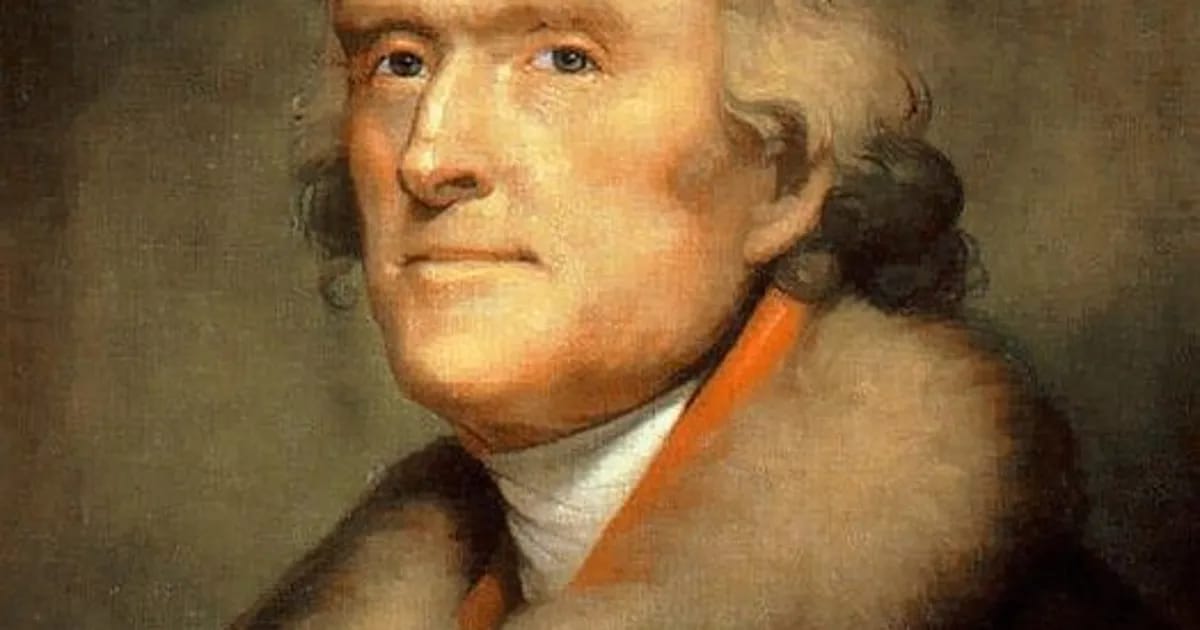
Thomas Jefferson, one of the principal architects of the American Republic and a fierce advocate of individual rights held complex yet forward-thinking views on religion, and especially on the Jewish people.
In 1787, the citizens of the United States adopted the Constitution. Article VI contains the following, Jefferson-inspired, phrase: “No religious test shall ever be required as a qualification to any office or public trust under the United States.”
Jefferson’s view of the Jewish people was marked by the same compassion he extended to his fellow Americans. In a series of personal letters written during the final decade of his life, he expressed remarkably sympathetic and forward-thinking views on Judaism, Jewish civic inclusion, and the broader ideal of religious liberty.
A Voice Against Religious Intolerance
In an 1818 letter to Mordecai Manuel Noah, a prominent Jewish American, Jefferson pointed to the historical suffering of the Jewish people as evidence of a universal truth: religious intolerance is not unique to any one faith, but emerges from power itself.
“Every sect,” Jefferson wrote, “disclaims [intolerance] while feeble, and practises it when in power.”
He praised American law for providing the "only antidote" to this vice, by placing all religions on equal legal footing.
He also acknowledged that more work remained to be done, and emphasized that education would be key to achieving full parity: “placing [Jews] on the equal and commanding benches of science,” he wrote, would help ensure they were seen as “equal objects of respect and favor.”
Critique of Biblical Morality
Though respectful, Jefferson was not uncritical of religious texts. In an 1820 letter to his longtime friend William Short, Jefferson expressed concern over the character of the God presented in the Hebrew Bible by Moses, whom he described as “cruel, vindictive, capricious, and unjust.” He also criticized Moses for failing to teach a belief in the afterlife, suggesting that such an omission left the moral system incomplete.
These critiques were consistent with Jefferson’s deist worldview, which prized ethics grounded in reason rather than dogma. Yet even here, his criticisms were directed at ideas, not at the Jewish people themselves.
Religious Pluralism and Civic Equality
Later that same year, in a letter to Jacob De La Motta following the dedication of a synagogue in Savannah, Georgia, Jefferson expressed deep pride that America had become the first nation to prove that both self-government and religious freedom were possible.
In this letter, Jefferson famously reversed the familiar political maxim, asserting that in matters of faith, unlike in affairs of state, “divided we stand, united we fall” - a powerful endorsement of Lockean religious tolerance and a warning against the dangers of enforced religious conformity.
Jefferson expressed his hope that Jews would take their place not only in science, but eventually “at the board of government.”
Secular Education as a Path to Equality
In one of his final letters, written in January 1826 to Isaac Harby, a Jewish teacher, playwright, and advocate, Jefferson returned to the theme of education. He condemned the injustice of excluding Jewish youth from public science education by requiring theological study that violated their conscience.
Such restrictions, he wrote, were a “cruel addition to the wrongs” already suffered. Jefferson proudly noted that the University of Virginia, which he had recently helped establish, imposed no religious tests or doctrines, setting an example of true freedom of conscience, and making it easier for Jews to attend.
Across these letters, Jefferson consistently demonstrated a deep commitment to Jews as equal citizens.
He championed religious freedom as a cornerstone of the republic, and saw the Jewish experience as a test case for the success of the American experiment.
Regarding the union of Church and State, Jefferson famously wrote:
“But a short time elapsed after the death of the great reformer of the Jewish religion, before his principles were departed from by those who professed to be his special servants, and perverted into an engine for enslaving mankind, and aggrandizing their oppressors in Church and State.”
Years later, Monticello, Jefferson’s beloved estate, was preserved for nearly a century by Jews who remembered Jefferson’s legacy of liberty and who repaid his grace with gratitude.
Uriah Phillips Levy, the first Jewish commodore in the U.S. Navy and a hero of the War of 1812, purchased Monticello out of sincere reverence for Jefferson’s defense of freedom of conscience. Despite facing antisemitism in both military and civilian life, Levy and his family safeguarded and restored Jefferson’s home.
Uriah, and his nephew, Jefferson Monroe Levy, did so not for personal gain, but to honor a man who, in an age of religious intolerance, spoke out for equality. It was a profound act of respect: Jews preserving the home of a Founding Father who defended their right to belong.