Humans are vulnerable - in need of God to deal with the inability to discern.
Every movement from the self reveals another dimension of dependence. Yet the decisive experience of exposure occurs in the relationship between child and mother.
Here we encounter a profound paradox: the protector introduces into an uncertainty.
And is the exposer herself. To the very reality in which she is unable to defend.
This original condition is later reproduced throughout social life. Human beings live under institutions, customs, expectations, judgments, and systems of authority. We reenact the paradox of being exposed by our protectors again as civilians.
In all cases the same question remains: can autonomy devoid of the prerequisite of "power" - exist?
Jean Francois Lyotard answered that question. "We never pay that which we owe childhood", from this comes the mutual critique of the feminine, and the state. As combining existential & political liberation and coercion.
Spinoza regarded caution as a fundamental virtue of the self. Was it caution of external boundaries?
At the external boundary, a person is examined/held/visible. Limitations are manufactured without consent. We are now children again. And as patriots , are we not children ? Re-experiencing policing at every fabric of our being, some even promise a rebirth in the process....
Willingly observed, interpreted, and acting.
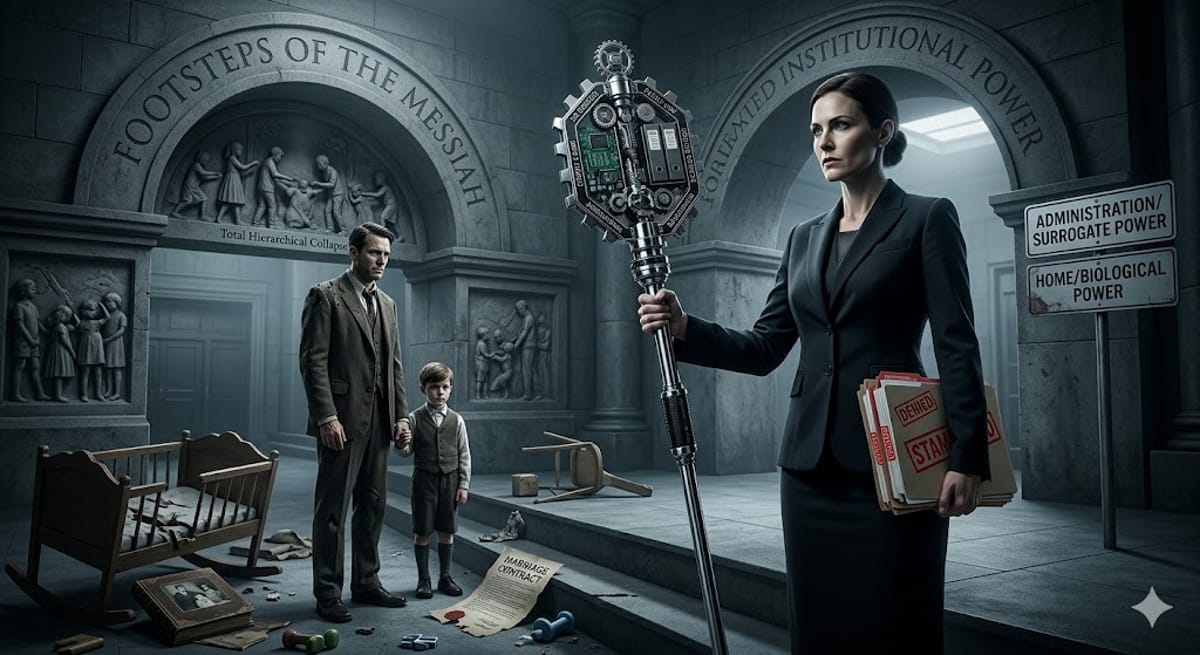
Woman exercises her deepest influence over the world, by turning the child's exposure to the world into the adult's law of the state. This is where the home turns into the political. The feminine into the law. Where the schoolyard functions as the state's womb.
Mother helps determine the conditions under which exposure will occur, via sensation which helps give meaning to external phenomena. For mother, there is a duality between the sexual-self and the child. For the child, between the mother and the world. It is the man, as the object of the sexual-self, and as the powerful function in the world , that can bring equilibrium in order for the political which derives from the maternal not to be chaotic, by mimicking an external creator of the dynamic.
The temptation arises when the mother no longer understands herself as the guardian of a vulnerable person but as the owner of that person’s field of vulnerability for various array of possible reasons. The ability to protect as an ends may become the ability to expose as a means, which may become a place of humiliation or dominance. Love and care will be replaced by management, and surveillance. The woman will attempt to become a man.
The child is no soul entrusted to his birther. But an object through which the parent settles an account. Thus, instead of an organic unification of love, the state becomes the whole world, and so too can mother, if twisted, becomes the uni party.
Pregnancy and birth confront a woman with an unavoidable truth that life emerges through dependence, limitation. When experienced in a secular lens, as depravation, powerlessness, or injustice, it may also produce resentment against nature.
Thus create confining conditions that are reproduced as political tyranny because that resentment can then be transferred to the child/man's reading of nature or power.
The mother may punish the child for the burden of life. She may attempt to recover a power by controlling the helplessness she was required to carry.
The fear of the person who possesses the power to give life, shelter vulnerability, and then betray them , creates the microcosms of any unjust embedded sin of control.
The underlying danger must not be denied.
Watched but not seen. Corrected but not guided. Visible to but denied a private interior.
For this type of morbid motherhood the world is the political.
The child cannot escape exposure. He depends upon the parent to make exposure bearable.
When that responsibility is betrayed, a passive object before forces he cannot understand and has no power to resist, is discovered. The very person who should have interpreted the world for him, out of a justified paranoia, focus on love and warmth, now serves him to the world. All is done by lack of softness and warmth, or manipulation.
This explains the peculiar horror of the beautiful but cruel mother.
Beauty ordinarily suggests harmony, tenderness. Cruelty concealed within beauty produces a deeper rupture because of betrayal and mistrust. What can wound a child more than a face associated with safety becoming the gateway of fear?
Beauty separated from mercy, becomes morally disorienting.
The family requires a structure capable of restraining this danger. This is one reason paternal authority cannot be reduced to an optional emotional presence. The father’s proper role is to establish limits around the entire household, including upon parental power, as an external translator between the female and her result in life (the child) and the world.
The father represents differentiation: the recognition the child is not an extension, that love is not ownership by mother to child, but by man of woman.
Some mothers become harsh and emotionally distant because they have rejected what they perceive as weakness in traditional womanhood. They confuse tenderness with passivity, gentleness with foolishness, and maternal devotion with submission.
In seeking to become invulnerable, they may abandon the very qualities that make maternal power work.
True maternal strength is the capacity to constantly encounter helplessness without exploiting it.
The central moral question is therefore not whether women should possess power. Women inevitably possess profound formative power through motherhood, family life, education, and culture.
The question is whether that power will be governed by humility in face of exposure. Thus, reverence for the freedom of another soul, freedom the mother never fully achieves without a man.
The mother stands at the first boundary between the human being and the world. She can make that boundary a shelter, a doorway, or a prison.
Civilization depends, to a remarkable degree, upon which man/child she chooses.