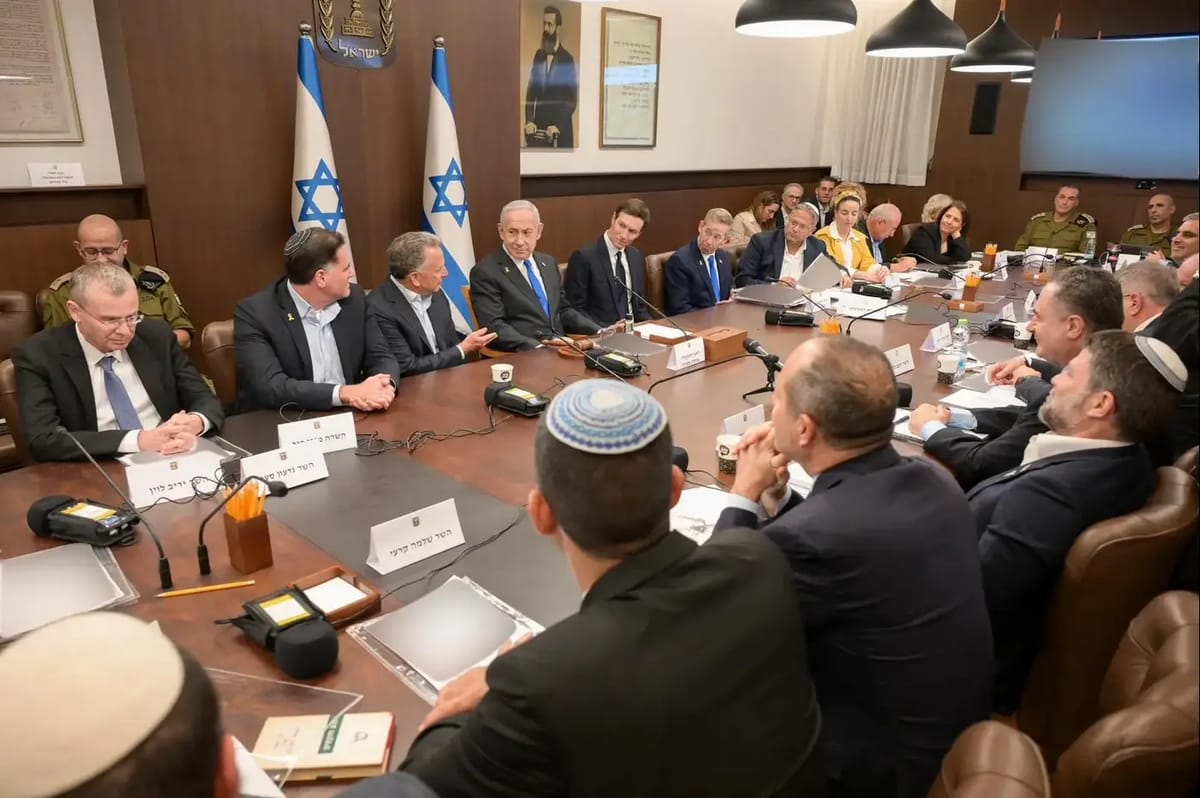
Israel's Cabinet final approval of the hostage deal came after a marathon series of deliberations that began with a delayed security cabinet and spilled into a government meeting that did not start until after 22:00.
Prime Minister Benjamin Netanyahu met privately with Witkoff and Kushner before they appeared in the ministerial session for roughly half an hour. Shortly thereafter, applause was heard in the cabinet room and ministers approved the prisoner list that would form part of the deal.
Several ministers, including Itamar Ben-Gvir, Bezalel Smotrich, Orit Strock, Yitzhak Wasserlauf and Amichai Eliyahu, publicly announced their opposition. Ben-Gvir said he would vote against the measure but stopped short of threatening to resign.
The presence of the U.S. envoys in a domestic cabinet meeting was widely noted as unusual. Officials said the envoys had been involved in mediation efforts and arrived from talks in Sharm el-Sheikh where the outline of the agreement had been negotiated.
According to the government decision, 250 of some 270 designated “security” detainees will be released, and an additional 1,700 Gaza residents who were arrested after October 7 and were not involved in the massacre will be freed. The deal also includes the transfer of 22 minors and a framework for returning bodies of terorrists to Gaza, a ratio of up to 15 bodies for every one deceased hostage returned.
The government approved that the first phase would return 20 living hostages and 28 deceased (including four non-Israelis) within 72 hours of the completion of Israeli military preparations.
Officials cautioned that Hamas has said it does not know the precise whereabouts of nine of those listed as deceased, and therefore not all remains might be handed over within the initial 72-hour window.
A dedicated international task force, comprising representatives from Israel, the U.S., Egypt, Turkey and Qatar, will work to locate and return missing remains after the first phase.
Jerusalem’s plan stipulates that terrorists released who were convicted of specific lethal crimes will be expelled from Israel and not allowed to return to Israel or Judea and Samaria.