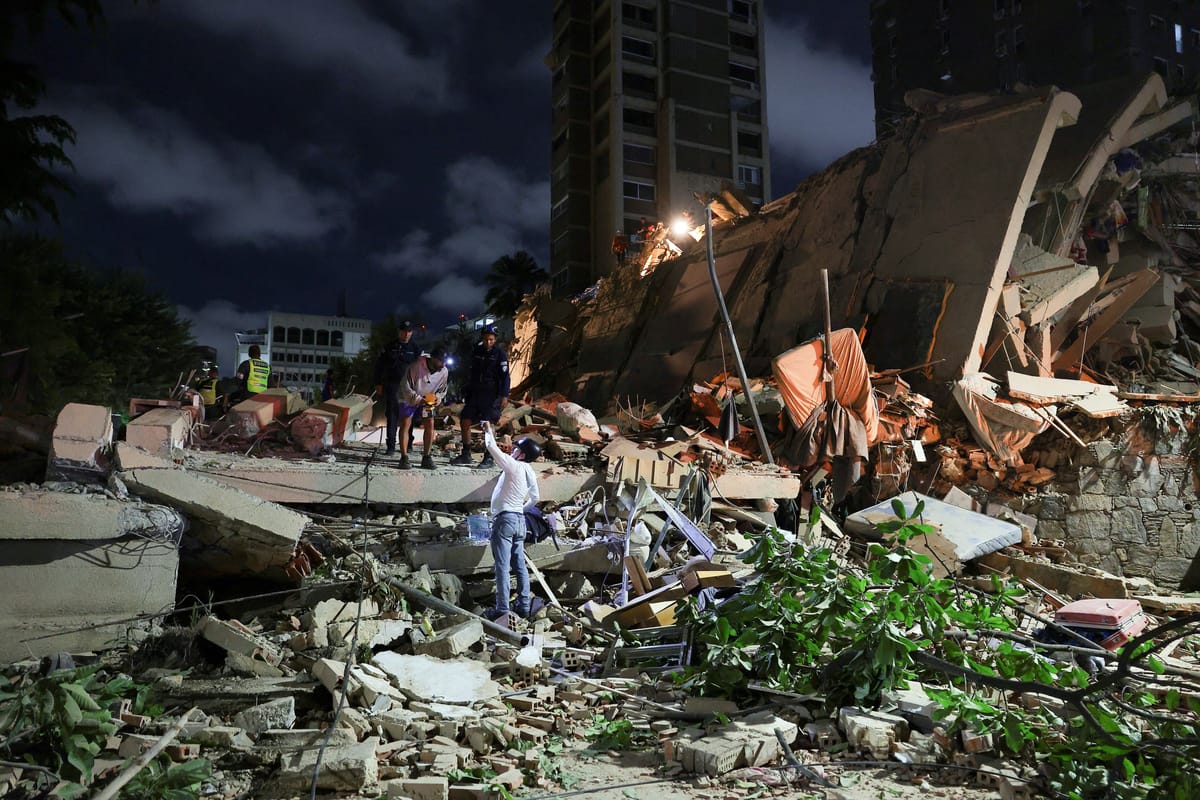
Venezuela is facing one of the worst natural disasters in its modern history after two powerful earthquakes struck the country on Wednesday evening, leaving hundreds dead or injured, collapsing buildings across parts of Caracas and nearby states, and sending tens of thousands of families searching for missing relatives.
The back-to-back earthquakes, measured at magnitudes 7.2 and 7.5, struck roughly 100 miles west of Caracas and were felt across northern Venezuela. The U.S. Geological Survey issued a red-alert warning for shaking-related fatalities and economic losses, a category that often signals the need for a national or international response.
Official casualty figures are still changing rapidly. Venezuelan authorities initially reported at least 164 deaths and nearly 1,000 injuries, while later international reporting placed the number of dead higher, with more than 1,500 injured and hundreds still believed to be trapped under rubble.
The scale of the missing-persons crisis may be far larger. Independent monitoring platforms and family-reconnection pages have listed tens of thousands of people as unaccounted for, with one platform reporting roughly 45,000 missing entries as desperate families try to locate relatives amid power outages, damaged phone networks, and blocked roads.
The hardest-hit areas include Caracas, La Guaira, Carabobo, Yaracuy, Miranda, Aragua, and other northern states. Reports from the ground describe collapsed apartment buildings, damaged hospitals, downed power lines, and severe damage at Simón Bolívar International Airport, forcing authorities to close the country’s main international gateway.
Acting President Delcy Rodríguez declared a state of emergency shortly after the quakes and said the government was working to move heavy equipment into devastated areas. Interior Minister Diosdado Cabello warned residents to remain outside because of the danger of aftershocks, after dozens of tremors followed the initial shocks.
The United States has begun deploying search-and-rescue teams, medical resources, and humanitarian assistance. Secretary of State Marco Rubio said American rescue teams from Fairfax County, Virginia, and Los Angeles were being sent to help locate survivors trapped beneath collapsed buildings.
President Donald Trump said the United States was “ready, willing, and able to help,” adding that he had instructed federal agencies to prepare for a rapid response. The U.S. effort is expected to include search-and-rescue personnel, disaster-response teams, medical aid, logistics support, and potentially broader regional coordination.
International aid is also beginning to move toward Venezuela. The United Nations is coordinating urban search-and-rescue deployments, while several Latin American and European governments have offered personnel, medical supplies, equipment, and emergency funding.
The disaster hits Venezuela at a moment of deep national fragility. Years of economic crisis have weakened infrastructure, damaged the healthcare system, and left millions dependent on humanitarian aid even before the earthquakes. That makes the rescue operation more difficult and raises fears that the death toll could rise sharply in the coming days.
Despite the devastation, Venezuela’s oil sector has so far reported limited disruption. Chevron said its Venezuelan operations remain active and that its employees have been accounted for. Reports also indicate that key refining and export facilities have continued operating, though officials are still assessing broader infrastructure damage.
The crisis is now becoming a test not only of Venezuela’s emergency response, but also of Washington’s ability to lead a humanitarian mission in a country long defined by hostility toward the United States.
For thousands of Venezuelan families, however, the political dimension is secondary. The urgent race is now beneath the rubble, where every hour matters, and where the number of missing continues to grow.