There is a pattern that runs through German political culture -- from the Weimar Republic to the Third Reich to the Brussels-centered order of today -- that deserves serious examination, especially as Europe edges toward a confrontation with Russia that nobody seems able to stop and few seem to understand.
To grasp where we are, it helps to understand where we have been.
The Scapegoat Mechanism
By the end of the First World War, Germany was diplomatically humiliated and economically broken. Its ruling class, the Prussian and Junker aristocracy, needed a pressure valve. They found one in Adolf Hitler: a failed art student, a man whose highest personal aspiration seemed to be the authority of a staff sergeant, someone who had never finished secondary school nor held a serious civilian job. He was, in a word, manageable. Appointed to lead their political party, then their government, and finally granted dictatorial powers through the Enabling Act (following the conveniently timed Reichstag fire), Hitler was the perfect decoy.
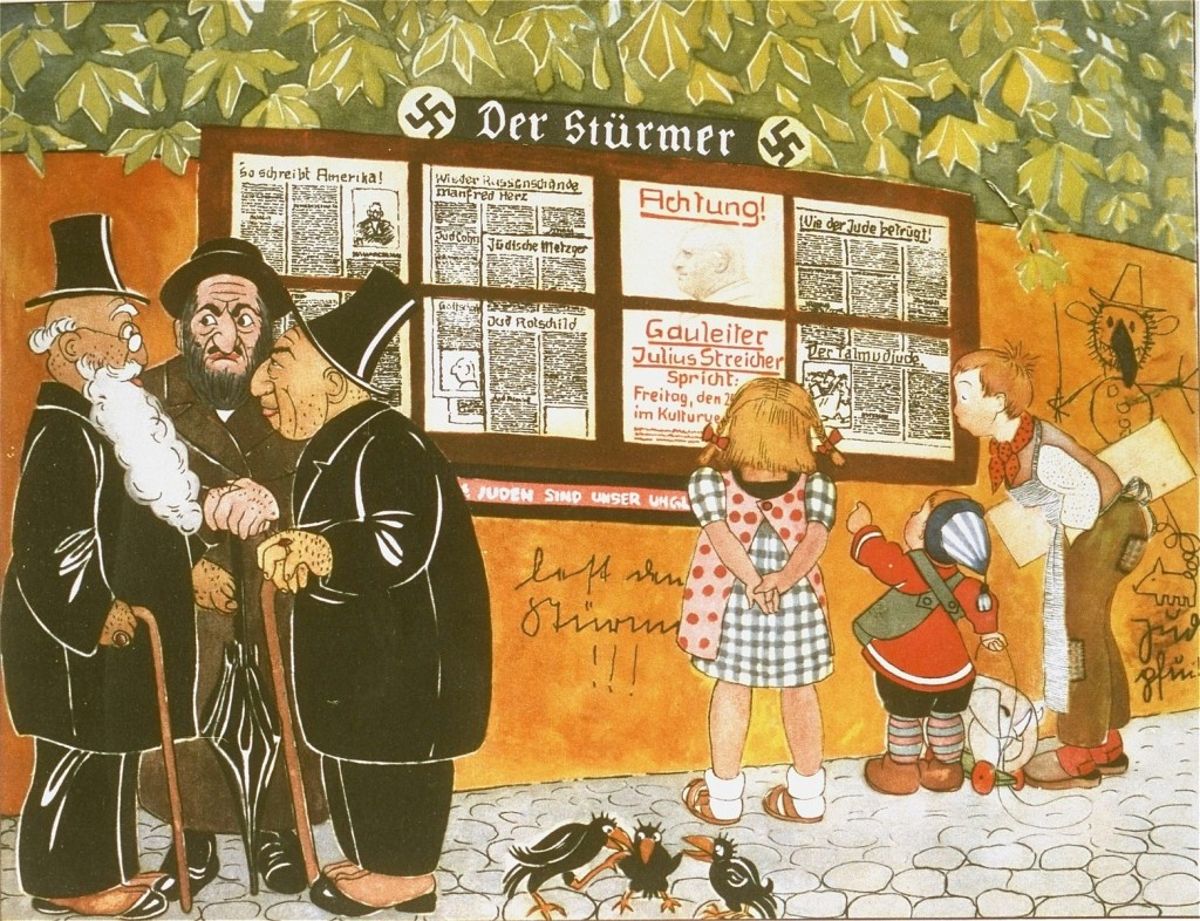
The psychology at work here is well-documented. Carl Jung, the foremost psychologist of that era, called it mass psychosis. In behavioral terms, what the Nazi movement embodied was what psychologists call a replacement activity -- redirecting thwarted energy toward an easier target. Germany could not conquer Europe (yet), so it turned on its Jews: a domestic enemy that could actually be defeated, providing a temporary sense of power and momentum. When the Wehrmacht stalled outside Moscow, Leningrad, and Stalingrad, permanently, as it turned out, the Holocaust escalated. The Wannsee Conference of 1942 was, in this reading, another displacement event: the army could not advance, so the killing machinery intensified elsewhere.
Hitler's animating philosophy, laid out in Mein Kampf, was essentially the metaphysics of a tantrum: the supremacy of will over reality. Facts, logistics, history, causality, none of these mattered. What mattered was wanting hard enough. It is the ideology of a two-year-old dressed in military uniform, and it was catastrophic precisely because it was attached to industrial capacity and feudal loyalty structures that amplified rather than corrected it.
The crucial insight is this: the real architects of Germany's catastrophe -- the industrialists, the aristocrats, the cartel barons who bankrolled the Nazi party -- were never seriously threatened. The rage of ordinary Germans was carefully redirected outward and downward, toward Jews, Slavs, and foreign enemies, rather than upward, toward the class that was actually exploiting them. The feudal structure survived. The oligarchs endured.
Denazification That Never Was
Germany was never truly denazified. The military command structure was largely preserved. The social hierarchies, feudal, deferential, highly monitored, remained intact. The economic cartels that had enabled Hitler continued operating under new names and new arrangements. What changed was the rhetoric, not the underlying architecture.
What persisted, and this is the central claim, was what might be called a replacement attitude: a cultural disposition to sanctify an act of will rather than reform the underlying system. Progress is performed; the power structure is untouched.
This matters because it shapes how Germany (and by extension, the EU institutions Germany dominates) responds to failure. Rather than interrogating the structural causes of a setback, the instinct is to find a new target, a new enemy, a new theater in which the frustrated will can assert itself.
The Eastern Project
From 1989 onward, Germany found itself in an extraordinary position. The collapse of the Soviet Union opened Central and Eastern Europe to German economic and political penetration without a shot being fired. For three decades, this project advanced steadily. Then, in February 2022, Russia moved to reassert control over its immediate periphery, "okraina" in Russian, literally "borderlands," which is the etymological root of "Ukraine" - and the project hit a wall.
For the architects of a German-led European order, the stakes could not be higher. A genuinely independent Russia, let alone a fragmented one that could be absorbed piecemeal, represents the difference between regional dominance and genuine global influence alongside the United States and China. This is why the response to Russia's actions has been so disproportionate, so resistant to negotiation, and so indifferent to the human cost borne by Ukrainians.
The EU, NATO, the WEF: these are, in this analysis, the modern institutional expression of the same cartel impulse that organized German heavy industry in the 1930s. Large, hierarchical, technocratic, deeply averse to the kind of democratic accountability that might actually threaten the people at the top.
The Pattern Repeats
In late 2023, when the EU's political project in the Palestinian Authority was visibly collapsing, and NATO's Ukraine strategy was producing stalemate rather than Russian collapse, the same displacement mechanism kicked in. Rather than reassess the underlying strategy, the response was to double down, find new enemies, and intensify the existing commitments. The will would not be questioned.
This is the tell. When a system responds to failure not by examining its premises but by escalating its aggression, whether toward an external enemy or an internal scapegoat, you are watching a replacement activity. You are watching an elite protect itself by directing the energy of failure elsewhere.
The Uncomfortable Conclusion
The lesson of the 1930s, one that Western political culture claims to have internalized, is that this dynamic does not self-correct. The feudal-vassal structure, once in motion, cannot be talked out of its trajectory by appeals to reason, international law, or shared humanity. It has to exhaust itself.
That is a grim conclusion. It means the current crisis likely has to run its course, failing visibly and at scale, before the underlying power structures can be seriously challenged. Negotiated off-ramps are available; they are simply not wanted by those whose position depends on the conflict continuing.
Understanding this does not make the situation less dangerous. But it at least names what we are dealing with: not a rational security dispute with rational solutions, but a displacement mechanism operating at civilizational scale, driven by elites who have learned that the best way to survive their own failures is to ensure that somebody else pays for them.
The author draws on the work of psychologists including Carl Jung (mass psychosis), and the behavioral concepts of Ersatzhandlung (replacement activity) and the Ovsiankina Effect (resumption of interrupted goals after substitution) to analyze modern European geopolitics.