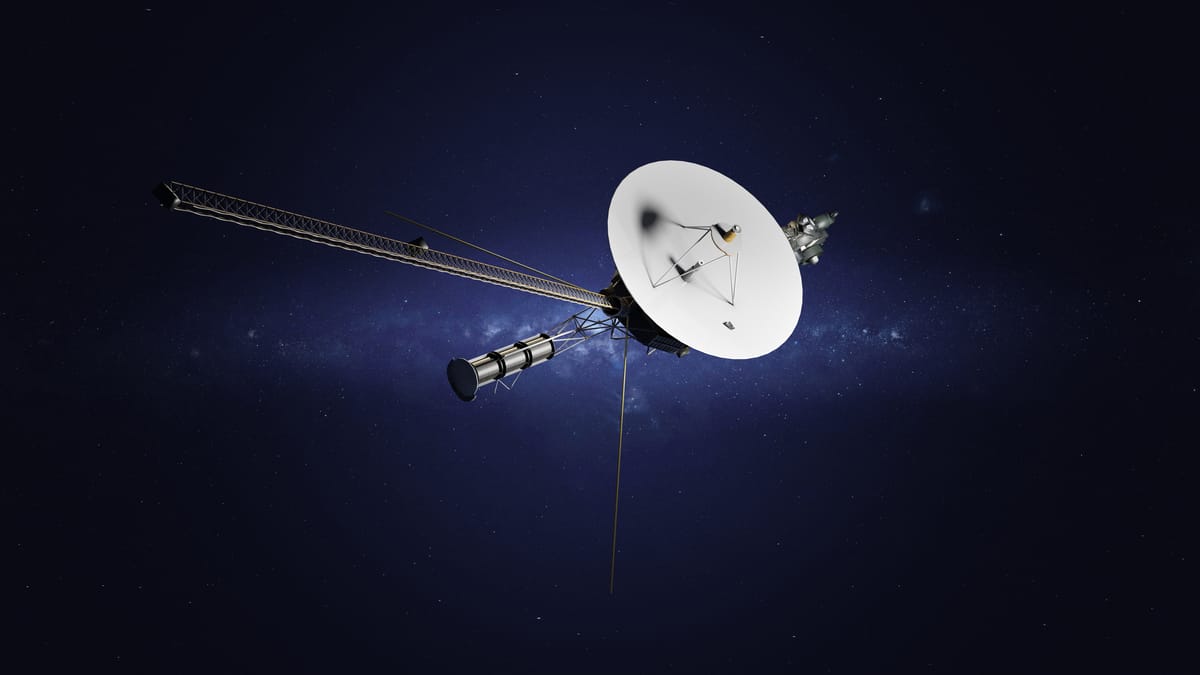
NASA's Voyager 1, launched nearly five decades ago, is set to reach a distance of one light-day from Earth on Wednesday, November 18, at 12:16 p.m. Israel time, according to a report by Kikar HaShabbat. A light-day is the distance light travels in 24 hours, about 26 billion kilometers.
The spacecraft, traveling at about 61,000 kilometers per hour, is the most distant human-made object from Earth. It has already crossed beyond the boundaries of the solar system and is still transmitting. Once it passes the new mark, a radio signal sent from Earth will need a full day to reach it, and any reply will take another full day to travel back.
Even by astronomical standards, the distance is vast. The more familiar unit, the light-year, is the distance light covers in a full year, about 9.5 trillion kilometers. For comparison, Alpha Centauri, the nearest star system to our own, lies about 4.24 light-years away.
Voyager 1's achievement goes beyond distance. Since its launch on September 5, 1977, the probe has gathered unprecedented scientific data on the outer planets and later on the region outside the solar system.
On its journey past Jupiter and Saturn, Voyager 1 discovered a thin ring around Jupiter and two previously unknown moons, Thebe and Metis. Near Saturn, it identified five additional moons and a ring that came to be known as the G ring.
Its twin, Voyager 2, was launched 16 days before Voyager 1, but the two set off on different trajectories. While Voyager 1 focused on Jupiter and Saturn among other targets, Voyager 2 went on to Uranus and Neptune. It is expected to reach one light-day from Earth in November 2035, about nine years after its sister craft.
Alongside their scientific instruments, both spacecraft carry an unusual item: a golden record meant to offer a portrait of Earth and humanity to anyone who might find it.
The gold-plated copper record, about 30.5 centimeters in diameter, contains images, sounds, music and spoken greetings in 55 languages. Among the selections are Beethoven's Fifth Symphony, Chuck Berry's "Johnny B. Goode" and traditional songs of Indigenous Australians. It also includes instructions intended to explain how to locate Earth.
Almost 49 years after its launch, Voyager 1 continues its journey into the space beyond the solar system.