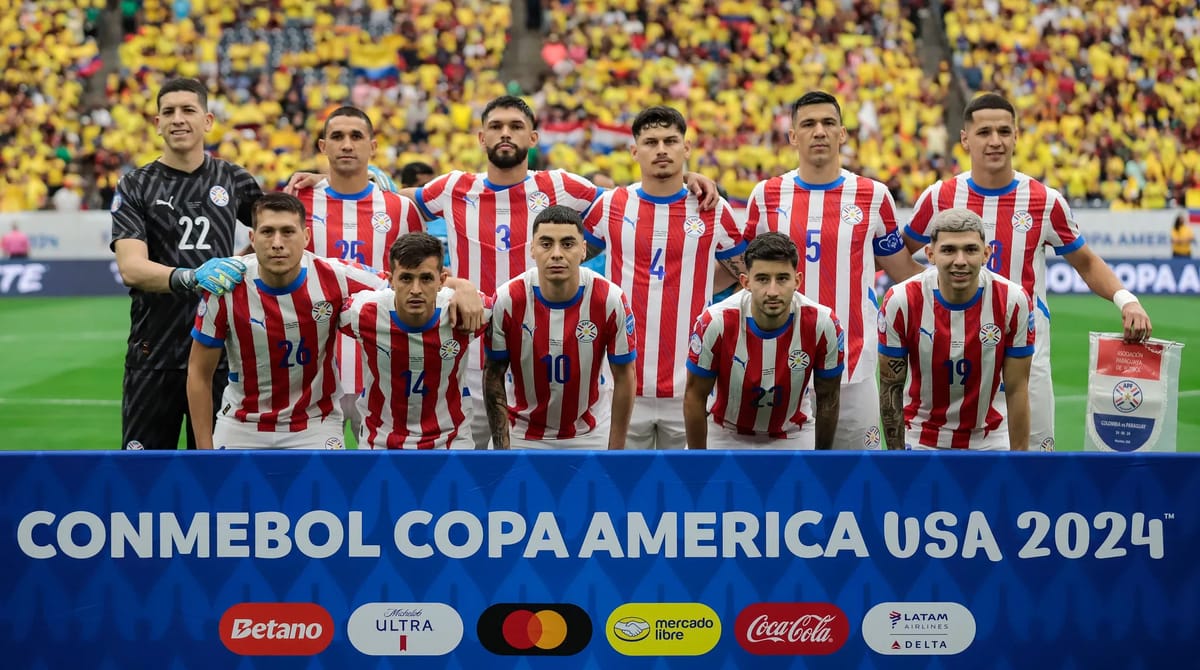
Paraguay has never been considered one of world football's true powers.
Beyond legendary names like Chilavert and Santa Cruz, few casual football fans could name many players from the likable South American nation.
Historically, Paraguay has usually been viewed as sitting somewhere under Chile and near Peru in South America's football hierarchy. It qualifies for major tournaments from time to time, but unlike Brazil or Argentina, most of its squad plays either in the Brazilian or Argentine leagues, with only a handful competing in Europe's elite competitions.
That is precisely what made today's victory so remarkable.
Paraguay entered the match as the ultimate underdog.The Paraguayan coach captured the contrast perfectly: Germany's players were raised in Europe's most prestigious football academies, while his players were raised on the red soil of Paraguay.
The match itself followed a familiar script. Germany dominated possession for long stretches and created pressure. Paraguay, however, needed only one genuine opportunity early in the game to take the lead, and then defended it with extraordinary discipline for more than ninety minutes and throughout extra time.
Germany thought it had found a dramatic equalizer in the closing moments, but the goal was ruled out after VAR determined that a slight collision between a German defender and the Paraguayan goalkeeper constituted a foul.
The penalty shootout only added to the drama. Germany, a nation traditionally regarded as football's greatest penalty specialists, surprisingly missed two of its first three penalties. Paraguay nearly let victory slip away after missing its final two attempts, but ultimately held its nerve to complete one of the tournament's biggest upsets.
There was something deeply uncharacteristic about Germany's collapse from the penalty spot. Composure in shootouts has long been one of the defining traits of German football. This time, however, it was Paraguay that displayed the greater discipline when everything was on the line.
That is the beauty of the World Cup.
For ninety minutes, and sometimes a little longer, the world's richest football nations, with all their resources, academies, and billion-dollar infrastructures, become equal to everyone else once the whistle blows. The World Cup has always been capable of producing extraordinary surprises.
Nor is Paraguay the only example in this tournament. Several smaller nations have proven they belong on this stage. Others, such as Iran and South Korea played excellent football for much of the competition despite falling short. But Paraguay once again demonstrated that poor countries can compete with virtually anyone and would comfortably rank among Europe's strongest national teams if it played there regularly.
Perhaps this is the strongest argument yet for expanding the World Cup.
Not simply because it generates more revenue, but because it gives smaller football nations the opportunity to create unforgettable moments. Football is a global game, and the expanded tournament allows more countries to prove that greatness is not reserved exclusively for the traditional giants.