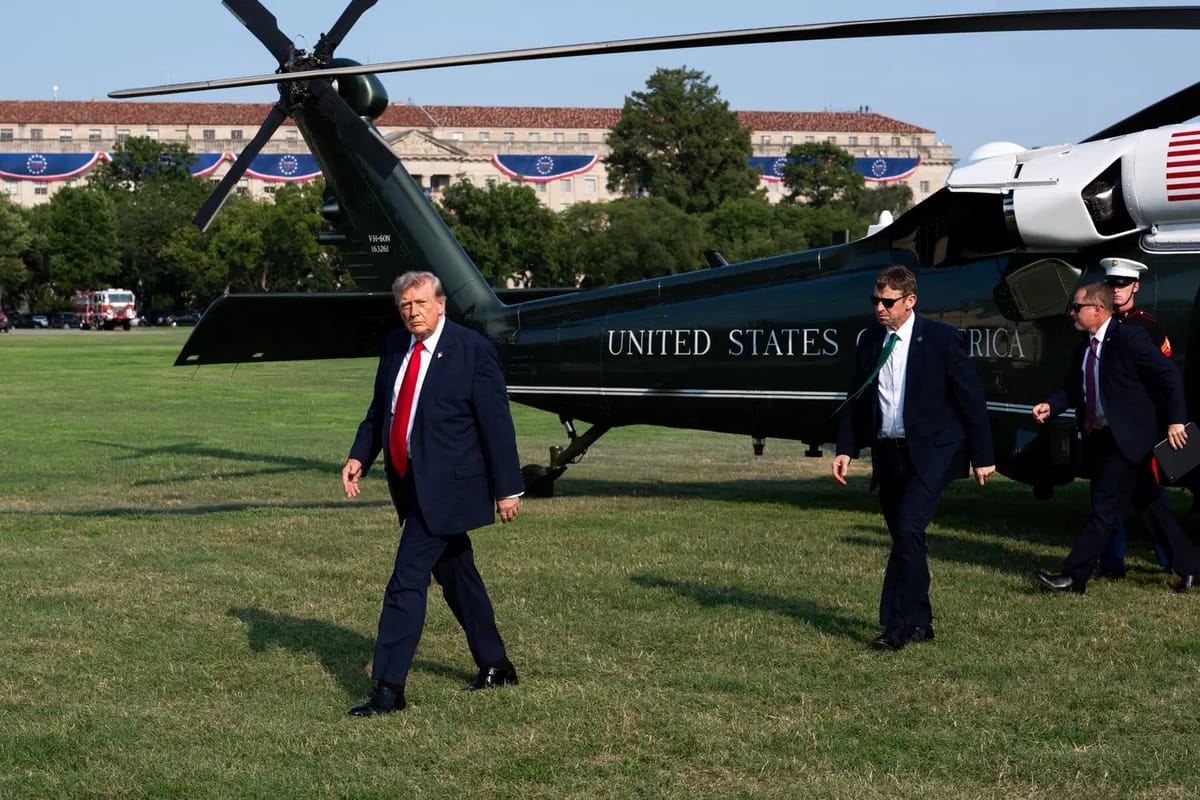
As President Trump's approval rating sinks to the lowest point of his second term, his impulsive decision-making style has drained the institutional processes meant to constrain exactly that kind of erratic leadership. The fracturing undermines U.S. intelligence coordination at a moment when Israel's security establishment faces its own delicate challenge: maintaining American partnership while preserving operational freedom against Iran.
Trump's polling has collapsed to 38–40% approval overall, with support among independents at just 34%, marking his weakest standing since returning to office. The decline tracks almost directly with the drawn-out Iran conflict, escalating energy prices, and tariff-driven inflation that has squeezed American household budgets. The trajectory mirrors George W. Bush's similar collapse during the Iraq War, when Bush dropped below 40% approval roughly 18 months into his second term and stayed there. The parallel is instructive: both presidents found themselves ensnared between aggressive foreign policy commitments and economic headwinds at home.
But Trump's chaotic leadership style has triggered a second crisis, this one institutional. The National Security Council, designed after World War II to prevent any president from managing global conflict in isolation, has been effectively hollowed out by Trump's preference for rapid-fire decisions made without bureaucratic deliberation.
According to multiple U.S. media reports, the intelligence community has fractured into competing fiefdoms. The CIA and the Office of the Director of National Intelligence (ODNI) have effectively ceased functioning as a unified system. The CIA has halted contributions to joint intelligence assessments related to the Iran war, amid disputes over information-sharing protocols and disagreements over a task force established by former DNI Tulsi Gabbard. CIA Director John Ratcliffe has argued the ODNI task force operates recklessly, circumventing established procedures. ODNI officials counter that the CIA has blocked access to critical intelligence.
The result: analysts in both agencies acknowledge, privately and in background conversations with journalists, that predicting Trump's next move has become essentially impossible. Bureaucratic machinery designed to deliver vetted assessments to the president now delivers them to a leader who often disregards them.
Into this institutional void, Iran's new leadership has injected a different kind of disruption. Unlike traditional adversaries who guard strategic communications, Tehran is conducting its diplomatic and military posturing almost entirely in the open—via state television, social media, and public statements. Iranian officials announce positions, declare red lines, and warn of retaliation through channels the whole world watches simultaneously. This transparency-as-tactic makes it harder for Washington to thread the needle between deterrence and negotiation. Negotiations over reopening the Strait of Hormuz continue without resolution, with Trump threatening renewed strikes if the waterway is not opened "soon".
For Israel, the strategic picture is more complicated still. Prime Minister Benjamin Netanyahu's government maintains what officials describe as daily coordination with the Trump administration, but that coordination sits atop uncertainty. Israeli strategic experts have warned that Trump's recent pivot from military confrontation toward diplomatic engagement with Iran has left Jerusalem in a precarious position, with emerging framework agreements containing "dramatic holes" that could allow Tehran to preserve nuclear infrastructure while constraining Israeli military options.
Behind closed doors, Israel's security establishment voices sharp frustration, not at American policy broadly, but at the gap between what military operations actually accomplish and what the political leadership claims publicly. Officers and intelligence officials describe significant tactical and operational successes against Iranian targets, but express concern that inflated public statements undermine credibility and complicate future coordination. The concern is not novel: it reflects a long-standing tension in Israel's strategic culture between operational security and political messaging.
Netanyahu has convened multiple high-level security discussions at Israel's military headquarters regarding the framework of any potential U.S.-Iran agreement, expressing deep concern about provisions that could allow Iran to preserve nuclear capabilities.
The fundamental problem for Jerusalem is structural: Israel cannot simply wait for Washington to resolve the Iran question, nor can it afford to alienate its most important military and intelligence partner by moving independently. The solution requires what Israeli defense officials call "flexibility," the ability to maintain coordination while preserving Israel's operational freedom, all while managing a partner whose decision-making has become genuinely unpredictable.
Whether this balance holds through the remainder of Trump's term depends partly on whether his domestic political situation stabilizes. Historically, presidents with approval ratings below 40% struggle to sustain foreign policy initiatives without domestic political collapse. Trump's second term is now tracking toward precisely that threshold.