Here's a question worth asking out loud: Did the greatest geopolitical deal of Donald Trump's second term get shaped, at least in part, by a soccer tournament?
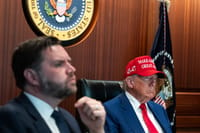
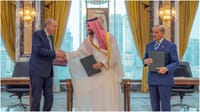
The timing alone demands scrutiny. On June 14, with the World Cup already underway across 11 American cities and Iranian players literally landing in Los Angeles, the Trump administration announced a breakthrough framework with Tehran: a 60-day ceasefire extension, a reopening of the Strait of Hormuz, an end to the U.S. naval blockade, and the beginning of nuclear negotiations. Trump, ever the showman, announced on Truth Social: "Ships of the World, start your engines. Let the oil flow!" The next day, Trump and Vice President JD Vance both virtually signed the agreement.
The optics were impossible to ignore. The Iranian soccer team had arrived in the United States on Sunday, hours before Trump's announcement about an agreement with Iran, landing in Los Angeles after flying from Tijuana, Mexico, a day ahead of their World Cup opener against New Zealand, marking the first time in World Cup history that a host nation is at war with one of the participants.
Coincidence? Perhaps. But there is a serious argument to be made that the World Cup — Trump's crown jewel of American soft power, the tournament his task force spent years engineering — created an enormous security pressure that helped push a deal that critics say falls far short of what the war was launched to achieve.
The Threat Landscape Was Genuinely Terrifying
This isn't speculation dressed up as analysis. The threat warnings were real, sustained, and alarming.
The FBI's Director Kash Patel warned explicitly that World Cup matches could be targets for extremists: "For the FBI and its partners, preventing terrorist attacks is job #1 during the upcoming 2026 World Cup. Extremists have used major global sporting events in the past to do harm and spread their twisted ideologies."
U.S. Homeland Security Secretary Markwayne Mullin warned that threats surrounding the international tournament remain "extremely high, especially in soft areas outside of the stadiums," noting that over the 39-day tournament, "we're going to have basically 78 Super Bowls in 11 cities."
Intelligence briefings from U.S. officials and FIFA, obtained by Reuters and reported in March, warned that the potential for extremist attacks on games, fan events, or transportation infrastructure, as well as civil unrest, had grown significantly because of heightened tensions over Trump's immigration policies and the war with Iran. The U.S. government had already committed to the problem on a massive scale: $846 million in grants to nine U.S. host states to shore up cybersecurity, emergency response preparedness, security, and drone protection across 11 host cities.
The Iran dimension of that threat was specifically documented. A Department of Homeland Security bulletin cited 14 threats and actual attacks undertaken by Iranian proxy groups, cyber actors, and lone wolves since February 28, 2026, including a deadly shooting in Austin, a cyberattack against a medical technology company that wiped out more than 200,000 systems and extracted 50 terabytes of critical data, a vehicle-ramming attack at Temple Israel in Michigan, and an attack on the White House Correspondents' Dinner.
The bulletin warned explicitly: "Iranian-aligned hacktivist groups including Handala Hack, Cyber and 313 Team, and various others have targeted U.S. companies and critical infrastructure networks in retaliation for the war. Iran has vowed to seek revenge on the United States in the aftermath of the war."
CSIS, in a comprehensive threat assessment published just days ago, catalogued what the convergence of war and World Cup on U.S. soil actually means: transit hubs, hotels, and gathering areas, where crowds fill metro lines, train stations, and downtown corridors, present a wide array of targets. High-profile individual targets include players, coaches, FIFA officials, visiting heads of state, and dignitaries.
Then there is the Austin shooting, the data point that should keep Trump's security team awake at night. Ndiaga Diagne's March 2026 mass shooting at an Austin bar was carried out the day after the United States and Israel killed Iranian Supreme Leader Ali Khamenei, by a gunman wearing Iranian-flag clothing and the words "Property of Allah." That wasn't an organized state attack. That was one radicalized individual, one weapon, one accessible location. Multiply that scenario across 11 cities, 78 matches, millions of fans, and hundreds of soft-target zones, and you begin to understand what American security officials were staring at.
Iran's Own Hybrid Leverage
While Trump dismissed Iran's World Cup participation as irrelevant, "I really don't care," he told Politico in March. "I think Iran is a badly defeated country. They're running on fumes." --- the Iranians were playing a subtler game.
Iran didn't need to directly threaten a stadium bombing to exert World Cup pressure. The threat was structural. Tehran's proxy networks, cyber actors, and state-aligned "hacktivist" groups were already operating on American soil and against American infrastructure. A new hacktivist persona, "Ababil of Minab," claiming disruptive attacks against multiple U.S.-based organizations, was assessed by Insikt Group as likely operated by Iran state-sponsored threat actors, and the persona may be leveraged to target the upcoming World Cup.
Iran also deployed the tournament as a propaganda theater of its own. Before the Iran-New Zealand match in Los Angeles, Iran released a fresh AI-generated propaganda video invoking the memory of children killed likely in a U.S. strike on an Iranian school, portraying the national team members as Lego-like figures walking hand-in-hand with killed children to the pitch. Fans in the stands unfurled a sign in the stands referencing 168 children killed in a U.S. military strike on an Iranian elementary school.
The message Iran was transmitting was unmistakable: We are here. We are in your country. We are not going away. And the world is watching every frame.
The Deal Itself: What Did Trump Actually Get?
This is where the "ridiculous deal" critique finds its most solid footing. Strip away the fanfare and examine the substance.
Of the stated targets when the U.S. and Israel launched the war on February 28, Iran still has a missile program, support for armed proxies in the region like Hezbollah, and a stockpile of highly enriched uranium. The nuclear program, the stated justification for the entire war, remains unresolved, kicked 60 days down the road for negotiation.
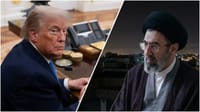
Trump reiterated that "Iran will never have a nuclear weapon," while also telling The New York Times that Iran would be permitted low-level nuclear enrichment, a significant retreat from his earlier position calling for the complete dismantling of Iran's nuclear program.
The emerging deal drew sharp criticism from Israel's government and from critics within Trump's own Republican Party, with some saying it did not improve on the terms of the 2015 Iran nuclear deal that Trump withdrew the U.S. from during his first term and still describes as "bad."
The critique from the Center for International Policy was blunter: "Trump said that his war on Iran would be quick, decisive, and force the regime to totally capitulate or collapse. The tragic failure of Donald Trump's Iran policy has now played out exactly as antiwar critics warned it would."
Even Trump's own timeline tells a damning story. On March 6, Trump had demanded Iran's "unconditional surrender" and threatened attacks on Iranian energy infrastructure if a deal was not reached, setting deadlines of March 21, then March 23, then April 7. The attacks were subsequently postponed as Pakistan arranged a conditional two-week ceasefire.
From "unconditional surrender" to "low-level enrichment permitted" in roughly 90 days. Whatever happened to those terms?
The Inconvenient Connection
To be clear: there is no publicly documented statement from Trump or any senior official explicitly linking the Iran deal timeline to World Cup security concerns. Andrew Giuliani, head of Trump's World Cup task force, when asked directly whether the Iran deal could affect Iran's team participation, gave a non-committal "We'll see." The deal would extend the ceasefire, reopen the Strait, lift blockades, and begin 60 days of negotiations, but its precise relationship to the tournament's security calculus has not been officially addressed.
What we know is this: Trump bombed Iran in February and said he didn't care about the World Cup implications. By June, with the World Cup already live on American soil, Iran's players were sleeping in Tijuana and commuting to Los Angeles, Iranian propaganda was playing in American stadiums, and 14 documented Iran-linked attacks or threats had already been recorded on U.S. soil. The deal was announced the day Iran played its World Cup opener. The signing happened the following day.
Trump is many things, but he is not politically indifferent to spectacle. The World Cup was meant to be his showcase — 78 matches in 11 cities, a billion eyes on America, his name attached to the greatest sporting event on earth. A terrorist attack, or a cascading series of Iran-directed incidents across American stadium corridors, would have been catastrophic. Not just for national security. For Trump personally.
Is it possible the World Cup didn't factor into the negotiations at all? Technically. Is it plausible that 107 days of inconclusive war, mounting domestic terrorism from Iran-linked actors, a global mega-event on American soil with "extremely high" threat levels, and a deal signed literally while Iran played its opening match are all unrelated? You decide.
What we can say with confidence is this: whatever drove Trump to this table, the deal he brought home is significantly less than what he went to war to achieve. Iran still has its uranium. Its proxies are still active. Its nuclear program is still running. And the World Cup, for now, goes on.