
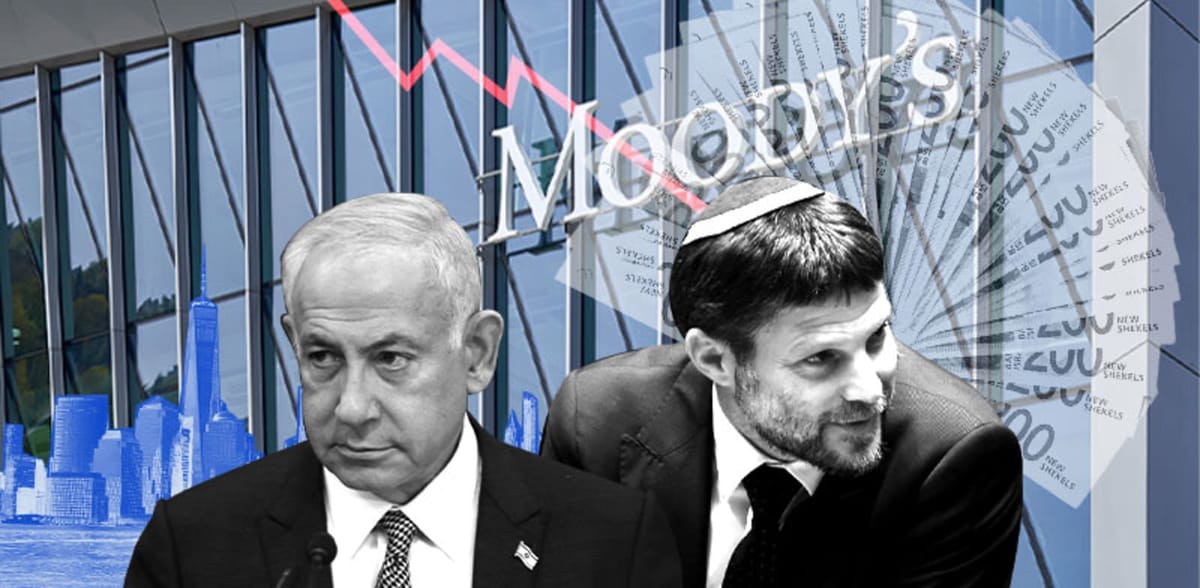
Israel’s economy has reached a critical turning point. After a grueling year of consecutive downgrades and "negative" warnings, Moody’s Investors Service has officially upgraded Israel's credit outlook from Negative to Stable.
While the agency maintained the actual credit rating at Baa1, the lowest level in the nation's history, the shift in outlook serves as a major signal to global markets: the period of freefall has likely ended.
The decision by the world’s second-most influential rating agency, reflects a significant shift in risk assessment. According to the agency’s analysts, the peak of the "geopolitical risk" has passed. The primary driver for this newfound stability is the endurance of the ceasefires in both Lebanon and Gaza that have held firm since the closing weeks of 2024. Furthermore, the dreaded scenario of an all-out regional escalation with Iran has, for now, failed to materialize.
The Foundations of Resilience
In its report, Moody’s highlighted several "anchors" that prevented a further collapse of the Israeli economy:
- A Durable High-Tech Sector: Despite the massive mobilization of reservists and the disruption of daily life, Israel’s tech engine continued to drive growth and attract interest.
- The $220 Billion Safety Net: Israel continues to hold massive foreign currency reserves. This "financial cushion" provides the state with immense maneuverability and reassures international lenders that the country can meet its obligations.
- Institutional Strength: The report credited the Bank of Israel and other economic institutions for maintaining an "active and credible" policy throughout the crisis.
The Reality Check: A Long Road Back to "A"
Despite the optimism, the Baa1 rating remains a somber reminder of the war’s cost. This rating places Israel’s creditworthiness on par with developing economies such as Thailand, Kazakhstan, and Peru.
A "Stable" outlook means that another downgrade is unlikely within the next 12 to 18 months. However, the agency was clear that an upgrade back to the "A" category will require more than just an end to the fighting. The government will need to demonstrate disciplined management of the debt-to-GDP ratio and prove that the current stability can translate into long-term political and economic growth.
What This Means for the Public
For the average citizen and global investor, this news is the financial equivalent of a "fever breaking." When a country’s outlook is stable, it can borrow money on the international market at more favorable rates. This effectively lowers the interest burden on the national budget, potentially freeing up billions for civilian reconstruction and public services.
While the scars of the 2024 conflict remain visible in the national deficit, the message from the global financial giants is clear: the Israeli economy has withstood its greatest test in decades, and the foundation for a "day after" recovery is now officially in place.