
In an era of skyrocketing national debts and digital currencies that are detached from physical reality, Yoav Netzer offers a radical "reboot" of the financial operating system. His proposal, the Corrected Fractional-Reserve System (CFRS), centers on a new regulatory lynchpin: the National Repayment and Forfeiture Authority (NRFA).
NRFA
The "NRFA" Protocol: An Israeli Engineer Solved the Debt Trap through Systems Engineering
The following analysis explores a provocative proposal by systems engineer Yoav Netzer regarding the structural overhaul of the global banking system

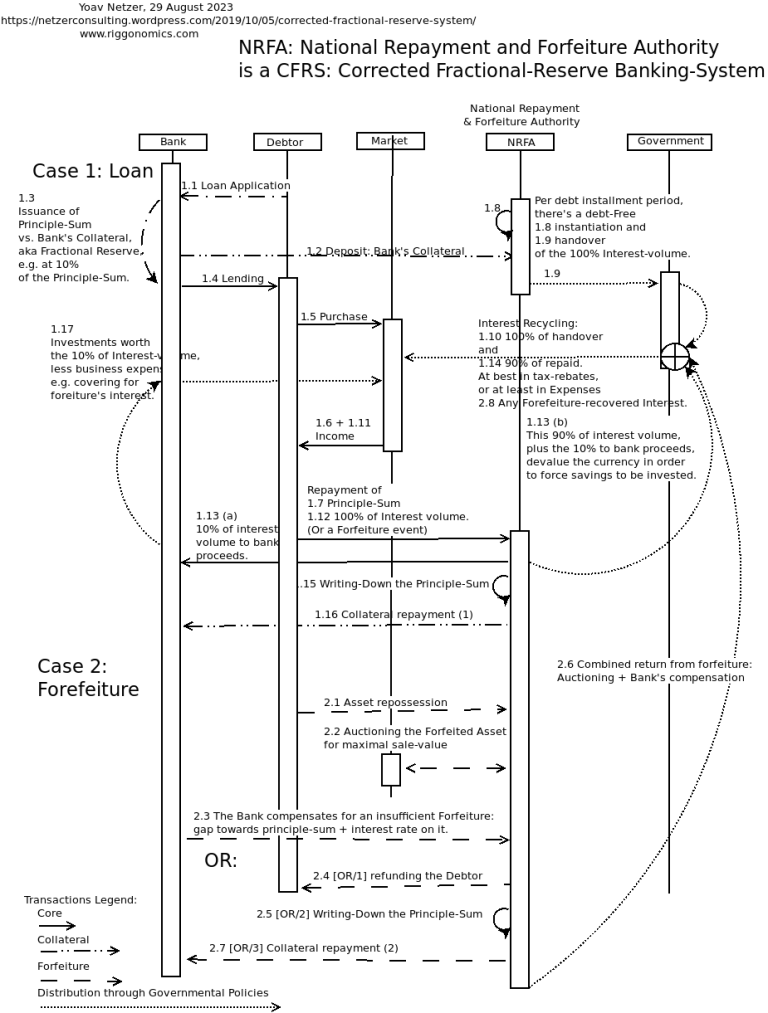
Netzer approaches economics not as a social science, but as systems engineering. His premise is simple: Money is a metaphor for energy and "vitality" (the capacity to produce). When the system allows money to exist without a corresponding "work" requirement, the system crashes.
The Core Problem: "Permanent Money" as Enslavement
Under the current fractional-reserve system, when a bank issues a loan, it "creates" money. However, when that loan is repaid, the principal often stays within the banking sector’s coffers. Netzer argues this creates a Pharaonic Feudal Cast, a class of rentiers who own the economy simply because they were the first to "print" the entry in the ledger.
He characterizes existing alternatives as equally flawed:
Bitcoin/Crypto: Dismissed as "remote-controlled cookie-points" and "panopticon" tech with no attachment to human vitality.
The Gold Standard: Labeled a "Spiral of Death" that limits economic growth and ignores the fact that "gold will not cook you dinner."
The NRFA Solution: How It Works
The NRFA is designed to act as a "circuit breaker" for debt. It changes the destination of your loan repayments to ensure money supply reflects actual economic energy.
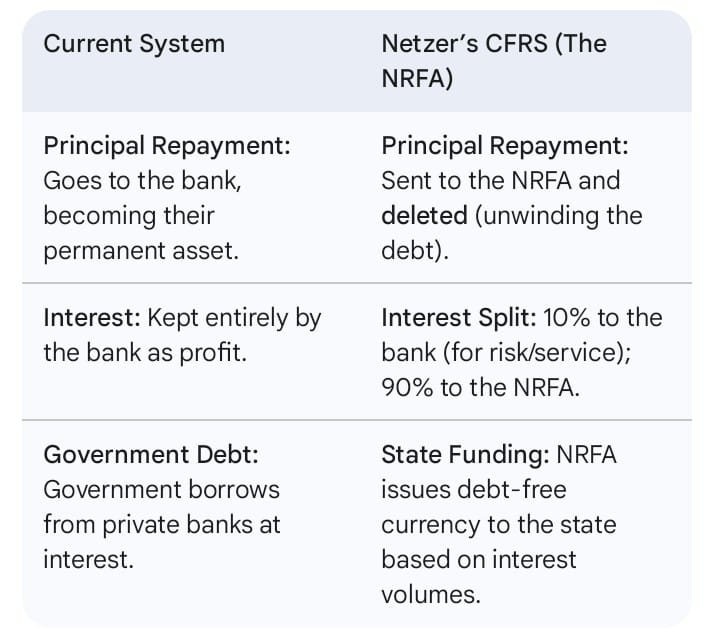
Current System | Netzer’s CFRS (The NRFA)
1. Unwinding the Debt
Netzer’s most striking mechanical change is the deletion of the principal. He argues that since the money was created "out of thin air" via a signature (debt), it must be "voided" once the work associated with that debt is completed. This prevents the money supply from bloating into an unpayable bubble.
2. The 90/10 Interest Split
To prevent the government from becoming a "vassal" to private banks, the NRFA captures the lion's share of interest. This money is then funneled back to the government, not as a loan, but as debt-free currency. This allows for tax rebates, effectively "trickling down" the value of the money to the working population.
Why It Matters: Beyond the Spreadsheet
Netzer’s warnings are stark. He argues that without this correction, the world faces an economic and political meltdown.
Preventing the Rentier Economy: By forcing capital owners to invest in "productive activities" (like growing potatoes or manufacturing) rather than speculative financial assets, the system stays tethered to "vitality."
The Nuclear Safeguard: In a unique systems-engineering twist, Netzer notes that governments are the ultimate guarantors of nuclear power plants. If the financial system collapses and governments default, the maintenance of 600 nuclear reactors fails. In his view, fixing the ledger is quite literally a matter of planetary survival.
Yoav Netzer’s NRFA proposal is a call to return to "Honest Banking." By treating money as a temporal reflection of human labor and energy rather than a permanent commodity, he seeks to dismantle the "Ponzi-scheme" nature of modern finance.
It is a vision where the banker is a service provider, the government is a self-lending entity, and the currency is a true quantifier of a nation’s "vitality."