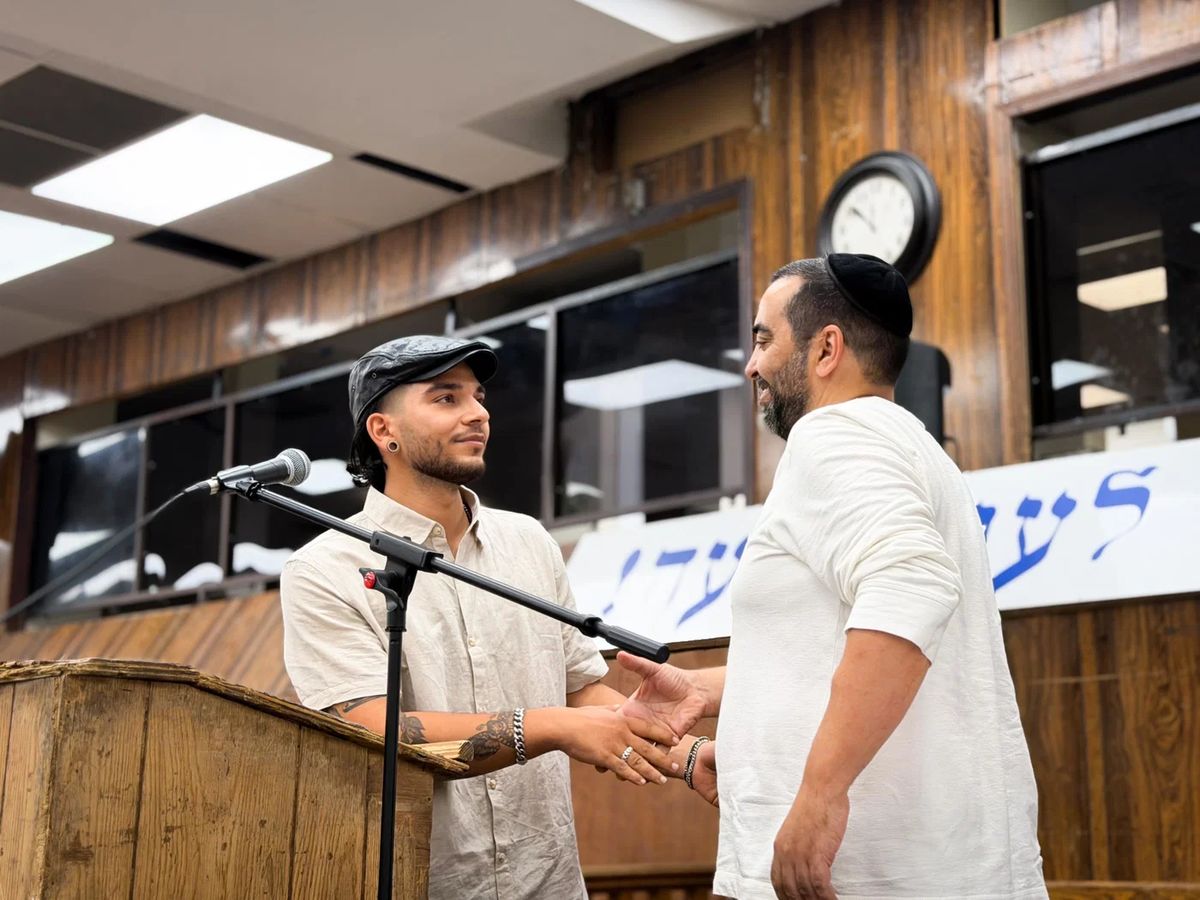
Former Gaza hostage Yosef Chaim Ohana, a graduate of Chabad educational institutions, moved thousands of attendees this week with a deeply personal address at the central Chabad-Lubavitch headquarters at 770 Eastern Parkway in Brooklyn, delivered during a gathering marking the twelfth of Tammuz, the Chabad holiday known as the Festival of Redemption.
Ohana, who was freed from captivity in Gaza earlier this year, was invited to address the crowd and shared the profound spiritual and human insights he developed during his long, harrowing days held deep underground, facing daily uncertainty and mortal danger. For Ohana, standing on the stage of the famous Brooklyn study hall carried particular personal significance, given his deep, lifelong connection to Chabad dating back to his childhood.
Ohana opened his remarks with visible emotion, describing the Chabad roots that shaped his character. He recalled studying at a Chabad Talmud Torah in Nachalat Har Chabad in Kiryat Malachi, noting to applause that he had been part of what Chabad calls "Kvutza Pei Aleph," the cohort designation for the year students traditionally spend at the movement's central study hall in New York as part of their six years of yeshiva education in Israel.
He went on to describe how Chabad's core teaching, emphasizing every Jew's personal mission in the world, accompanied him even through his darkest moments in captivity. He explained that everyone carries out their own mission, whether that means helping a fellow Jew put on tefillin, since the greatest mitzvah in the world is doing good for another Jew. Fifty meters underground, he said, he came to understand that the meaning of doing good for another person was enough to sustain him through living anywhere and enduring anything he was forced to endure.
Despite the immense hardship and trauma he experienced, Ohana emphasized that the ordeal ultimately refined his character and left him spiritually and emotionally stronger. He told the crowd that being there had, in a sense, worked in his favor, because today he can stand before them and say he feels stronger, with deeper faith. There are enormous difficulties, he said, but no one can take away the understanding he gained of the meaning found in life's smallest, most meaningful details.
He explained that it was specifically in a place where every physical freedom had been stripped from him that he discovered the true depth of the values he had been raised on, foremost among them the love of one's fellow Jew.
The most powerful portion of his address addressed the practical application of "love your neighbor as yourself" within the narrow tunnels of Gaza, under conditions of extreme hunger and overcrowding. He told the captivated audience that people recite the verse constantly, knowing it as the great principle of the Torah, but that its meaning only becomes real once you understand what it means to be five or six people, most of the time, surrounded entirely by people who hated you and wished you harm. He and his fellow captives, he said, were the only ones who had to actively wish good upon one another.
He described the difficulty of imagining six people confined to a space of one square meter, without food, facing mortal danger, suffering, where every small thing could ignite tension. That, he said, was where the real work of "love your neighbor as yourself" took place, the ability to truly see one another, to find companionship.
Ohana closed his address with a pointed and thought provoking message directed at those living in freedom, expressing hope that people would find genuine connection and mutual responsibility within their everyday routines, rather than losing their way amid the abundance of choices and distractions of modern life. He said that precisely because people living in freedom have the ability to choose other things, it may in fact be harder, since having so many options and so many stimuli, so much focus on looking out for oneself, financially or otherwise, can make it more difficult to recognize the importance of loving one's neighbor as oneself.