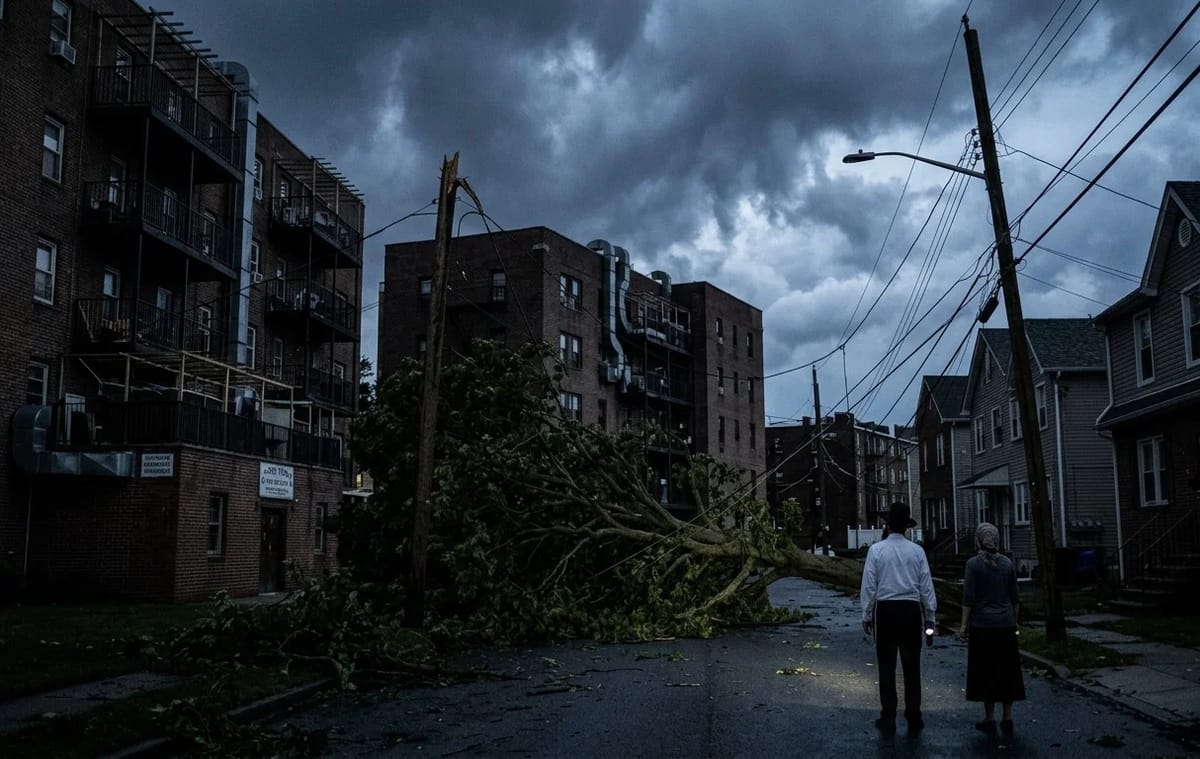
Thousands of Haredi families in Lakewood, New Jersey endured a sweltering, sleepless Shabbos this past weekend after a powerful thunderstorm packing wind gusts of over 110 kilometers per hour tore through the region, toppling power lines and trees and leaving tens of thousands of residents in the dark. With temperatures climbing to around 38 degrees Celsius, families were forced to spend the entirety of Shabbos in homes without air conditioning or lighting, as emergency crews worked around the clock to restore power. The storm is being blamed for at least one death.
The storm struck communities across the region shortly after candle lighting on Friday evening, knocking down utility poles, uprooting trees, and causing widespread damage throughout the area. According to Jersey Central Power and Light, the utility that serves much of the region, more than 200,000 customers lost power as a result of the storm, with wind gusts reaching up to 67 miles per hour causing major tree and equipment damage across its central and northern New Jersey service territory. By Saturday morning, roughly 150,000 customers remained without power, with Lakewood identified as one of the hardest hit areas.
The situation in Lakewood was made significantly more difficult by an accompanying heat wave, with temperatures during Shabbos climbing to around 100 degrees Fahrenheit. The combination of extreme heat with the absence of air conditioning, refrigeration and lighting forced thousands of Haredi families to endure oven like conditions throughout the entire day of Shabbos.
Utility crews mobilized more than 1,700 workers operating in continuous 16 hour shifts, and brought in additional support crews from neighboring states and regions to manage the scale of the damage, with JCP&L saying it was preparing for what is expected to be a multi day restoration effort. Crews managed to restore power to roughly 50,000 residents overnight, though the company has not provided an exact timeline for full restoration across all affected homes.
A spokesman for JCP&L, Chris Hoenig, described the storm as an unusually powerful line that moved from north to south and struck nearly every service area the company covers, leaving extensive damage that will require thorough repair work to the electrical grid. Beyond Lakewood in Monmouth County, the hardest hit areas included Morris County, with more than 51,000 customers without power, as well as Essex, Middlesex and Union counties. As an initial response to residents left unable to keep food refrigerated, utility companies began distributing free ice and bottled water at select retail locations and stores throughout the affected areas.
The storm's damage extended well beyond the power grid, causing serious transportation disruptions throughout New Jersey. NJ Transit rail service was suspended on major lines after more than 50 trees fell across the tracks and blocked the routes. Numerous roads were also closed due to downed power lines and fallen trees blocking travel lanes. In the Medford area, a direct lightning strike hit the roof of a local church and sparked a massive fire, requiring firefighting crews from nine different stations to bring the flames under control, in an incident that ended, remarkably, without injuries.
Local authorities in New Jersey are warning that the power outages have also affected water pumping stations, which could lead to a significant drop in water pressure for some residents in Monmouth County. Scotch Plains Mayor Josh Losardo confirmed with sorrow that one person was killed as a direct result of the storm on Friday night, though his identity has not yet been released for publication. Forecasters in the United States are warning that an additional system of thunderstorms may pass through the region, though it is expected to be weaker than Friday night's destructive storm.