China's Ministry of National Defense announced Sunday that Chinese and Russian navies will conduct the "Joint Sea-2026" exercise this month in waters and airspace near the port city of Qingdao in eastern China's Shandong province, the latest in a rapidly expanding series of joint military activities between the two countries.
The announcement comes days after Reuters reported that Russia's defense ministry had personally approved a secret Chinese military training program for Russian forces, with the agreement underpinning the arrangement signed on July 2 by a Russian major general and a Chinese senior colonel, according to two European officials who spoke on the condition of anonymity given the sensitivity of the matter. A senior Russian lawmaker who chairs the parliament's defense committee dismissed the report as "complete nonsense," saying Russia's military had nothing to learn from China's.
Internal Russian military assessments reviewed by Reuters told a more complicated story, praising the caliber of Chinese equipment, simulators and instructor expertise while noting China's lack of actual combat experience. That asymmetry sits at the center of why Western analysts are watching the relationship closely: Russia has accumulated more than four years of battlefield experience in Ukraine, including extensive exposure to drone warfare and anti-ship missile attacks, while China's large and technologically advanced military has not fought a war in decades. Some regional security analysts believe Beijing could draw directly on Russian lessons from Ukraine to prepare its forces for a potential conflict over Taiwan, where similar drone and missile threats would likely feature prominently.
China and Russia have conducted more than 110 joint military exercises since 2003, according to research compiled by the Center for Strategic and International Studies, with roughly a third of those taking place since Russia's full-scale invasion of Ukraine in 2022. The drills have grown steadily more sophisticated over that period, evolving from land-based counterterrorism exercises into more complex multidomain operations involving joint command centers and reciprocal use of advanced military equipment.
The geography of these exercises has also drawn scrutiny. In recent years, joint activities have taken place in the Yellow Sea, the East China Sea, the South China Sea, the Baltic Sea, the Sea of Okhotsk, and in international waters and airspace near Alaska and Japan. Japan's Ministry of Defense has described the pattern as a matter of grave concern from a national security standpoint, characterizing the drills as a demonstration of force intended to intimidate Tokyo. Analysts say Japan's deeper worry is less about any single exercise than about what the coordination might enable over time, including efforts to destabilize regional sea lanes, bolster North Korea, or support a forced reunification effort against Taiwan.
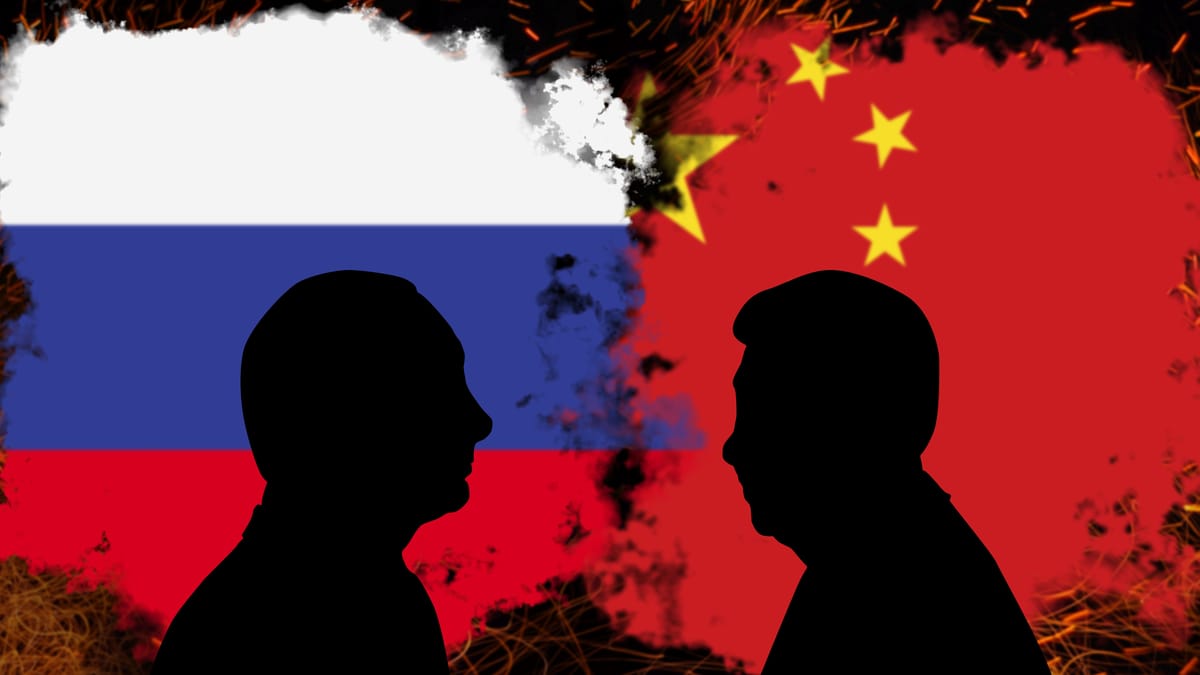
Beijing has consistently downplayed the exercises' strategic significance. A Chinese defense ministry spokesperson described a joint naval exercise last summer as simply an arrangement within the countries' annual cooperation plan, adding that it was not directed at any third party. Western defense analysts have taken a different view. A retired U.S. Navy captain who advises NATO on Russian military strategy wrote last month that the increase in bilateral military activity reflects a shared long-term strategic vision between President Xi Jinping and President Vladimir Putin aimed at challenging American military dominance, rather than a series of unrelated tactical decisions.
The deepening military relationship has also complicated Europe's approach to China. The European Union has already sanctioned Chinese companies it says are supporting Russia's war effort, and one European official argued that the bloc needs to stop viewing China primarily through an economic lens and instead treat it as what the official called a key enabler of Russia's war in Ukraine.
The relationship is not static. China's military capabilities have continued to grow steadily even as Russia's have been degraded by years of war in Ukraine, leaving Moscow increasingly dependent on Beijing both economically and industrially, particularly since Russia lost access to Western markets. That shifting balance of power between the two countries is itself a source of concern in Washington and European capitals, where officials say a Russia that emerges from the war as the far weaker partner, while still transferring hard-won combat expertise to a rising China, could leave the West facing a more capable and more assertive Chinese military in the years ahead.