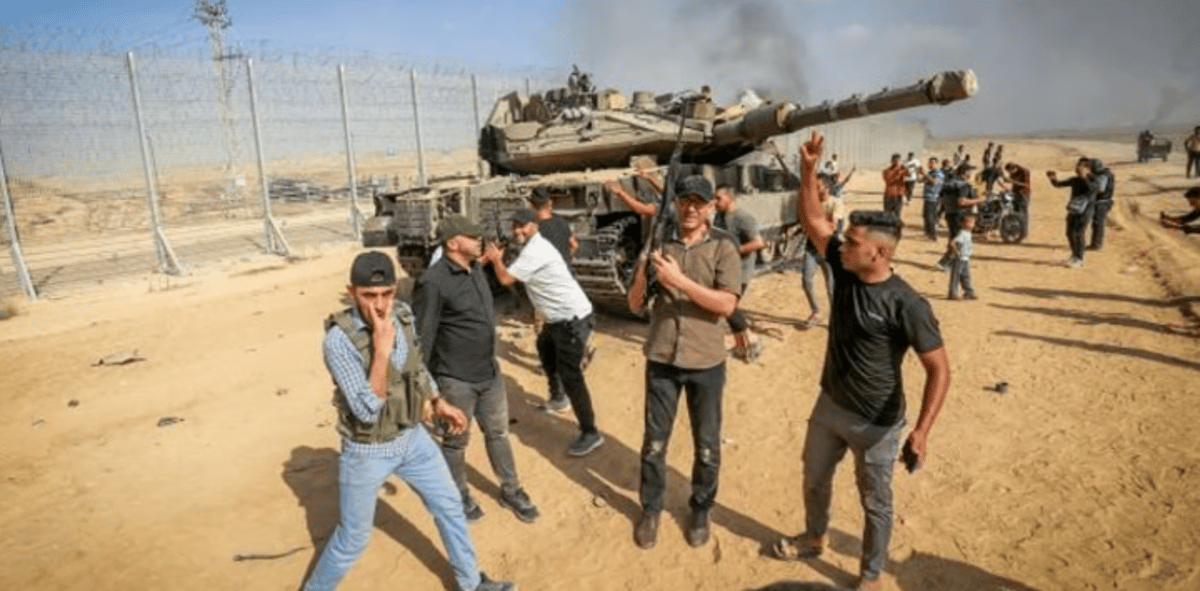
For nearly three years, one of the most consequential unanswered questions of the Oct. 7, 2023, massacre has been why Hassan Nasrallah, the Hezbollah leader who was himself caught off guard by the scale of Hamas's assault, never ordered his elite Radwan forces to cross into the Galilee, despite repeated pleas from Yahya Sinwar, the Hamas leader in Gaza who orchestrated the attack.
A new cache of internal Hamas documents, reported Sunday by Doron Kadosh, a military affairs correspondent for Israel's Galei Tzahal radio station, and drawn from research conducted by the Meir Amit Intelligence and Terrorism Information Center, lays out in granular detail the years of coordination between Hamas, Hezbollah and Iran's Revolutionary Guard that preceded the attack, and the moment at which that coordination broke down.
According to the documents, the relationship dates back to at least 2019, when senior Hamas officials wrote to both Nasrallah and Iranian Supreme Leader Ali Khamenei asking that Hezbollah and Iran serve as "a help and a support" to the Gaza-based movement.
The first real test of that partnership came during the May 2021 conflict known in Israel as Operation Guardian of the Walls. A document attributed to Khaled Ghanem, identified as the head of Hamas's overseas military intelligence branch, describes how the three parties, Hamas, Hezbollah and the Revolutionary Guard, established a joint intelligence war room in Beirut during the fighting. According to the document, Hezbollah passed Hamas extensive information on Israeli troop deployments and air force activity, and intervened to prevent the killing of Ahmed Ghandour, at the time a Hamas brigade commander in northern Gaza.
The most striking claim in the document, according to Kadosh's report, is that Hezbollah was responsible for foiling one of the Israeli military's major deception operations during that same round of fighting: a ground feint intended to draw Hamas fighters into what Israel called the "Metro," the network of tunnels beneath Gaza, in order to strike them from the air. The document states that Hezbollah passed Hamas a warning two hours in advance, alerting the group that the operation was a ruse meant to generate a target bank rather than a genuine ground invasion. A former senior Israeli security official confirmed to Galei Tzahal that Hezbollah played a significant role in undermining that operation.
The documents also describe a meeting held in Beirut in May 2022, attended by senior Hamas officials Saleh al-Arouri and Khalil al-Hayya, Nasrallah, and a Revolutionary Guard general identified as Izadi. According to the account, Hamas representatives argued that Israel's political fragility under the Bennett-Lapid government, combined with a wave of terrorism in the West Bank, presented an opportunity for a broad military campaign. Nasrallah, according to the documents, was cautious, and pressed the group to first articulate a clear strategy and objective. He is quoted asking whether the goal was a total retreat of the occupation, or something narrower, such as preventing Jews from entering the Al Aqsa Mosque compound, which he characterized as a modest aim that would not require war.
Following that meeting, Sinwar reportedly sent Nasrallah a letter outlining several possible scenarios. His preferred option, described in the documents as "the second securing system," envisioned a multi-front surprise attack aimed at destroying Israel entirely, including the invasion of ground forces from Jordan and Syria. The documents indicate this scenario was originally intended to be carried out around Passover of 2023, not in October. Nasrallah is described as having endorsed the plan as a realistic and achievable scenario, in contrast to Israeli assessments at the time; the documents note that an intelligence officer in the IDF's Gaza division dismissed the warnings as an imaginary scenario.
Throughout 2023, according to the documents, Sinwar grew increasingly convinced that Hezbollah would join a full assault. In June of that year, he reportedly told members of Hamas's political bureau in Gaza that the group had succeeded in moving Hezbollah and Iran past what he called their post-2006 psychological paralysis, and that both were now highly prepared to forge an alliance with Hamas. He reiterated that confidence to Hamas's Shura Council in August, even though an internal Hamas military intelligence document had separately warned of a psychological barrier and hesitation within Hezbollah's leadership in Lebanon.
At 6:29 a.m. on Oct. 7, as Hamas launched its assault, Sinwar sent an urgent letter to Nasrallah. In it, according to the documents, he apologized for not giving advance notice of the attack's timing and asked Hezbollah to immediately carry out concentrated bombardment and a ground offensive of its own.
Nasrallah did not act. According to the documents, he declined to deploy the Radwan forces, and it was only roughly a day later that Hezbollah began what the documents describe as comparatively symbolic fire on Mount Dov. Sinwar, the documents indicate, found himself alone in the fight he had spent years trying to build into a multi-front war.
Oct. 7 remains, in the words used to frame the new reporting, an unprecedented national catastrophe for Israel. But the documents make clear that a full Hezbollah entry into the war that same morning would have transformed the scale of the disaster substantially, and that the Galilee was, in effect, spared a second mass killing.