The exposed stones, the broken vaults, and the surviving floor tiles are not simply cold archaeological remains. They are the living reality of our shared story of destruction, a reality you can touch, be moved by, and use to step more fully into the days of Bein HaMetzarim. Because the destruction of Jerusalem deserves to be remembered every single day, not only during these three weeks, and not only on the Seventeenth of Tammuz.
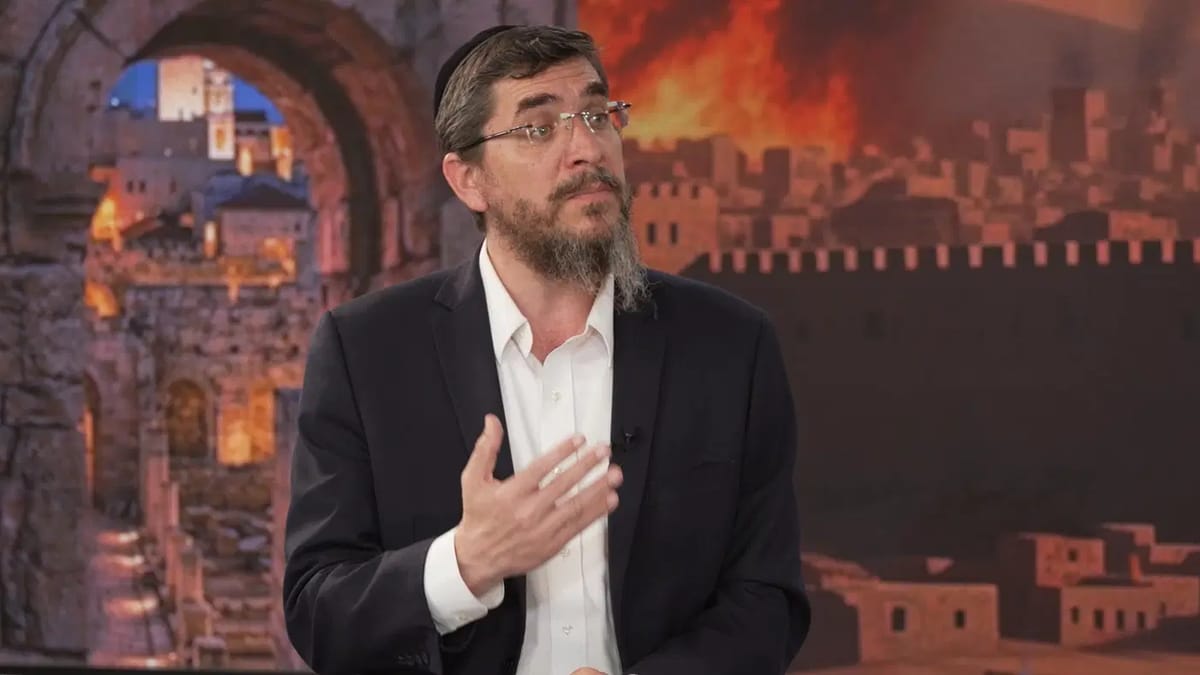
As the fast that opens the period of mourning for the Temple begins, Jewish history refuses to let go of its hold on the holiest site on earth. In a special broadcast timed to the fast, "In the Courtyards of the House of Hashem," host Yossi Abado promised something entirely different from the usual retelling. "We talk about the destruction, but tonight we're going to see it with our own eyes," Abado opened. "We're setting out on a breathtaking journey deep underground, into the heart of the Temple Mount, to uncover the great buried secrets of the holiest place in the world."
His guest, Rabbi Tzvi Grinspan, an expert on the Temple Mount and on discoveries in the Old City, explained that just as the month of Elul is a time of preparation for the Days of Awe, this journey was designed to prepare us for Tisha B'Av, bringing the destruction closer to the heart through real, physical sights.
Where Did the Mountain Go?
Today, we don't actually see the Temple Mount in the shape of a mountain, with a peak and slopes. Look at the Mount of Olives, and you see a clear mountain, with a summit and a descent. But look at the Temple Mount, and you see an enormous plaza, massive walls, and a golden dome. The mountain itself has vanished, buried beneath the plaza.
How did a mountain disappear? The Gemara in Bava Batra tells how King Herod launched a massive building project to expand the Temple, as an act of atonement for having killed the Sages of the Sanhedrin at the urging of Bava ben Buta. The Mishnah states, "Whoever has not seen the building of Herod has never seen a beautiful building in his life."
Rabbi Grinshpan explains it with a simple image: Herod took a hollow box and flipped it over the mountain. He built four massive retaining walls around the mountain's slopes, and filled the space between them with an intricate system of vaults stacked upon vaults, floor upon floor of stone arches and columns supporting the enormous plaza from below.
Yossi Abado added an insight from the Zohar: beyond the engineering itself, gazing at the floor of the Temple Mount, at the floor of the Azarah, holds a deep spiritual secret. There is a moving custom during the three pilgrimage festivals in which people climb to the rooftops of the Porat Yosef yeshiva in the Jewish Quarter to look out toward the site of the Temple and the floor of the Azarah, coming as close as physically possible out of sheer longing, simply to gaze at the place. The Zohar teaches that the moment a person looks toward the floor of the Azarah, the place of the Divine Presence, the Shechinah itself looks back at that person with love.
The Man Who Mapped What Lies Beneath
How do we know about all these hidden chambers, if no one was ever inside them? Beyond the detailed descriptions found in the Mishnah in tractates Middot, Yoma, and Parah, there is a surprising figure who enters the story. Nearly 160 years ago, a man was sent to the land on behalf of the British Kingdom to survey the territory under Ottoman rule. His cover story was that of an archaeologist. His name was Charles Warren. He descended into the depths and sketched, in precise detail on wooden panels, the very columns and vaults that support the mountain from below. The ceiling above those vaults in his drawings is the floor of the Temple Mount itself.
The walls we see today represent only a fraction of their original height. Rabbi Grinspan pointed to Robinson's Arch, above which once stood a gate roughly four stories tall, and recalled the torches of Simchat Beit HaShoeivah, which illuminated all the courtyards of Jerusalem from a height of fifty cubits. From this, one can understand that less than half the original height of the walls is visible to the eye today.
The Largest Underground Mosque in the World
In recent years, Arab workers dismantled the upper plaza of the Temple Mount, breaking apart original vaults dating back to Temple times and clearing the rubble away by truck. Beneath the floor, dozens of rows of ancient vaults were exposed, and it was there that the largest underground mosque in the world was built.
On the final Friday of Ramadan, Arab officials declared that 250,000 people had come to the Temple Mount. "I was standing on one of the rooftops, looking out," the rabbi recounted. "Maybe ten thousand, fifteen thousand. Where was everyone else?" The answer, he explained, is that the crowds were underground, gathered on the enormous red carpet spread across the floor of the vast space beneath the plaza, filling it with thousands of worshippers. In a chilling detail, the columns supporting that very space clearly bear the marks of Herodian stonework, identical to the stones of the Western Wall. Those same columns from Temple times now serve as the foundation of the mosque.
Destruction Within Destruction
The desecration did not stop there. Roughly twenty years ago, Arab workers removed dozens of tons of earth from the Temple Mount and dumped it into the Kidron Valley. Dedicated volunteers with the Temple Mount Sifting Project have since been sifting through that soil, uncovering rare finds from the First and Second Temple periods, among them colorful floor tiles from the Temple itself, breathtaking in their beauty even broken, woven together in extraordinary geometric patterns. Destruction within destruction, meant to stir within us a longing and yearning for the Divine Presence to be revealed once again.
"Every Holy Place Is More Destroyed Than the Last"
Rabbi Tzvi Grinspan closed the emotional journey with a quotation from a letter the Ramban wrote from Jerusalem nearly 760 years ago, words that remain etched in the heart: "Every place holier than another is more destroyed than the other, and Jerusalem is the most destroyed of all." The holier the place, the deeper the destruction visible within it. It is the ruin itself that testifies to the holiness, and it is the ruin that gives birth to the longing and the yearning.
The Ramban closed his letter with the very words Yossi Abado chose to close the entire broadcast: "May the One who merited us to see it in its destruction merit us to see it when the Divine Presence returns to it, speedily in our days."
To see the discoveries for yourself, the rare footage, the images from deep beneath the ground, and the full story, the special broadcast "In the Courtyards of the House of Hashem," released for the Seventeenth of Tammuz fast, is available now.