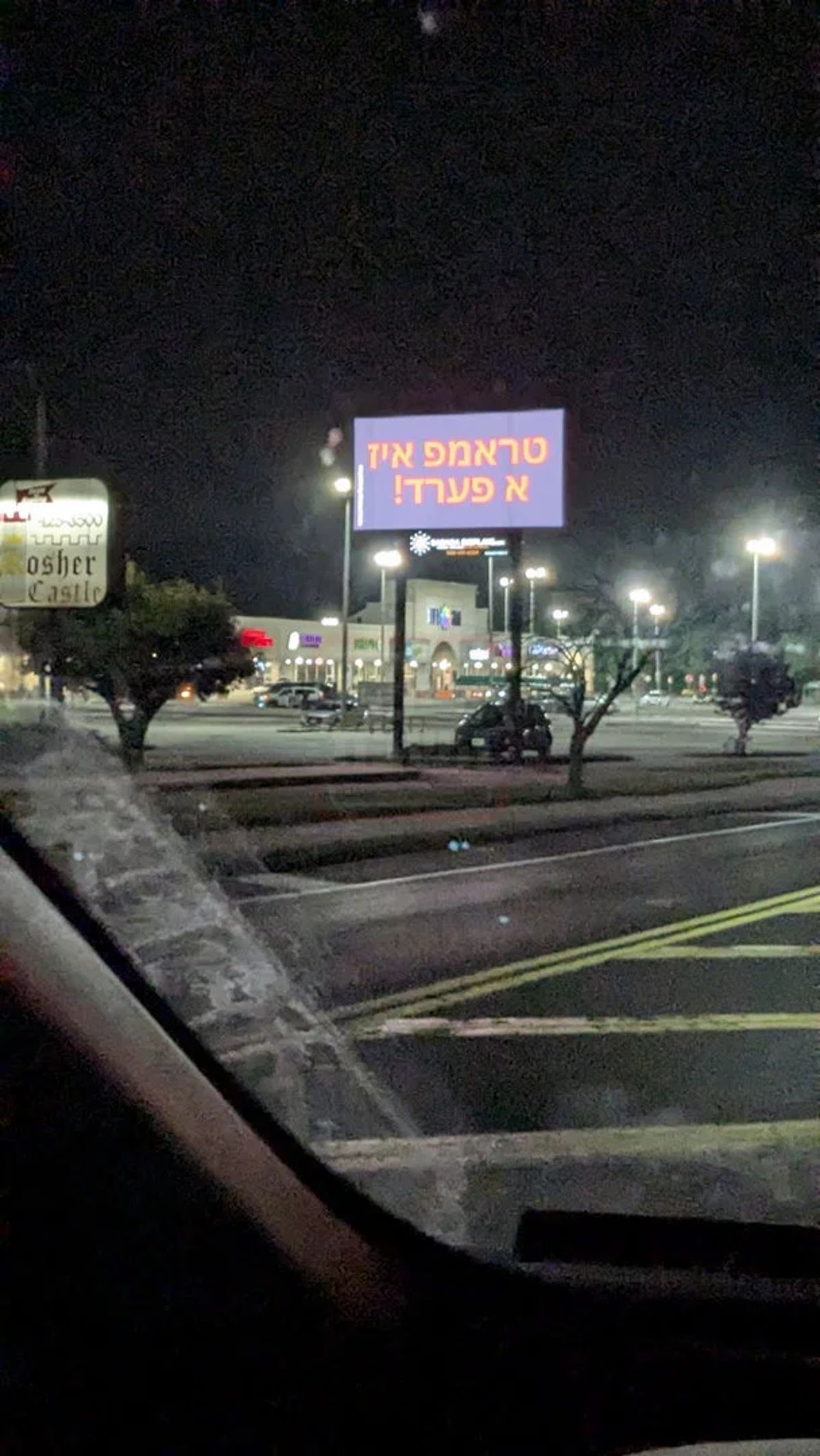
A massive illuminated billboard appeared Wednesday night in Monsey, New York, on Route 59, directly across from the Evergreen Kosher Market. The message, written in Yiddish in white Kiddush letters, was unambiguous: "Trump is a s****ck."
The location matters. The Evergreen is not just a supermarket. It is the commercial and social heart of Monsey's massive Haredi community, where thousands of families gather daily. Placing a political attack on the president in that exact spot, illuminated for visibility, was a deliberate act of cultural defiance.
Shoppers leaving the market stood stunned. Within minutes, the billboard became the central conversation of Monsey and spread rapidly across social media, with residents rushing to the location to document the unprecedented public denunciation.
A Community That Once Had Faith
What makes this moment extraordinary is historical context. The Haredi street in Monsey has long supported Trump and viewed him as a close ally of Israel. His policies on Jerusalem, his opposition to the Iran deal during his first term, his rhetoric on Jewish security interests, all created a deep bond between this insular community and the president.
That alliance has now fractured.
"People here are just boiling," a local community activist told Kikar HaShabbat. "The Haredi street in Monsey largely always supported Trump and saw him as a great friend. But the recent steps, the surrender agreement with the Iranians, alongside his statements, just broke the dishes. This billboard in front of the Evergreen expresses what many people here think quietly. But this time someone decided to put it in neon lights so everyone would see."
The language of his account is significant. Not disappointment. Not criticism. Boiling. Broken. A complete rupture.
The Iran Deal as Betrayal
The anger centers on Trump's newly signed Memorandum of Understanding with Iran. From the perspective of Monsey's Haredi community, the deal represents an abandonment of Jewish security. These are people who feel complete solidarity with Israel, who see themselves as stakeholders in Israeli security, and who trusted Trump to remain a bulwark against Iranian nuclear ambitions.
Instead, they see capitulation. Market rallies and oil price declines, which Trump has cited as evidence of the deal's success, mean nothing to families who view the agreement through the lens of existential threat.
The activation of the billboard, in a hyper-visible community space, signals that this is no longer a quiet dissatisfaction expressed in private conversations or around dinner tables. It is now public, undeniable, and targeting the sitting president directly.
An Unprecedented Public Statement
In a community that typically operates through internal networks and private discourse, the decision to erect a massive political billboard is extraordinary. It suggests that the pain runs deep enough to override the Haredi community's traditional preference for operating outside public political messaging.
The choice of Yiddish and the specific term "schmuck" is itself loaded. These are markers of internal community solidarity, a way of communicating in the idiom that binds Monsey's insular world together. The message is not directed at the broader American public but at the community itself, as a validation that their anger is legitimate, real, and shared.
Local residents report that the billboard has become an instant pilgrimage point. People are traveling to the location specifically to see it, photograph it, and share it with others as evidence that the rupture is real and that resistance is now visible.
What Comes Next
The question now is whether this is an isolated expression of anger or the beginning of a broader political realignment. The Haredi community in Monsey has significant economic and voting power within New York politics. A permanent break with Trump would reshape the political landscape in ways that extend far beyond Monsey itself.
For now, the billboard stands as a stark public statement: the faith is broken. The friend is gone. And a community that once believed in Trump's commitment to Jewish security has moved to open, unfiltered anger.
In Yiddish. In neon lights. In the heart of their world.