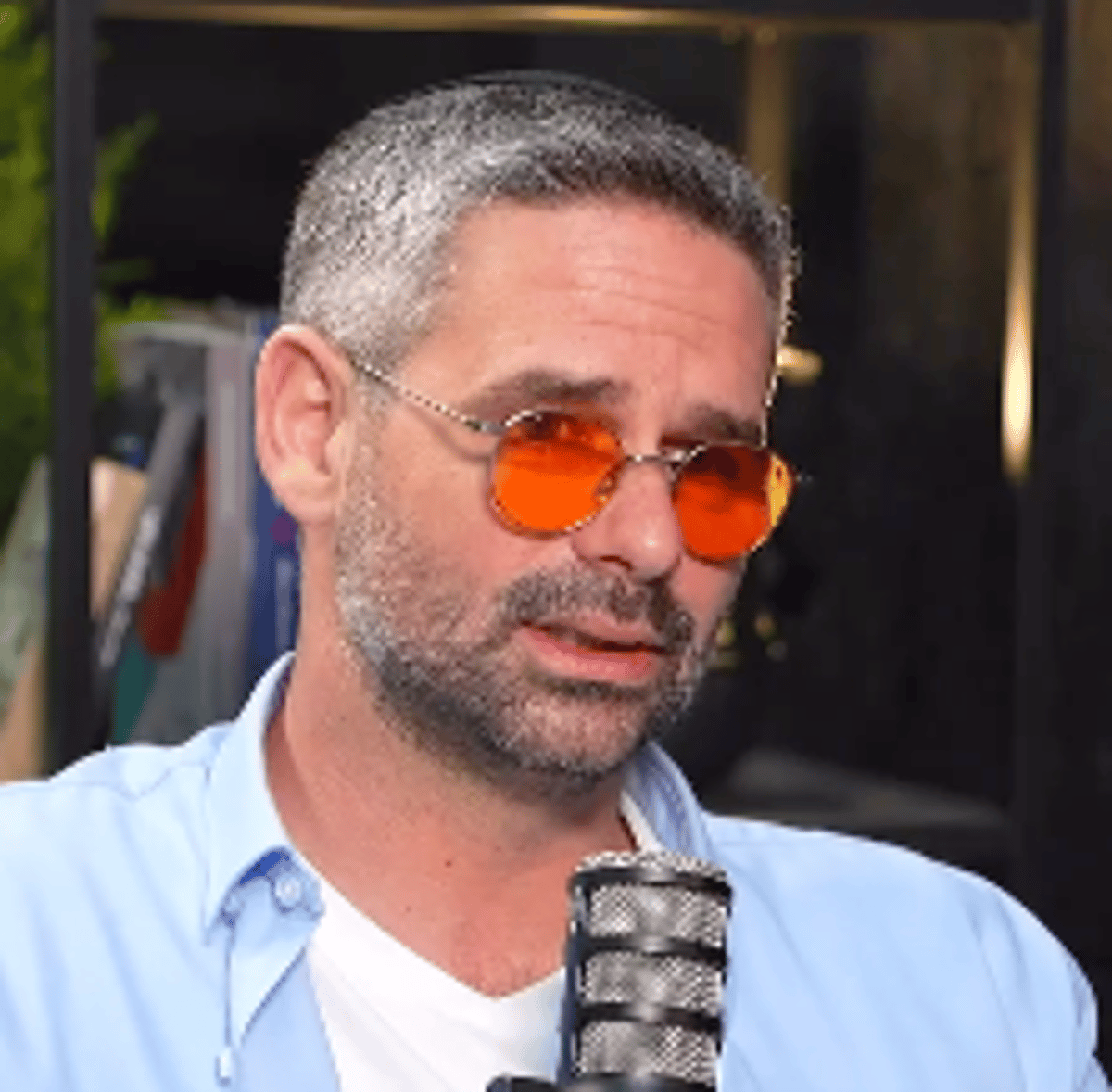
He arrived in Israel at 12, not knowing a word of Hebrew. He left Berlin behind, but Berlin didn't leave him. What followed was a journey through street violence, yeshiva walls, blindness, and divorce - and somehow, on the other side of all of it, Sharon Avak found something most people spend their whole lives searching for.
Sharon Avak was born in Israel to parents from the former Soviet Union, but he grew up in Berlin. His Jewish identity, he says, amounted to little more than a Star of David and a vague awareness of being different. "The only thing that defined a lot of Soviet Jews as Jewish was antisemitism," he says. "In Germany, nobody was chasing you for being Jewish anymore, so people didn't always know why to stay Jewish."
Then, at 12, the family moved back to Israel. The landing was rough.
"I remember the first day of school. I showed up in a button-down shirt, top button closed. Everyone else was in tracksuits and flip-flops. I understood pretty fast that I was in a different world."
He didn't speak Hebrew. The only sentence he knew: My name is Sharon, I don't speak Hebrew.
In the neighborhood where he ended up, that kind of vulnerability was a liability.
"I was afraid they'd bother me, so I started bothering first," he admits. The streets around him operated by their own rules, honor, violence, fear, knives. Friends who didn't make it. "I had two options: be one of the ones doing the kicking, or be one of the ones getting kicked. At least, that's how it looked to me then."
He describes it all without self-pity, but with a kind of careful distance, the distance of a man who has had a long time to look back at someone he no longer recognizes.
The turning point didn't come from a crisis. It came from a question.
Sharon ran into an avreich named Lior Naor on the street and threw a philosophical question at him about G-d, half expecting a dismissive answer, the kind of pat response he could walk away from. Instead, he got a real answer. Then another. Then another.
"What surprised me was that they actually knew how to talk," he laughs.
A few days later, Lior invited him for Shabbos. Sharon came, not out of belief, but out of curiosity. He walked in, looked around, and his first thought was: They don't even have a TV in the living room. How poor are these people?
But something happened over the course of that Shabbos. The singing. The Torah. The warmth. The sense of a world with depth he hadn't known existed.
"I suddenly saw content. I saw truth."
Three months later, he was in yeshiva.
Sharon doesn't frame his teshuva as an escape. "I wasn't in a crisis. I wasn't depressed. I wasn't looking for a refuge. I simply saw truth." He fell in love with Gemara, with the beis medrash, with the long hours of learning. He watched two avreichim sitting and learning and thought: I want to be there.
And he got there.
But life had other plans.
He had been living with RP, retinitis pigmentosa, a degenerative eye disease, since childhood. At first it only affected him at night. Then his field of vision began to narrow. By the time he was 19, he received an official blind certificate.
"They took my license. That was very hard."
But the physical loss, he says, wasn't the hardest part.
"The fear was harder."
He pauses, and then says the line that has come to define how he sees the world:
"The fears are more painful than the pain itself."
"For years I was afraid of what the future would hold. Today I understand that the fear caused me far more suffering than reality ever did."
Sharon isn't completely blind, and that, paradoxically, creates its own challenges. People look at him and see a tall, confident, articulate man. They don't see the internal negotiations that accompany every social interaction, not knowing if someone is extending a hand, not being able to read a facial expression, standing too close or too far, the small mortifications that accumulate across a day.
For years he avoided weddings, gatherings, crowds. Not because he didn't want to be there. Because of the fear.
"You learn to sit in the corner of the room. The safest spot."
He also navigated divorce within the yeshiva world, a place that doesn't always have language for people in that situation. Long Shabbosim. Loneliness. "There were moments," he says quietly, "when I just wanted noise in the house."
But he kept going.
"Success," he says simply, "is just continuing to walk forward."
By the end of the conversation, there's something almost disorienting about listening to Sharon Avak. The man who nearly lost his sight seems to see more clearly than most. He's lived inside street violence and inside the beis medrash. He's known the shattering of a marriage and the building of a self. He's held a blind certificate and a daf Gemara in the same hands.
And what he's arrived at, after all of it, is something quiet and hard-won:
You can have a limitation and be a winner. You can be perfectly healthy and be lost. The two have nothing to do with each other.
The story of Sharon Avak isn't a story about blindness.
It's a story about a man who stopped being afraid of the dark, and discovered that even there, you can see more than you ever imagined.