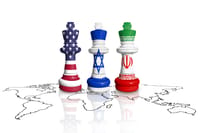
The Netherlands designated Israel as a foreign security threat for the first time, listing the country alongside Iran and Russia in a national security assessment that has triggered a diplomatic crisis and sharp Israeli rejection.
The report published by the National Coordinator for Security and Counter-terrorism (NCTV) says that Israel attempted to influence public opinion and politics in the country by circulating documents directly to Dutch journalists and politicians instead of using official diplomatic channels.
The National Coordinator for Terrorism and Security (NCTV) report, released on July 17, lists Israel as one of the countries that aims to "control public opinion and political decision making."
The Catalyst: Amsterdam Antisemitism Report
The Israeli designation centers on the Foreign Ministry's "Diaspora Affairs and Combating Antisemitism" report circulated after violent incidents in Amsterdam in November 2024. NCTV provides the example of a report disseminated by the Diaspora and Combating Antisemitism Ministry following the Ajax-Maccabi Tel Aviv violent attacks in November 2024. "The report was not shared through official channels with the Dutch government but was sent directly to specific politicians and journalists," said NCTV.
Israeli officials characterized the distribution as standard public diplomacy documenting antisemitic violence targeting Israeli fans. Dutch security officials described the circumventing of diplomatic channels as unprecedented and potentially destabilizing to Dutch social cohesion.
Jerusalem's Response
Israeli government officials rejected the comparison as fundamentally distorted. Israeli officials stated that the Foreign Ministry's effort to document and publicize antisemitic attacks was a legitimate response to threats against Israeli citizens and part of standard public advocacy regarding Jewish safety in Europe.
The designation was framed by Jerusalem as conflating routine diplomatic outreach with the intelligence and espionage operations of authoritarian states—a characterization officials called a "serious distortion" of Israel's attempts to counter antisemitism.
Broader Context: ICC and Trade Disputes
The NCTV report reflects deeper tensions between Israel and the Netherlands beyond the diaspora ministry incident. The NCTV report also expressed concern over threats—allegedly from both Israel and the United States—against the International Criminal Court (ICC) in The Hague.
Additionally, the Netherlands has adopted increasingly critical stances toward Israeli policy, including bans on imports from settlements and restrictions on military exports. In the report, Israel is classified alongside other countries such as North Korea, Iran, Russia and Turkey, all of which are assessed to use similar strategies to influence and destabilize foreign governments and societies.
Geopolitical Deterioration
Recent polls in the Netherlands show a marked increase in negative sentiment toward Israel among the Dutch public. There is growing support for a more critical approach to Israeli policy, including calls to suspend economic and military cooperation.
The designation reflects a significant shift in Dutch-Israeli relations. Historically, the Netherlands was viewed as a stable democratic ally of Israel. The NCTV classification signals institutional re-evaluation of that relationship—driven partly by Dutch security assessments, but also reflecting broader European public opinion shifts following the Gaza conflict.
Political Implications
The report does not necessarily trigger immediate policy changes, but it establishes formal security-agency designation of Israel as a foreign influence threat—language typically reserved for adversaries. The comparison with Iran and Russia has become a focal point of Israeli objections, with officials arguing the designation conflates legitimate diplomacy with hostile state interference.