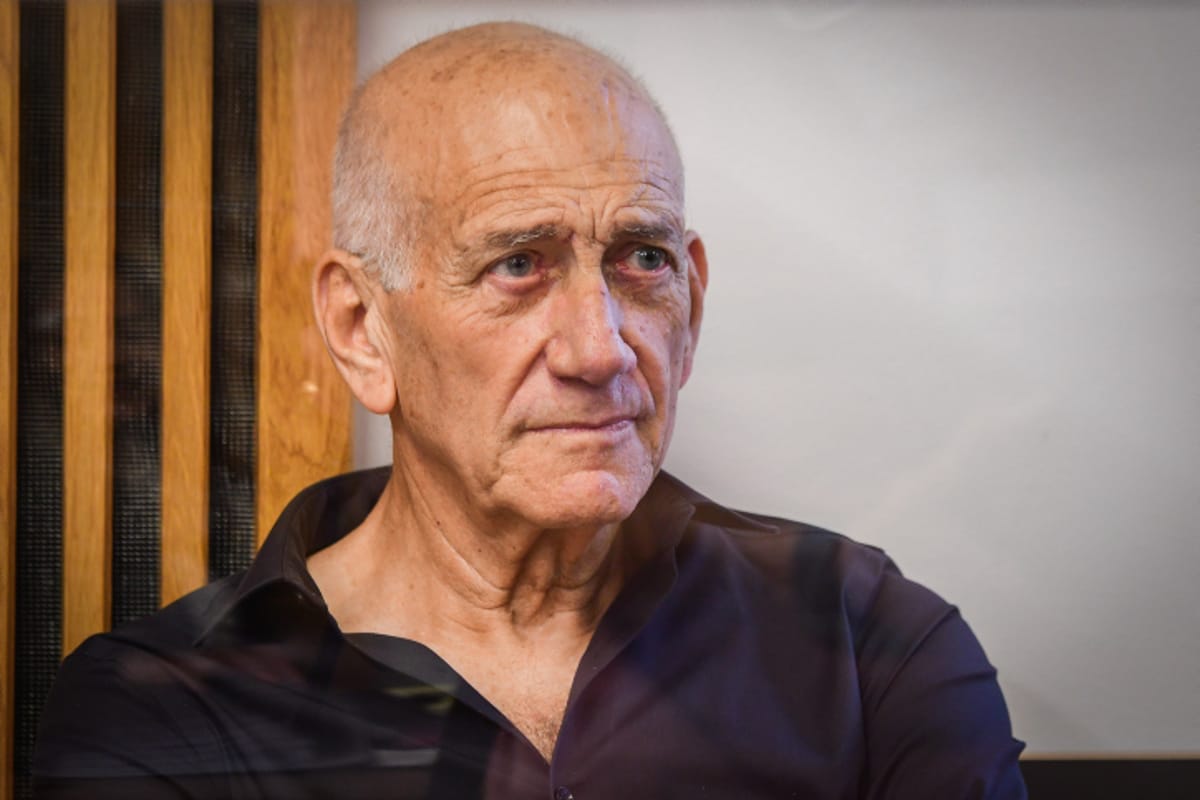
Former Prime Minister Ehud Olmert has revealed previously unpublished details of Israel's 2007 operation to destroy Syria's secret nuclear reactor. He described the moment he learned of it and the fear of a leak that kept him awake at night.
Olmert spoke with journalist Amit Segal on N12's video podcast "Matzav Ha'azana," marking the release of his new book. He walked Segal through the chain of events that led to the reactor's discovery, the covert operations to gather more intelligence, and the effort to keep Damascus from realizing that Israel knew what was happening on its territory.
Olmert credited the discovery to a single young Mossad officer, identified only as "Anat," who repeatedly insisted that Syria was secretly developing nuclear capabilities even as her superiors dismissed the idea. She was criticized for not being a team player and was even summoned to a pre-dismissal hearing before she was proven right. Olmert said she now holds a senior position in the Mossad.
"Young people sometimes know much more than the generals," he said.
Recalling the briefing where the reactor's existence was confirmed, Olmert said: "In the meeting were Dagan, Tamir Pardo, Amnon Sofrin, and one more person whose name cannot be revealed, who was Dagan's assistant. The conversation went on as long as it went on, and then they left. I told my secretary to call Yoram Turbowicz and Shalom Turgeman. When they came in, I told them: 'There's a nuclear reactor in Syria, we're going to destroy it.'"
"There was silence," he continued. "I told them that now we won't deal with the question of how it happened that we didn't know, but rather we'll do everything so that it won't exist. This thing didn't let me rest. I went home, Aliza saw that something was happening."
Asked by Segal whether he feared the secret would leak before Israel could act, Olmert admitted that it haunted him. "There's that fear all the time, I would wake up at night from fear that it would leak," he said. He explained that the circle of people exposed to the information kept growing as preparations advanced.
Olmert also disclosed an unusual episode involving Yossi Cohen, then a senior Mossad officer and later its director. As part of preparations for the possibility of war, Israel's security establishment planned to abduct Ibrahim Othman, the head of Syria's nuclear program, and record him admitting the reactor's existence. Instead, Cohen acted on his own, went directly to Othman's home in Europe, knocked on his door and tried to recruit him as an informant.
The former prime minister also described the difficult choices the operation required. Because Israel's satellite and surveillance resources were limited at the time, the security establishment had to prioritize monitoring the Syrian reactor over intelligence efforts to locate captive soldier Gilad Shalit.
As for Syrian dictator Bashar al-Assad, Olmert noted that about six weeks before the strike, Assad had hinted in a speech to parliament that the Middle East would see changes within six months. After the reactor was destroyed, Assad chose to stay completely silent rather than expose his weakness.
Israel destroyed the reactor at Deir ez-Zor in September 2007 and officially acknowledged the strike in 2018.