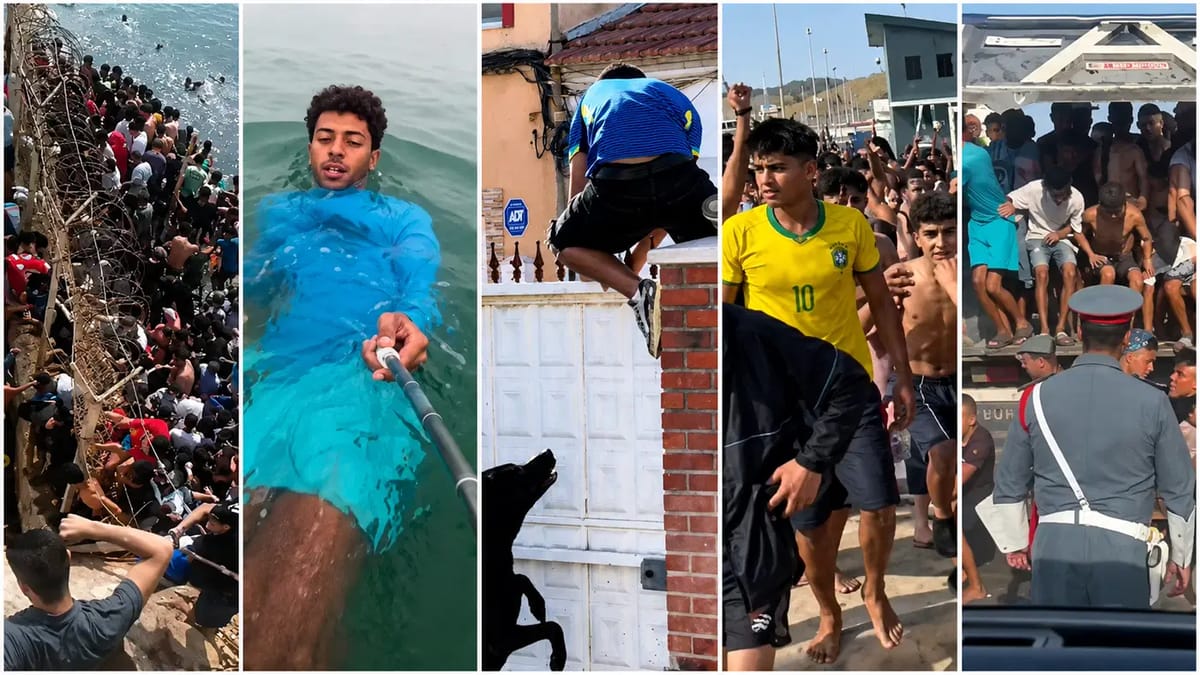
The death toll in Spain's Ceuta border crisis with Morocco has climbed to 67, with deaths including some who drowned and some who were killed in a stampede to cross a breakwater barrier. Between 50,000 and 60,000 migrants breached the tiny Spanish territory's frontier between Thursday and Friday, in what authorities are describing as an unprecedented mass crossing event that has fractured European unity over migration policy.
Spain announced it was installing a 500-meter-long containment barrier along the breakwater fence into the sea after the surge. The scale of the incursion overwhelmed Spanish border security forces and triggered immediate political crises across the European Union, with member states imposing unilateral controls and publicly questioning Spain's ability to maintain its territorial integrity.
Most of the 50,000 to 60,000 people who entered Ceuta had returned to Morocco by Friday evening, as authorities in the enclave said many of those who died drowned as crowds streamed over the border by land and sea on Thursday, overwhelming border guards.
Political Fallout and EU Divisions
Spanish Prime Minister Pedro Sánchez accused some European allies of mounting a "selfish, polarizing and unlawful" response to the migration crisis, after Italy and other EU states took unilateral action. Italy temporarily reinstated border checks on arrivals from Spain, while officials in Finland and Denmark backed calls to consider suspending Spain from the Schengen area over its handling of the crisis.
Sánchez used a letter to the European Commission to defend Spain's broader migration record, saying its policies had "dramatically" reduced irregular arrivals and made the country "the second most secure external border in the EU," despite it being the bloc's only member state with a land frontier in Africa.
The U.S. State Department also criticized Spain's immigration policies and said the incident was a direct result of the Spanish government's "deliberate efforts to enable and facilitate mass illegal migration into Europe."
The Crossing Routes
Most migrants swam across the narrow strait or scaled border fences in what residents and security officials described as scenes of chaos. Video footage on Thursday showed hoards of people, mainly Moroccans, walking around the breakwaters onto local roads, with most appearing to be young men, but there were also families with women and small children.
A handful of exhausted migrants who swam to Ceuta's urban Tarajal beach Saturday morning were met by soldiers who escorted them back across the border.
Context: Prior Incidents and Triggers
The situation was similar to one that occurred in May 2021, when some 10,000 Moroccan and sub-Saharan youths entered the enclave within days, though the scale of this week's crossing appears to exceed that earlier crisis. Security analysts blame a combination of factors: a recent Spanish Supreme Court ruling that migrants intercepted at sea cannot be summarily returned, aggressive people-smuggling operations, and potentially messaging on social media encouraging the crossing.
The incident comes in the wake of a massive amnesty scheme: in early July, some 609,737 of the 1.17 million migrants in Spain who applied for legal status obtained temporary work permits, making it the largest regularisation of black market workers in European history.
Restoration of Control
On Saturday, Spanish officials began installing a floating barrier near the Tarajal breakwater, a key entry point into Ceuta, to "comply with" the Supreme Court ruling in July. Spain's interior ministry says the majority of those who entered the Spanish territory in North Africa have already returned to Morocco.