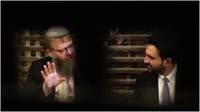
Attorney Azriel Fridenberg opened a Kikar FM interview with a Japanese metaphor: kintsugi, the art of mending broken pottery with gold. His entire life, he said, is that pottery, shattered multiple times, bound back together not hidden but highlighted.
At 27, Fridenberg was a millionaire. He traded diamonds in Sierra Leone for a Belgian businessman, became the right hand of the country's de facto ruler, and flew shipments of gems and cash across continents. Then he shot someone.
In Antwerp in the mid-1980s, a dispute over diamond smuggling ended when Fridenberg walked into a rival's office with a gun. A scuffle ensued. He fired into the air and fled, leaving his ID behind. He took nothing. But the arrest came. He was convicted of attempted murder and robbery. Sentence: 17 years. The president commuted it to 11. He served seven.
"I have no excuses," Fridenberg told interviewer Eli Gotthelf, his voice direct and without performance. "I did it with my own hands. There's no night I pass without turning it over. The guilt is entirely mine."
The prison years, which Fridenberg describes as "hell on earth," broke him in ways the physical confinement never could. His wife divorced him at his request. His children bore the stigma. Decades later, even after release, that weight remained.
But something shifted during his incarceration. Fridenberg, raised religious Zionist, combat veteran of the Yom Kippur War (he fought at the Chinese Farm in the Sinai), came under the spiritual mentorship of Haredi leadership. When released, he rebuilt incrementally, managing cigarette machines in IDF bases, traveling the country, generating income from almost nothing.
At 50, an age when most plan retirement, he enrolled in law school. His classmates were children compared to him. He graduated and fought through the Israeli bar association's committee, which had to certify a man with a felony record. They did.
Fridenberg became a sought-after criminal defense attorney. He represented organized crime figures, bank robbers, prisoners. His insight, the visceral knowledge of how interrogation rooms operate, how prison breaks the spirit, became his advantage. "I have X-ray vision for what happens in interrogation rooms and courthouses," he explained to Gotthelf.
The relationship that defined his second life came through Haredi gedolim. Rabbi Shach, the Steipler, Rabbi Chaim Kanievsky, all became advisors to a man with a violent past. How a convicted felon gained access to the highest rungs of Haredi leadership is itself remarkable. Fridenberg credits their ability to see the person beneath the crime. "There are people who do evil because they are evil. But there are people where the evil is like wool on a sheep, it sits on them, but it's not part of them. The gedolim knew how to see that."
The redemption didn't hold completely. Eight years ago, while practicing law, Fridenberg crossed professional lines with clients. He smuggled prohibited items into prison, luxury watches, boxing gloves, partly out of identification with his clients and partly out of blurred judgment. The charges never included drug smuggling (which media initially alleged and Fridenberg categorically denies), but the conviction came anyway. Nine and a half months in prison; his license suspended for six years.
"That was hell on top of hell," he said. Once again, his family bore the consequences of his failure.
When his license was restored, Fridenberg shifted entirely. He abandoned criminal defense and moved into family law, representing women in crisis, those breaking from abusive relationships. His office became focused on restitution through that work.
Gotthelf, the interviewer, summed up what sits across from him: a man who has endured collapse twice, who carries fractures that will never fully heal, but who continues forward with an intensity and hunger that defies the arithmetic of his age. "I'm sitting across from someone who's been through so much, and there's hunger and a spark in his eyes like a child wanting to devour the world."
Fridenberg's message is unvarnished: the weight of failure follows you forever. His children still carry the stigma of his imprisonment. The shame never fully lifts. But the work of repairing, of taking those shattered pieces and binding them intentionally, visibly, with gold, is possible. It's just never finished.