Back to the Past

Prophet Samuel's Burial Site Questioned

A newly revealed 18th-century letter from a revered Hasidic leader describes seeing Samuel's tomb south of Bethlehem, not at the traditional site north of Jerusalem

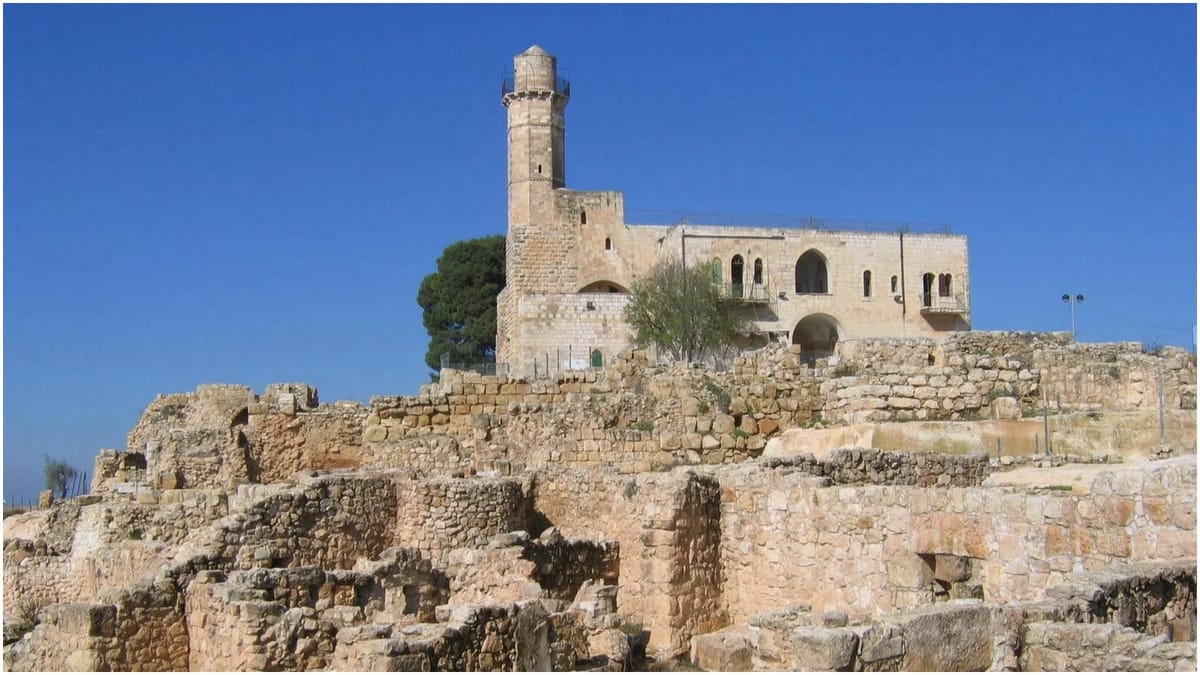
Tomb of the Prophet Samuel

For hundreds of years, Jewish tradition has identified the tomb of the Prophet Samuel at a site called Nevi Samuel (Arabic for "Prophet Samuel"), located on a hilltop north of Jerusalem.

One of the most prominent early witnesses to this tradition was Rabbi Ovadia of Bartenura, who immigrated to the Land of Israel in 1488 and served as chief rabbi of Jerusalem.

In his letters, he wrote: "The grave of our master Samuel of Ramah is still today in Jewish hands, and people come to prostrate themselves there every year on the 28th of Iyar, the day of his death, from all the surrounding areas, and they light large torches upon it".

Yet not all rabbinic authorities accepted this identification. Two distinguished 19th-century Torah scholars who conducted systematic surveys of the Land of Israel, Rabbi Yosef Schwartz, author of "Tvu'ot HaAretz", and Rabbi Yitzchak Goldhar, author of "Admat Kodesh", both questioned whether Samuel was actually buried at Nevi Samuel.

The debate recently resurfaced when a Hasidic publication printed an article strongly defending the Nevi Samuel identification. According to reports, the article was prompted by a dispute between two Hasidic leaders, one of whom had publicly stated he would not visit the site on Samuel's yahrzeit because he "smelled impurity" there , meaning he doubted the tomb's authenticity, similar to how the Baba Sali refused to enter certain sites he believed were Muslim shrines rather than authentic Jewish holy places.

The article accused anyone questioning the Nevi Samuel location of being influenced by biblical criticism rather than authentic Jewish tradition. But now, a newly publicized letter from an 18th-century Hasidic master adds a surprising dimension to the debate.

Ready for more?

Rabbi Yosef Schwartz (1805–1865) was born in a town between Bohemia and Bavaria and studied at the advanced yeshiva in Würzburg.

He immigrated to Jerusalem in 1833 and spent decades systematically exploring the entire Land of Israel. His groundbreaking work "Tvu'ot HaAretz" was translated into English and German, and the rabbinical court of the ultra-Orthodox Edah HaChareidis community relies on his halachic research to this day, even when it conflicts with the Chazon Ish. He died during an epidemic in Jerusalem and was buried on the Mount of Olives.

Rabbi Yitzchak Goldhar (1847–1925) was born in Slutsk, Russia, and immigrated to Israel in 1895, settling in Rosh Pina. He worked as a surveyor in the Galilee for Baron Rothschild while spending twenty years traveling throughout the Land of Israel to identify locations mentioned in the Bible, Talmud, and Midrash. His book "Admat Kodesh" received approbations from all the leading rabbis of the Land of Israel, including the Ridbaz, Rabbi Yosef Chaim Sonnenfeld, Rabbi Avraham Yitzchak Kook, and the Maharil Diskin. He was buried on the Mount of Olives.

Both these Torah scholars, who studied Scripture intensively, questioned the identification of Nevi Samuel as the Prophet Samuel's burial place.
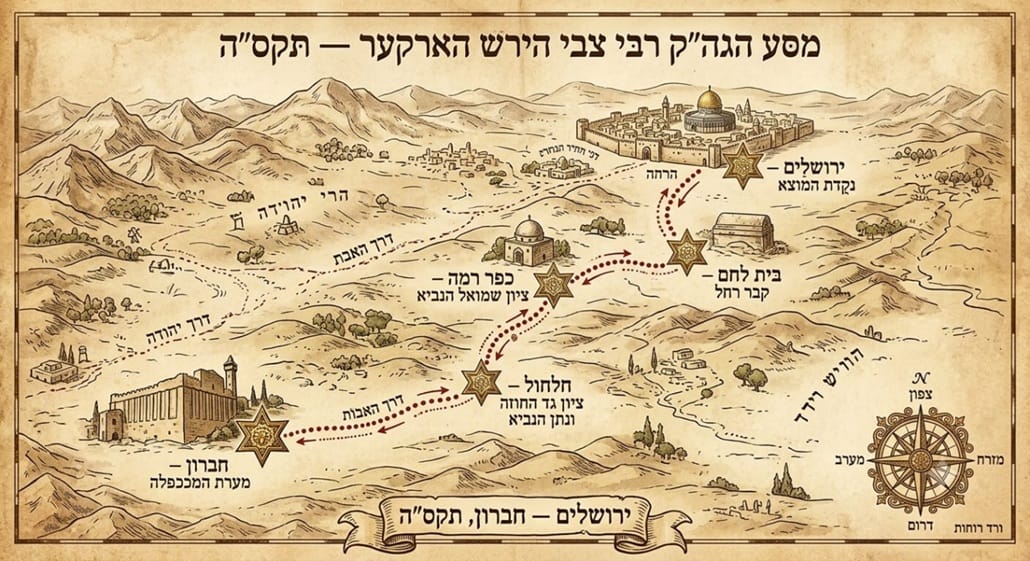
An Old Map Of Jerusalem-Hebron Road
An Old Map Of Jerusalem-Hebron Road (AI Illustration)

Rabbi Tzvi Hirsh Harker was among the leaders of the Hasidic community, disciples of the Baal Shem Tov , who immigrated with great self-sacrifice to Tiberias at the end of the 18th century.

His greatness and holiness were legendary. The Baal Shem Tov's grandson, Rabbi Baruch of Mezhibuzh, testified about him: "These Jews illuminate the Garden of Eden for us on the holy Sabbath".

The Rebbe of Lakhovich mentioned him in the same breath as the Ohev Yisrael of Apta. And Rabbi Ze'ev Wolf of Tcherni Ostraha testified that on the Sabbath he merited a clear divine spirit.

His devotion to his teacher, Rabbi Menachem Mendel of Vitebsk, was extraordinary. When Rabbi Menachem Mendel rode on horseback through the Galilee, Rabbi Tzvi would run before him barefoot, his feet bleeding.

After the death of Rabbi Avraham of Kalisk, the leader of the Hasidic community in Tiberias, in the month of Shevat 1810, Rabbi Tzvi was appointed as the third successor to lead the Hasidic movement in the Land of Israel, students of the Baal Shem Tov, together with Rabbi Meir of Bichov. The two jointly led the Hasidic community in Tiberias. Rabbi Tzvi died on the 12th of Tishrei 1828 and was buried in the Tiberias cemetery.

In the autumn of 1805, Rabbi Tzvi Hirsh Harker wrote a letter to his students in the diaspora describing his return journey to the Land of Israel. He opened: "Peace to my beloved brothers, dear as my soul, beloved to me... people of kindness who cherish the Holy Land... whose purpose is to support our holy yeshiva and who wait and hope to hear good tidings".

During his visit to Jerusalem, he ascended a high mountain and gazed at the Temple Mount: "And within the courtyard was a very tall building from which one can see the entire site of the Temple".

What he felt there defied description: "When I saw it, fear and trembling seized me, my soul nearly departed from the intensity of the bitterness, and I could not bear to stand there... even physically one can see how awesome the place is, this is none other than the house of God".

From Jerusalem, Rabbi Tzvi traveled to Hebron. On the way, and this is crucial to our discussion, he wrote: "And we came to the city of Bethlehem, and before arriving at the city, right on the road, is the burial place of our mother Rachel, as written in the Torah, and upon it a large monument is built, and we entered inside and there is the grave. And we stayed there several hours. And there tears are plentiful. And there they write the names of each person on her grave. And we traveled through several villages and there are buried holy ones of the Most High. And the monument of Samuel of Ramah was visible to us from the road in the village of 'Ramah,' but the gentiles do not allow one to go to his grave. And on the road another village, and there a splendid building and inside it the monument of Gad the Seer and Nathan the Prophet, and we went there, and they allowed us only a brief time". [The tomb of Gad the Seer and Nathan the Prophet was identified in those years, and remains so today, in the village of Halhul.]

From there he continued to Hebron: "And from there we came to the holy city of Hebron... And we went to the graves of our holy forefathers. And the size of the cave and the beauty of the building cannot be described... for the building visibly appears to be from ancient times, and there they do not allow entry except at the cave there is an opening that descends into the cave".

What emerges from this letter is that Rabbi Tzvi Harker testified matter-of-factly that the tomb of Samuel of Ramah is in the village of Ramah located south of Bethlehem, not at Nevi Samuel north of Jerusalem.

The landmarks of Rabbi Tzvi Hirsh Harker's journey from Jerusalem to Hebron in 1805 were: Jerusalem (Temple Mount) , Bethlehem (Rachel's Tomb), the village of "Ramah" (monument of Samuel of Ramah), Halhul (monument of Gad the Seer and Nathan the Prophet), Hebron (Cave of Machpelah).

Research by Professor Yoel Elitzur and Land of Israel researcher Chezki Betzalel reveals surprising findings. The earliest evidence for locating "Ramah" south of Bethlehem is the Madaba Map , A mosaic map from the sixth century CE, carved on the floor of a church in the city of Madaba, Jordan. It is the oldest surviving map of the Land of Israel. On this map, Rachel's Tomb is depicted ,strikingly similar to the classic Jewish drawing of the structure built by Moses Montefiore, and next to it is written "Ephrath". Below and to the right of this, meaning southward, is written in Greek: "Ramah. A voice is heard in Ramah".

In other words, the Madaba Map, created fifteen hundred years ago, identifies the "Ramah" of the prophet Jeremiah, "A voice is heard in Ramah, lamentation and bitter weeping, Rachel weeping for her children", with the area near Rachel's Tomb and Bethlehem. Not with Ramah north of Jerusalem, consistent with Rabbi Tzvi Harker's account.

The Italian traveler Sanuto, who toured the Land of Israel in 1321, also mentions "Ramah" near Bethlehem as a biblical site. Zev Vilnai, in the "Ariel" encyclopedia, quotes his words and identifies Jeremiah's "Ramah" with Beit Jala, A town "situated on a height overlooking Rachel's Tomb".

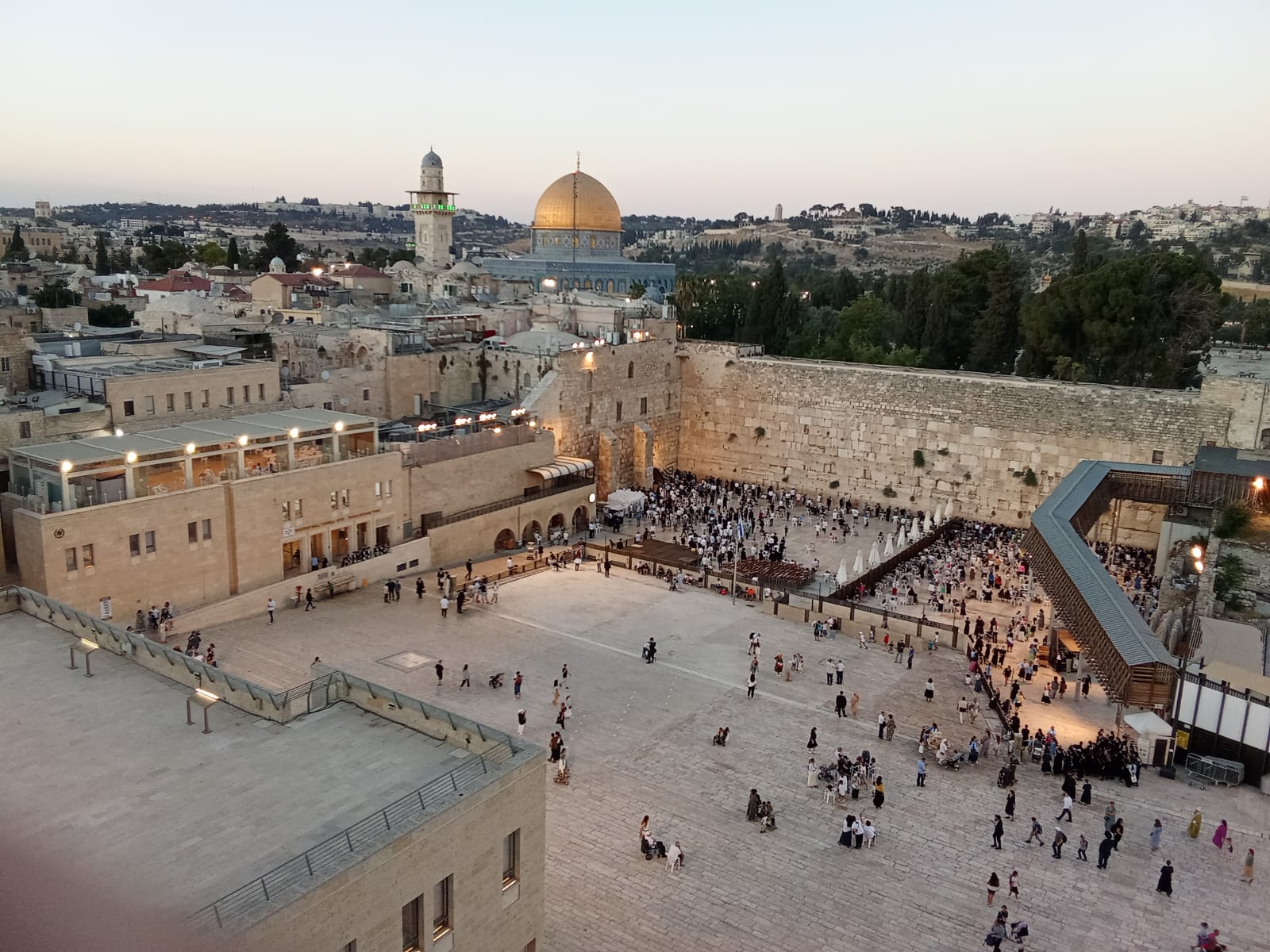
The Western Wall seen from the rooftop of Aish Hatorah, July 2025
The Western Wall seen from the rooftop of Aish Hatorah, July 2025 (Photo: Gila Isaacson)

So where is the Prophet Samuel actually buried? There are no fewer than thirteen proposed identifications. One of the most intriguing, suggested by Land of Israel researcher Chezki Betzalel, is Khirbet Shuna, north of Modiin Illit, A possibility that may be explored in future research.

"It's important to clarify", writes Professor Yoel Elitzur, "the Bible explicitly states: 'There was a man from Ramathaim-Zophim, from the hill country of Ephraim.' The hill country of Ephraim, that's the key point. Not the Ramah of Benjamin. Once we solve exactly where Ramah in the hill country of Ephraim is located, we will solve the riddle of the Prophet Samuel's burial. The moment the Bible itself writes that the man came from the hill country of Ephraim, and Nevi Samuel is not in the hill country of Ephraim but in the territory of Benjamin, the simple conclusion is: we must search for and find where this Ramah in the hill country of Ephraim is".

Land of Israel researcher Chezki Betzalel adds more emphatically that claiming Nevi Samuel is the Prophet Samuel's tomb is comparable to a traveler's tradition claiming that Joseph's Tomb is not in Shechem... and one cannot dispute the Bible under any circumstances.

Ready for more?

Join our newsletter to receive updates on new articles and exclusive content.

We respect your privacy and will never share your information.

Enjoyed this article?

Yes (24)
No (1)
Follow Us:

Unmissable content


Loading comments...

Also of Interest