Six months have passed without a single verified photograph or audio recording of Mojtaba Khamenei, raising a fundamental question for Israel: Is Iran still governed by a Supreme Leader, or has control shifted to a collective military leadership?
Khamenei's disappearance is not merely a sign of weakness. It may be the mechanism allowing the Revolutionary Guards to consolidate power while the Leader's name provides religious legitimacy to their decisions.
Key Timeline
February 28, 2026: The Israeli-American strike that killed Ali Khamenei. According to Iranian sources, his son Mojtaba was seriously injured in the face and legs during the attack.
March 8: The Assembly of Experts selected Mojtaba as Iran's third Supreme Leader. According to a Reuters investigation into his appointment process, the Revolutionary Guards applied heavy pressure on clerics and officials who opposed the selection.
April: Iranian sources told Reuters about a narrow leadership circle in which the Revolutionary Guards and the Supreme National Security Council determine much of the military and political direction.
August 10: President Masoud Pezeshkian claimed he met with Khamenei for seven hours. No photograph, video, or audio recording from the meeting was released.
August 28: Reuters reported that since his appointment, no current photograph, video, or verifiable audio recording has been published.
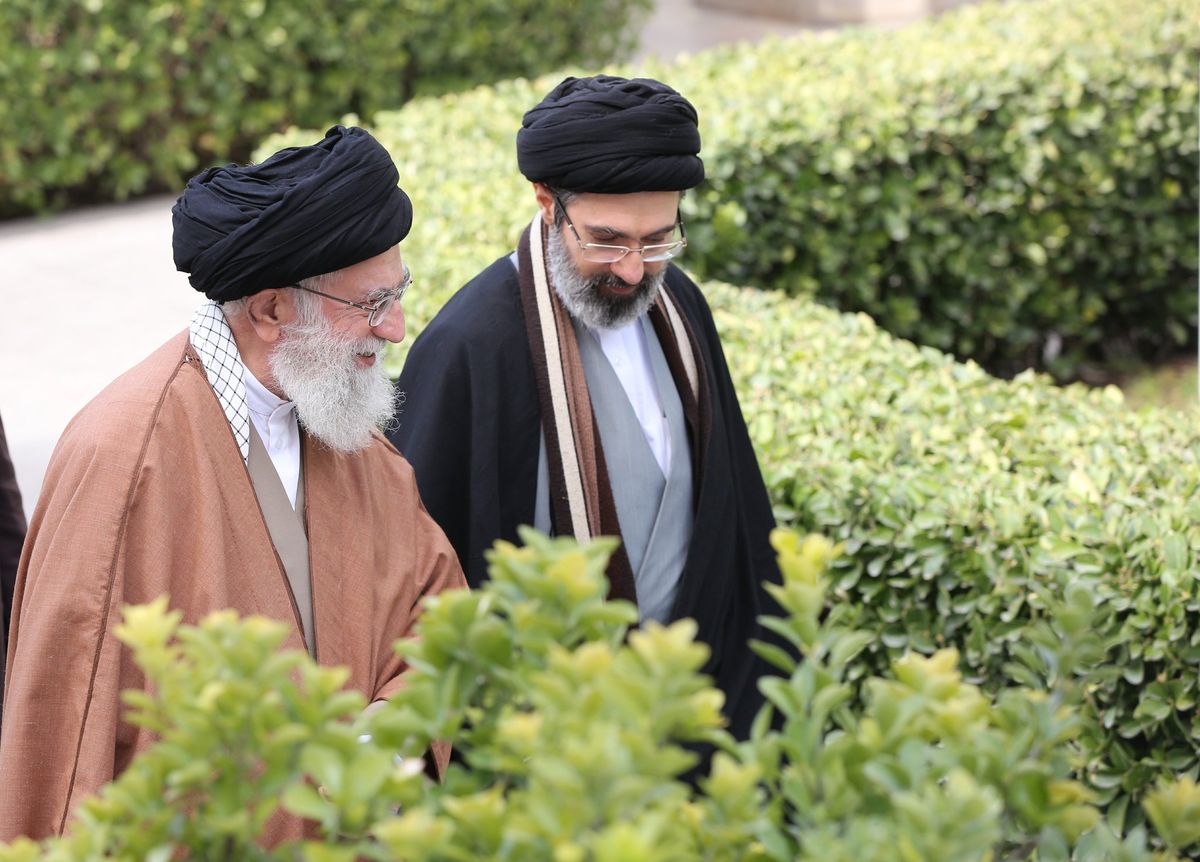
August 30: Another written statement was released in Khamenei's name. The accompanying photograph was taken from archival material shot before his appointment.
The Man Who Should Be Above All Is Nowhere to Be Seen
In Iran, the Supreme Leader is not a ceremonial president. According to Article 110 of the Islamic Republic's constitution, he determines the state's general policies, serves as commander-in-chief of the armed forces, is authorized to declare war and peace, and appoints the commander of the Revolutionary Guards and senior military officials.
Therefore, six months of absence is not a media detail. It creates a contradiction at the regime's heart: the man holding, at least on paper, the broadest authority in the state is not showing the public that he is actually exercising it.
The Iranian explanation is security-related. After Israel and the United States succeeded in reaching his father and a series of senior commanders, any new photograph could reveal location, work routine, or security perimeter. The explanation is possible and even logical. But we have no independent proof that Mojtaba is healthy, conducting meetings, or personally making final decisions. About his precise condition, we must say honestly: we do not know.
Even the seven-hour meeting Pezeshkian described is not sufficient evidence. It is a statement by a president operating within a system that does not allow him to publicly challenge the Leader's competence. Without photography, audio, or independent testimony, we can confirm the meeting was reported. We cannot confirm how it took place, how long it lasted, or what Khamenei's condition was.
The Israeli mistake would be to assume an invisible leader means a paralyzed state. In the past six months, Iran has continued operating forces, conducting diplomatic contacts, threatening energy routes, and suppressing internal opposition. The system has not collapsed. It has adapted.
Instead of a pyramid with one man at the top, a collective war leadership is forming in Tehran: Revolutionary Guards commanders, Leader's Office personnel, the Supreme National Security Council, Parliament Speaker Mohammad Bagher Ghalibaf, and President Pezeshkian. But this is not a partnership among equals. The military branches hold the power to impose policy, while the civilian tier gives that policy a governmental appearance.
Already in April, Reuters reported that according to sources involved in discussions, Khamenei's role was closer to legitimizing commanders' decisions than dictating them. However, in a later report on Iran's leadership, Iranian sources claimed he still makes the final decision on every major issue. Both versions exist. There is currently no independent way to determine which is accurate.
Who Benefits from the Fog?
The immediate answer is the Revolutionary Guards.
A strong leader can restrain commanders, mediate between rival camps, and bear responsibility for difficult decisions. An injured, hidden leader dependent on security mechanisms gives them a different kind of advantage: he exists when supreme approval needs to be presented, and is absent when someone needs to explain who ordered a failure.
The fog surrounding Mojtaba is not only the regime's problem. It is also the regime's asset. Any power center can claim it expresses the Leader's will, without the Leader himself appearing to clarify what that will is.
But this system has a price. A decision on an agreement with Washington, withdrawal from confrontation, or concession on the nuclear issue requires authority no one can deny. As long as Khamenei does not appear, any compromise could be presented within Iran as a betrayal woven behind his back. His very absence may make it harder for Iran to end a war than to continue it.
What Israel May Fail to Understand
Disruptions do not automatically translate into regime change. Eliminating a central leader can destabilize a system, but it can also transfer power to people who do not need popularity, independent religious status, or public consent.
Israel may have weakened the institution of Supreme Leader, but simultaneously accelerated a dangerous process: transition from a theocratic republic leaning on a supreme religious authority to a security state where military men rule behind a religious stamp.
The legitimacy question also runs deeper than his public absence. Mojtaba is the son of the previous leader, and his appointment initially sparked opposition due to the appearance of dynastic succession. According to Iranian sources who spoke with Reuters, several clerics objected to his selection and the Revolutionary Guards pressured opponents.
Therefore, a public appearance by Khamenei would not necessarily resolve the crisis. It might prove he is alive, but not that he is independent, competent, or possesses authority accepted by all power centers.
Scenarios to Monitor
The most likely scenario is continued hybrid rule: Khamenei will remain the official authority, while day-to-day decisions are made by a narrow security circle.
A second scenario is a controlled appearance designed to silence rumors without exposing his full condition. The test will not be the photograph, but continuous audio and a live encounter.
A third scenario, less likely but dangerous, is confirmation of serious incapacity. In that case, a struggle could develop among the Revolutionary Guards, the religious establishment, and the Leader's Office over the identity of the next authority.
Indicators worth tracking include commander appointments, changes in the Supreme National Security Council composition, contradictory messages regarding negotiations, disappearances of senior officials, and expansion of Basij powers.
Critical Perspective
The question "Where is Mojtaba?" attracts attention, but it is still the easy question. The hard question is what is being born in Iran while he is missing.
The Islamic Republic may have lost a visible leader. That does not mean it has lost its ability to operate. It may have simply replaced one ruler with a mechanism harder to identify, harder to deter, and much harder to topple.