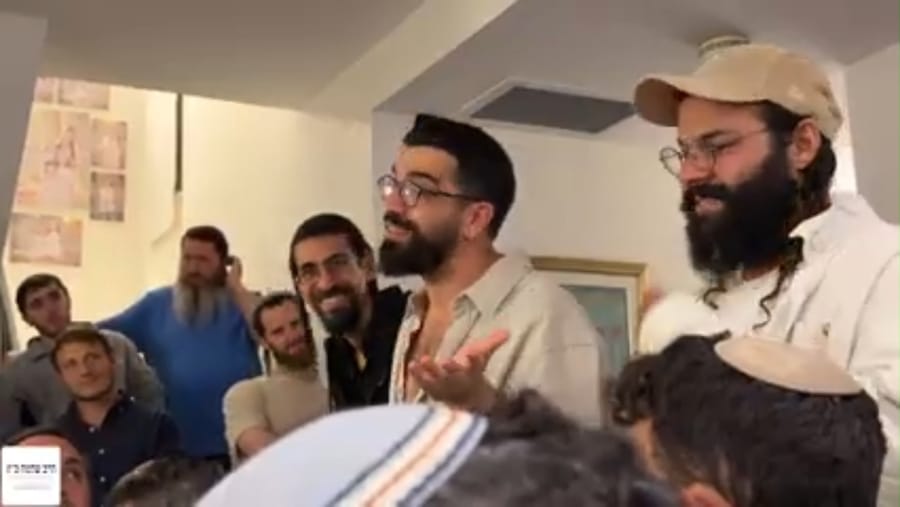
Israeli singer and songwriter Hanan Ben Ari spoke at a memorial event marking the yahrzeit of Reb Shlomo Carlebach zt"l, held at Shul Shirat David in the Judea and Samaria community of Efrat and led by the community's rabbi and musician, Rabbi Shlomo Katz.
During the evening, Ben Ari shared personal reflections on his relationship with faith and Judaism, and told the story behind his song "Hashiveinu."
"I think for many years I didn't dare say the word Hashem in my performances and in my songs, I didn't dare say the word Hashem, I called Him Elokim," Ben Ari said. "Elokim is very Israeli, it's something that's acceptable and people can contain it, it's in nature, people can contain nature."
He continued, describing a process he went through in his personal life: "I too was searching in my adult life for something natural, because maybe I was a bit disappointed by the Torah world that tried to speak high, high, above nature, and it didn't even reach nature itself. A Torah that tried to be higher than the simplest things didn't even reach the simple things."
Because of those feelings, he said, he wanted to return to the basic foundations of faith: "I said, let's go back, let's return to G-d before we climb to the heights of heights. Derech Eretz preceded Torah, that's how I felt within myself."
Ben Ari then revealed that for a long period he was afraid to release the song "Hashiveinu," fearing the reaction of Israeli audiences.
"Even when I tried to mediate it outward, I said I won't say Hashem, Hashem is a threatening word, it's religious coercion," he said. "This melody circulated among us for a very long time before it came out. People kept asking me, why don't you release the song? Here in Efrat they sang it for two years, and I kept feeling it wasn't the right time yet."
The fear, he said, was that Israeli audiences would be put off by the song's direct faith message: "I felt people would be frightened by it, that the Israeli public would be frightened by it. I felt it wasn't the time."
But then came the events of October 7, which he said brought a profound change: "Something about October 7, I think, broke the heart so deeply, when the heart is broken, it also opens. It opens to listen to deeper things."