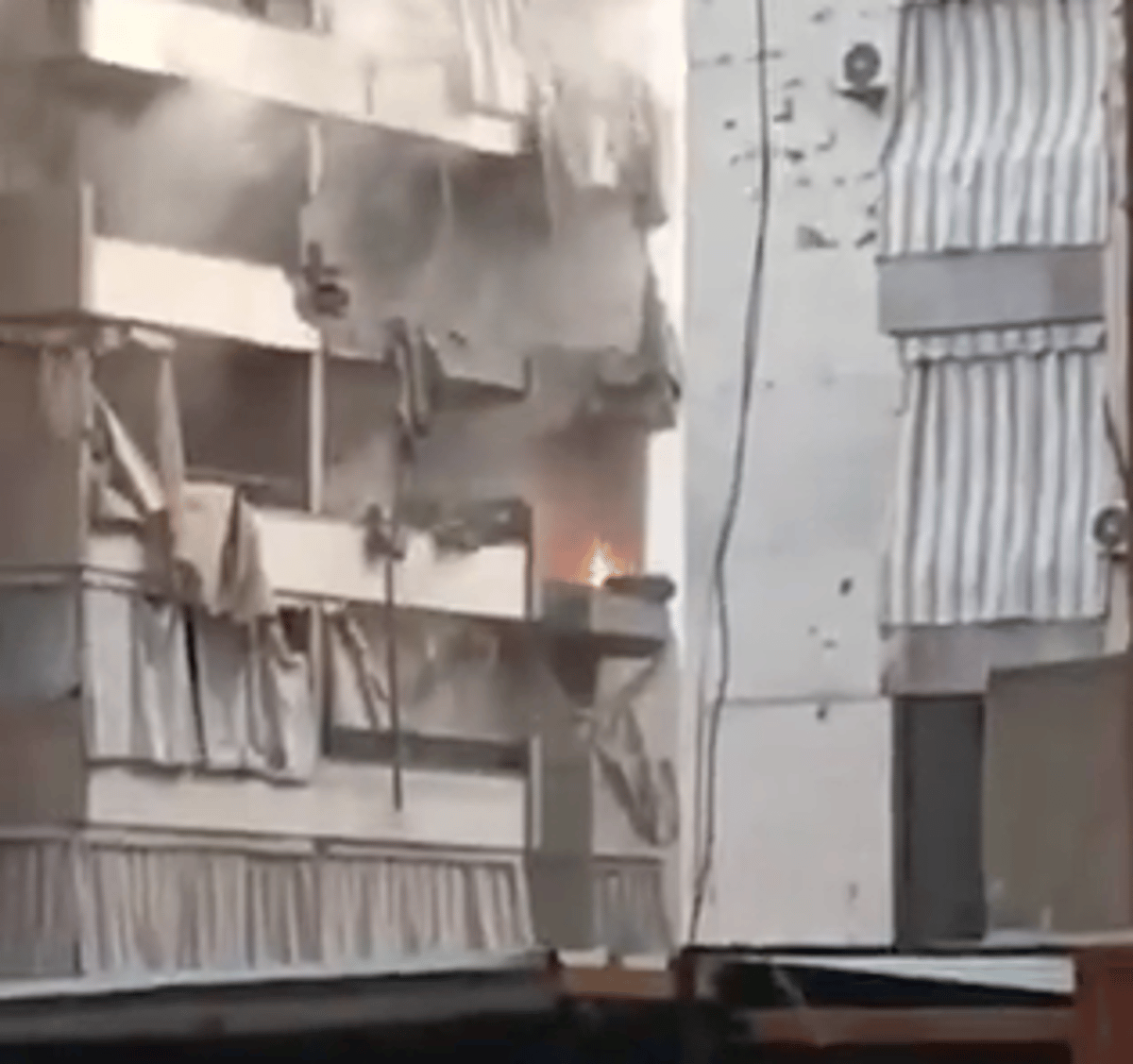
Senior Hezbollah figure Mahmoud Qamati, speaking from the scene of today’s Israeli strike, delivered a sharply worded statement to local media, accusing Israel of repeatedly violating agreements and dismissing the role of U.S. mediation.
“The Israeli enemy once again proves that agreements don’t work with it, and that America is no longer in a position that allows it to mediate,” Qamati said. “Any attempt at negotiations with the Israeli enemy, direct or indirect, is a waste of time. There is an agreement and Resolution 1701, and Israel violates them all, with America standing by its side.”
Qamati declared that Hezbollah sees “only one option, the path of resistance.”
He called for full coordination with the Lebanese state, insisting that all parties must act to enforce existing agreements.
“The enemy must understand that this lawlessness will not continue,” he added. “We are all responsible, the Lebanese state, the people, the resistance, and the army, and we all want to put an end to this recklessness.”
Lebanese President Aoun also condemned the strikes, while the Iranian Embassy in Beirut stated: “The scope of the strikes is expanding and now includes Dahieh in Beirut. The Israeli entity does not hesitate to threaten the security of the Lebanese people. However, these intimidating attacks will not weaken the determination of the righteous nor diminish their unwavering resolve to confront injustice.”
Hezbollah Analyst: Israeli Strike Marks Major Escalation, Future Moves Unclear
Hezbollah-affiliated commentator Khalil Nasrallah said that today’s Israeli strike represents a new and significant escalation, targeting a highly senior figure within Hezbollah. “There’s no doubt this reshuffles the cards considerably,” he said, adding that Israel has “taken the escalation to a new level,” though its ultimate objectives remain unclear.
Nasrallah noted that Israel is not seeking negotiations with Lebanon, increasing pressure on both the Lebanese state and Hezbollah. “Israel wants to impose its conditions, define the rules, and create a security zone under its control north of the Litani River,” he said.
Regarding Hezbollah’s position, Nasrallah said the organization cannot be entirely surprised by the strike, which targeted a “high-value figure without red lines.” He compared the attack to previous targeted eliminations, including that of Fouad Shukr, but noted that the current strike carries far greater weight.
“The Lebanese state must understand that Israel is rejecting diplomatic pathways,” Nasrallah said, pointing to U.S. awareness and tacit support of some of Israel’s actions. He described Hezbollah’s situation as complex and difficult, with the organization yet to announce an official stance or confirm the elimination of the targeted figure.
“The coming days could mark the opening of combat operations,” Nasrallah warned.
The critical decision now rests with Hezbollah: whether to absorb the blow and continue cautiously, or respond in a way that could spark significant escalation.