Interview: Knesset Member on Security Policy

MK Halevi: Border Failures Stem From Flaws

Member of Knesset Foreign Affairs and Defense Committee argues that Israel's security establishment has adopted a civilian rather than sovereign approach to borders, contributing to attacks like the one that killed Border Police officer Barel Shmueli

Amit Halevi

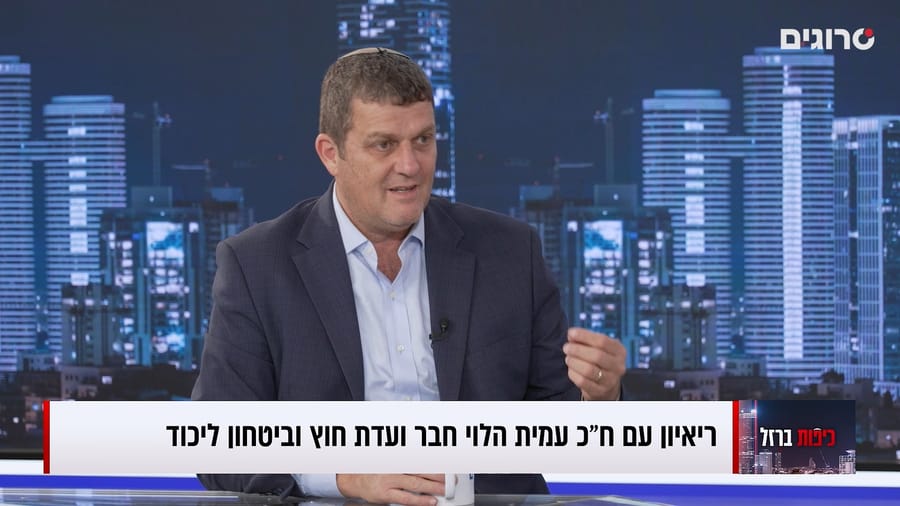
In an extensive interview with Srugim's "Iron Kippot" program, Knesset Member Amit Halevi of the Likud party outlined his legislative agenda and political philosophy, focusing on what he describes as fundamental conceptual failures in Israel's security and legal establishments.

Halevi, regarded as among the more ideologically driven members of Israel's parliament, spoke with interviewer Netanel Izak about issues ranging from education in East Jerusalem to how the Israel Defense Forces conceptualizes national borders. The lawmaker serves on the Knesset's Foreign Affairs and Defense Committee, giving him oversight of security policy.

Addressing internal party democracy ahead of Likud's primary elections, Halevi defended his party's system against criticism that it breeds political deal-making. When Izak asked why Likud's democracy appears to involve more political maneuvering than other parties with large memberships drawn from specific sectors, Halevi responded that "Likud in this sense is truly a microcosm of Israeli society and includes everyone."

He acknowledged that while he personally opposes reserved slots on the party list, the fundamental democratic principle remains intact: "Most of the list is chosen by 140,000 registered members... we want active citizens, which is why we haven't given up on primaries." This broad-based selection process, he argued, represents a democratic model even with its imperfections.

On border security, Halevi described legislation he championed following the death of Border Police officer Barel Hadaria Shmueli, who was shot at point-blank range by a terrorist who approached the Gaza border fence. The lawmaker argued that investigative reports identified tactical failures but missed the core problem: how a terrorist could reach the border at all.

"What does the concept of a border mean in the sovereign State of Israel?" Halevi asked. He contended that Israel's leadership has treated borders as something that can be approached freely, rather than as a sovereign national boundary. "For them, the border isn't perceived as a sovereign, national, political matter," he said, describing the prevailing attitude as either utopian ("John Lennon without borders and without flags") or simply negligent.

Halevi recounted how security establishment representatives and legal advisors opposed his legislation defining border infiltration as a security offense rather than merely a civil or economic matter. "They said the border is a civilian thing, it belongs to the police," he explained, describing what he calls the "civilianization" of concepts that should be treated as matters of sovereignty. The law ultimately passed, establishing that border penetration constitutes an attack on sovereignty requiring Shin Bet (Israel's internal security service) involvement.


Turning to education, Halevi criticized Israel's approach to curriculum and teachers in East Jerusalem, arguing the state focuses on "mowing the grass" rather than uprooting what he sees as the infrastructure of terrorism.

"We invest in the tip of the Kalashnikov," he said, using the rifle as a metaphor for focusing on immediate threats. "The most important infrastructure is education. What is the driving force? The rifle doesn't shoot by itself—there's a person, and the person has religious identity, ideological identity."

Halevi referenced legislation he introduced to prevent teachers who support terrorism from working in schools, noting that the legal system created numerous obstacles to this law over a two-year period. His argument centers on addressing what he views as ideological incitement at its source rather than only responding to violence after it occurs.

Halevi extended his criticism to IDF leadership over recent years, particularly targeting the "small and smart army" concept associated with former Chief of Staff Gadi Eisenkot, which he said rested on the assumption that "the era of wars is over."

"You look at the IDF's most classified documents... you see missiles and terrorists... but no enemy," Halevi said. "They don't see an enemy. They don't see the state, they don't see the culture... and that's how you get to October 7th."

The interview concluded with Halevi's perspective on Prime Minister Benjamin Netanyahu's ongoing corruption trial, which he characterized as an attempt to undermine democracy through the judicial system. "They're not boycotting Netanyahu," he argued. "They're boycotting the millions who see him as a candidate for the national camp... Netanyahu's trial is a window through which an ordinary citizen can understand what's happening behind the scenes... the goal was to bring down right-wing rule."

Halevi called on the public to participate in both the Likud primaries and general elections to ensure what he termed "a fighting team" that would continue deep reform of Israel's systems. "This train has left the station," he said. "It's a long process, but we're on the way."

Ready for more?

Join our newsletter to receive updates on new articles and exclusive content.

We respect your privacy and will never share your information.

Enjoyed this article?

Yes (45)
No (2)
Follow Us:

Unmissable content


Loading comments...

Also of Interest