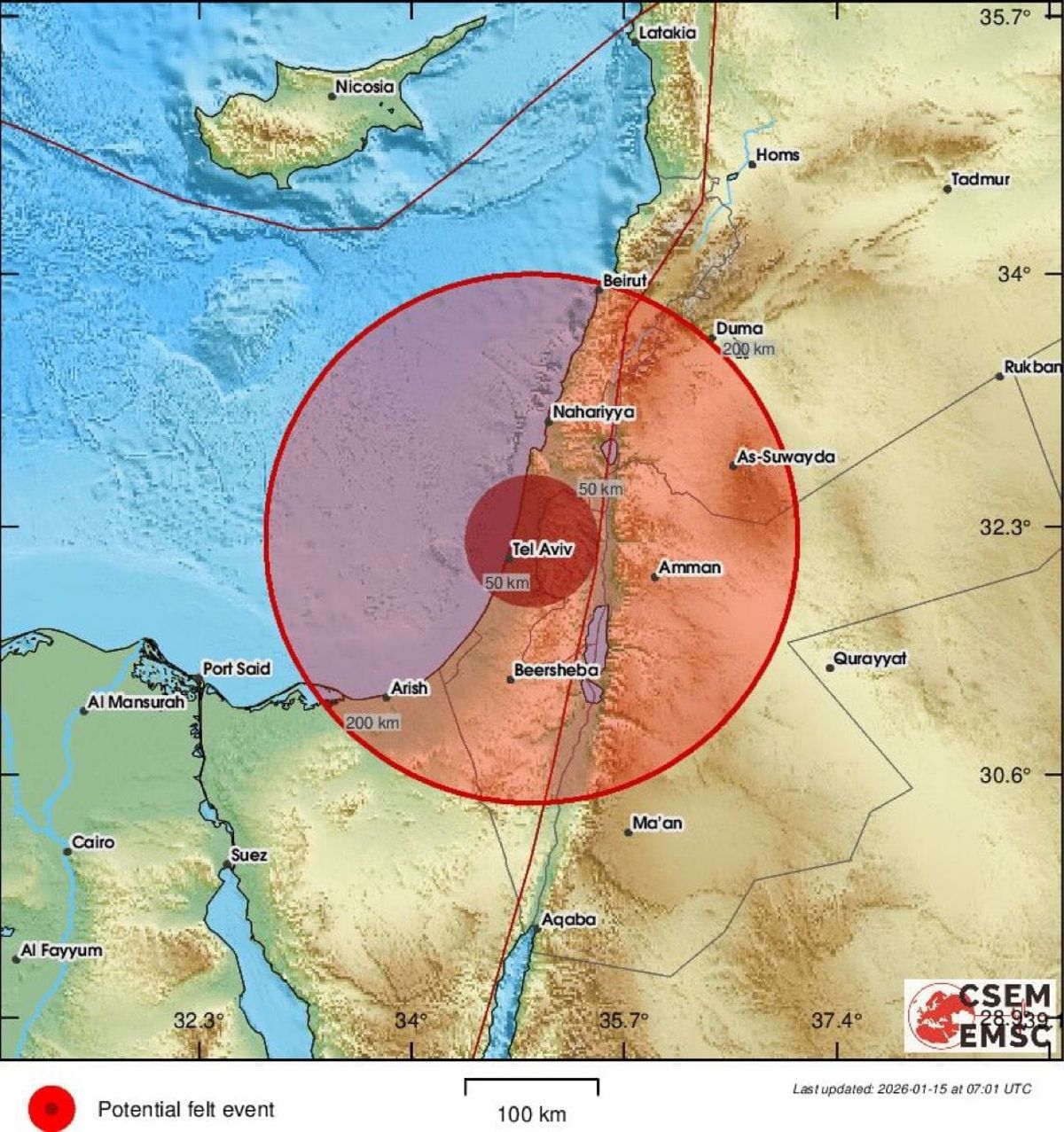
A magnitude 4.2 earthquake struck southern Israel on Thursday morning, rattling communities around the Dead Sea and the Negev desert, and sending tremors that were felt as far north as Jerusalem and central regions of the country.
The quake, which occurred at precisely 9 a.m. local time, triggered dozens of alerts and warnings, prompting widespread alarm among residents who initially mistook the shaking for the onset of hostilities with Iran. The epicenter was identified near the city of Dimona, according to the Geological Survey of Israel, but its effects extended broadly.
Alerts from the Home Front Command sounded in a string of locations, including Arad, Mitzpe Shalem, Kfar HaNokdim, and hotel areas along the Dead Sea.
Warnings also activated in Ein Bokek, Neve Zohar, Masada, Ein Gedi hot springs, the Jordan Valley, Al Fura'a, and the Rotem industrial zone.Despite the intensity of the tremors, officials from Magen David Adom, Israel's national emergency medical service, and local authorities reported no injuries or significant property damage as of late morning.
The event, however, evoked a morning of anxiety, with residents describing moments of confusion and fear.“We were sure it was missiles being launched from Iran,” one southern resident told local media, recounting the simultaneous outdoor sirens, phone alerts, and ground shaking that lasted more than a second. “We heard the alarms outside and on the phone, and felt the earth trembling.”
In a statement, the Israel Police said officers were deployed to scan roads and buildings in the Dead Sea area to identify any hazards and ensure public safety. “At this stage, no reports of casualties have been received,” the police added, urging the public to follow updates through official media channels and report any road or structural dangers to the emergency hotline at 100.
The quake comes amid heightened regional tensions, including recent U.S. warnings of potential military action against Iran over its crackdown on domestic protests. It also follows lighter tremors felt in Israel last November, originating from areas near Cyprus and Crete.The Ministry of Energy and Infrastructure, along with the Geological Survey, encouraged anyone who felt the quake to report it on the institute's website, noting that such data is essential for improving risk assessments and preparedness for future seismic events.
Professional authorities emphasized that the public should adhere strictly to guidelines from the Home Front Command, the body authorized to direct civilians and local governments in real time. These instructions are disseminated across various media platforms.Officials warned of potential aftershocks accompanying the strong quake, which could lead to secondary hazards such as fires, flooding, or leaks of hazardous materials. Caution is advised around damaged infrastructure, including electricity, water, and gas systems. Additionally, severe disruptions to communications could occur if facilities are affected, complicating access to real-time information and updates.
A document from the Knesset Research and Information Center highlights a concerning vulnerability: Approximately 80,000 residential buildings of three stories or more, constructed before 1980, do not meet current earthquake-resistance standards.
In a message to residents, the Magilot Regional Council reiterated emergency guidelines:
- For those indoors during a quake or alert, exit to an open area if possible. If not, enter a protected space like a bomb shelter (Mamad) with doors and windows open, or head to the stairwell and descend to exit the building.
- As a last resort, sit in an interior corner or under heavy furniture, protecting the head with hands.
- For those outdoors, remain in open spaces away from buildings, trees, power lines, or falling objects.
- Drivers should pull over to the side of the road and wait inside the vehicle until the shaking stops, avoiding bridges or overpasses.
- After a quake, do not return to damaged structures or approach the seashore, the council advised.