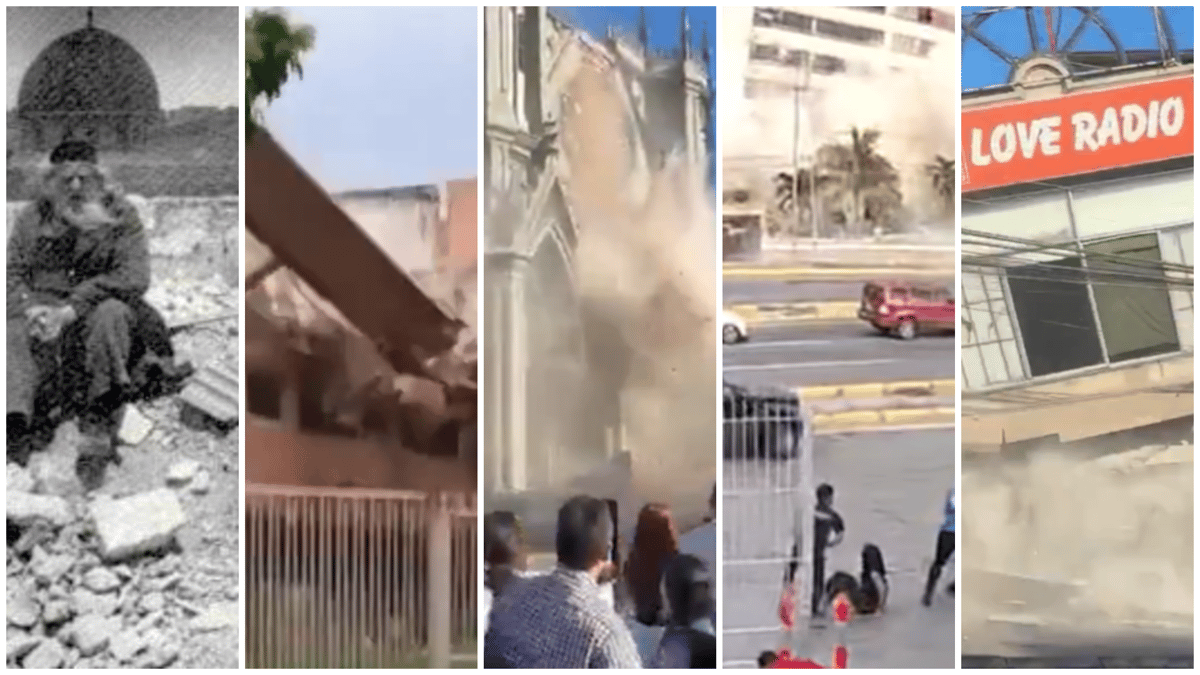
The year 2026 has become a nightmare of seismic disasters across the globe. A magnitude 7.8 earthquake in the Philippines claimed numerous lives. Venezuela suffered two deadly quakes within a single minute that devastated entire regions and killed more than 6,000 people. Most recently, a magnitude 7.4 earthquake struck Colombia, leaving thousands injured and missing beneath the rubble of collapsed cities. The string of catastrophes has left the world reeling and raised urgent questions about where the next major quake might strike.
Seismic Risk
Israel May Be Overdue for Major Earthquake
As devastating earthquakes strike Colombia and Venezuela in 2026, geologists note that Israel experiences destructive quakes roughly once a century—and the last one hit in 1927

As the earth continues to tremble worldwide, attention has turned anxiously toward the Dead Sea basin and the Dead Sea Transform fault—also known as the Syrian-African Rift. For Israelis, the question is increasingly not whether a major earthquake will strike, but when. Seismologists say Israel experiences a destructive earthquake approximately once every century. While experts emphasize this is a statistical average rather than a precise prediction, the historical record provides sobering evidence of the pattern's consistency.

The most recent major earthquake to hit the region occurred on July 11, 1927. Centered north of the Dead Sea, that quake killed hundreds and caused extensive damage in Tiberias, Jerusalem, and Jericho. The historical pattern extends back centuries: roughly 90 years before that, in 1837, an earthquake destroyed Safed and Tiberias, killing thousands. Earlier still, devastating quakes struck in 1759, 1202, and 749 CE—the latter known as the "earthquake of the seventh year"—destroying entire cities including Beit She'an and Sussita.

Nearly a century has now passed since the 1927 disaster, making the threat feel more immediate than ever. Israel's seismic vulnerability stems from its location along the boundary between the African and Arabian tectonic plates.
Experts warn that a major earthquake today could produce catastrophic consequences. Government estimates suggest approximately 7,000 fatalities are possible, depending on the epicenter's location and timing—with a winter nighttime quake considered the most dangerous scenario. The primary concern involves buildings constructed during the 1960s and 1970s that do not meet modern safety standards and could collapse on their occupants. An earthquake centered near the Dead Sea would severely impact central and northern Israel, while a quake in the Hula Valley would primarily affect Galilee residents.
Warning signs have already appeared: in 2023, tremors from Turkey's deadly earthquake were clearly felt in Israel, and recent years have seen several smaller quakes in the north and near the Gulf of Eilat. The experts' message is unequivocal: the current seismic quiet is temporary, and history teaches that the earth always responds.