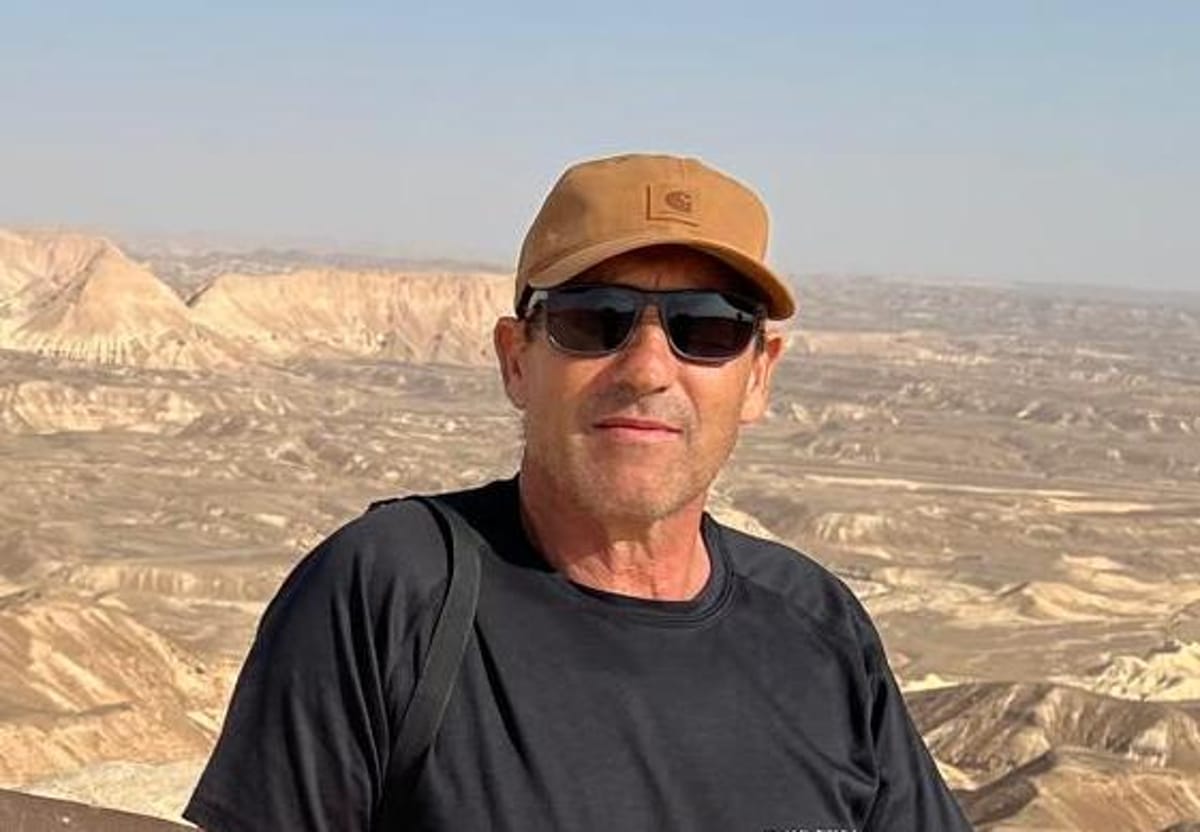
The October 7th attacks prompted many Israelis to reconsider the country's national security doctrine, but for Moshe Har-Zion, a social activist and co-founder of the "Artzi" movement, the answer has been clear since childhood, learned from his father, the legendary IDF fighter and scout Meir Har-Zion.
In a pointed opinion piece, Har-Zion highlighted the connection between land cultivation, settlement, and security, calling for bold and determined leadership. At the center of his argument, he positioned reserve Colonel Ofer Winter as a figure who embodies the Zionist approach he believes Israel needs today.
"There was no gap between belief and willingness to fight"
He reflected on his upbringing and the values instilled by his parents:
"I was privileged to grow up in a home where our right to this land was absolutely clear. My father, Meir Har-Zion, like many others of his generation, saw Greater Israel as the home of the Jewish people, and he fought and struggled for it ... Not only on the battlefield, he settled the land, and together with my mother Ruti, established an agricultural farm in Kochav HaYarden called 'Ahuzat Shoshana,' named after his sister Shoshana who was murdered in the Judean Desert in 1954. My father worked the land, connected to his roots, and thereby realized Zionism in practice. For him, there was no gap between believing in our right to the land and being willing to do what was necessary to hold onto it. That worldview accompanies me as well."
This philosophy led him to establish the "Artzi" movement, which aims to strengthen agriculture, rural areas, and field towns through a comprehensive strategic vision. "When we founded the 'Artzi' movement to strengthen agriculture, field towns, and rural areas, we placedr the connection between settlement, agriculture, Zionism, and sovereignty at the center. For me, these aren't separate domains. This is how you hold onto the land. It was true at the beginning of Zionism and it's true today. This hold applies to all parts of the land, the Negev, the Galilee, Judea and Samaria, the northern border, the western Negev, the Arava, and the Golan."
Agriculture and security: a question of national independence
Har-Zion emphasized that physical presence on the land and the ability to grow food aren't merely economic or rural matters, but existential components of Israel's security and independence: "Settlement brings security, and agriculture connects us to the soil and the land, allowing us to maintain control over territory and ensure our survival. Our ability to provide our own food is no different from our ability to defend ourselves with our own forces. Ultimately, it's a question of independence. In times of crisis, can we provide for our basic needs ourselves, or are we dependent on other nations?"
According to him, the principle of labor and guardianship is a fundamental commandment that has accompanied the Jewish people throughout history: "In my view, this is the meaning of Zionism today: not just knowing we have a right to the land, but ensuring and realizing that right, guarding it and working its soil. 'To work it and guard it,' just like the divine commandment in the Book of Genesis."