
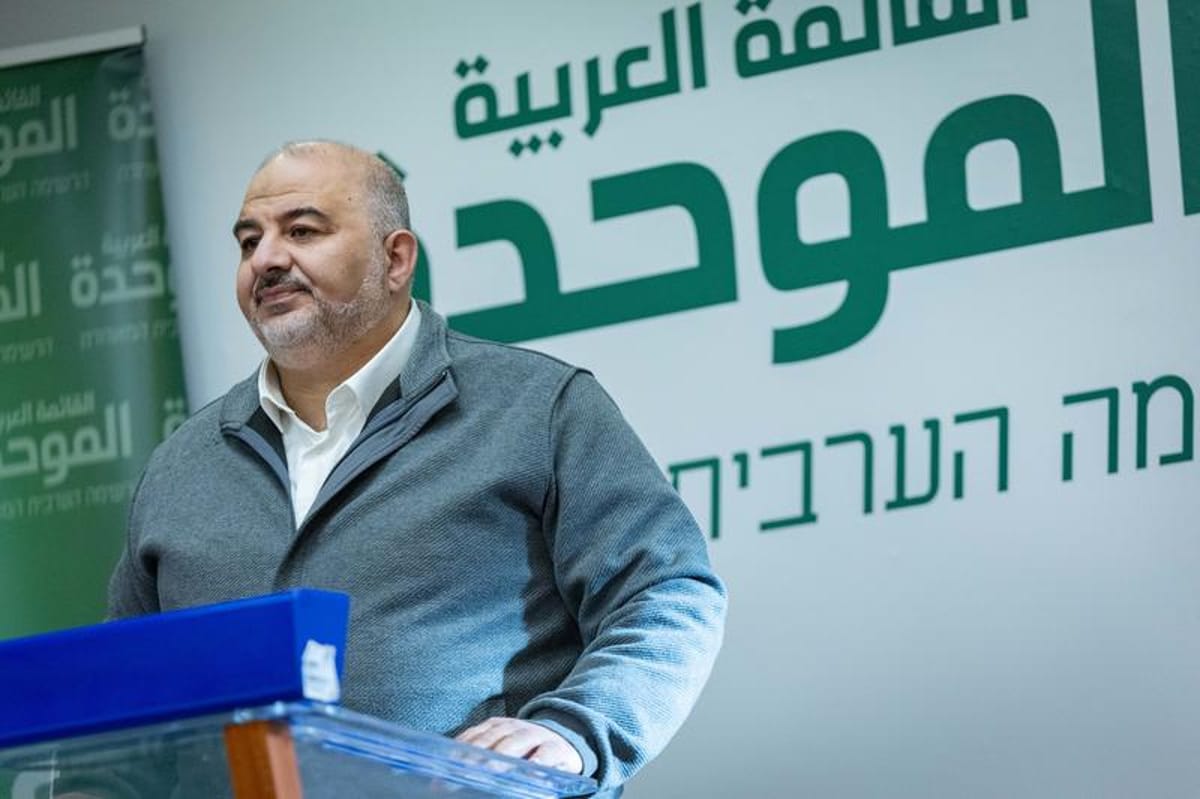
With Israel already edging toward the next election cycle, Mansour Abbas signaled a potentially significant political shift on Monday, announcing plans to fundamentally reshape Ra'am into a party that actively seeks Jewish as well as Arab members and candidates.
Speaking in a radio interview, Abbas framed the move as a “new path” for Ra’am ahead of the coming elections. He said the party intends to establish independent party institutions and redefine itself as a civic, civil party open to “every citizen of the State of Israel, Jewish and Arab alike,” including on its future Knesset slate. The goal, he argued, is to move beyond sectoral Arab politics and present Ra’am as a broader political home focused on citizenship, governance, and shared civil interests.
Abbas did not name specific Jewish politicians who might join, but said there are current Jewish members of Knesset he respects and would welcome, should they choose to run under Ra’am’s banner. The statement marks the clearest signal yet that Ra’am is exploring a structural and ideological expansion rather than simply tactical cooperation with Jewish parties, as it did during the Bennett-Lapid government.
The announcement comes against the backdrop of Abbas’s sharp criticism of the current government, which he accused of abandoning Arab citizens and allowing organized crime to flourish unchecked. He said there is currently no dialogue with Likud about future cooperation, arguing that the party has aligned itself with what he described as extremist sectoral partners at the expense of Arab communities.
While much of the interview focused on public security and Arab-Jewish relations, the electoral implications were unmistakable. By positioning Ra’am as a binational civic party rather than a narrowly Arab one, Abbas appears to be betting that exhaustion with identity-based politics has created space, however narrow, for a different kind of list. It is a gamble that challenges long-standing assumptions in Israeli politics about voter loyalty, party branding, and the limits of cross-communal appeal.
Whether Jewish voters will actually join or support Ra’am remains an open question, and Abbas offered no timeline for implementing the changes. Still, the declaration itself is notable. In a system built on blocs and sectors, Abbas is openly testing whether a party rooted in Arab society can survive, or even grow, by redefining itself as something closer to an all-Israeli civic movement.
For now, it is a statement of intent rather than a finished political product. But as election season approaches, it is a signal that Ra’am is not planning to sit still or play only defense. Abbas is clearly preparing his party for a very different kind of campaign, one that could either broaden its reach or leave it stranded between electorates that do not quite trust it yet.