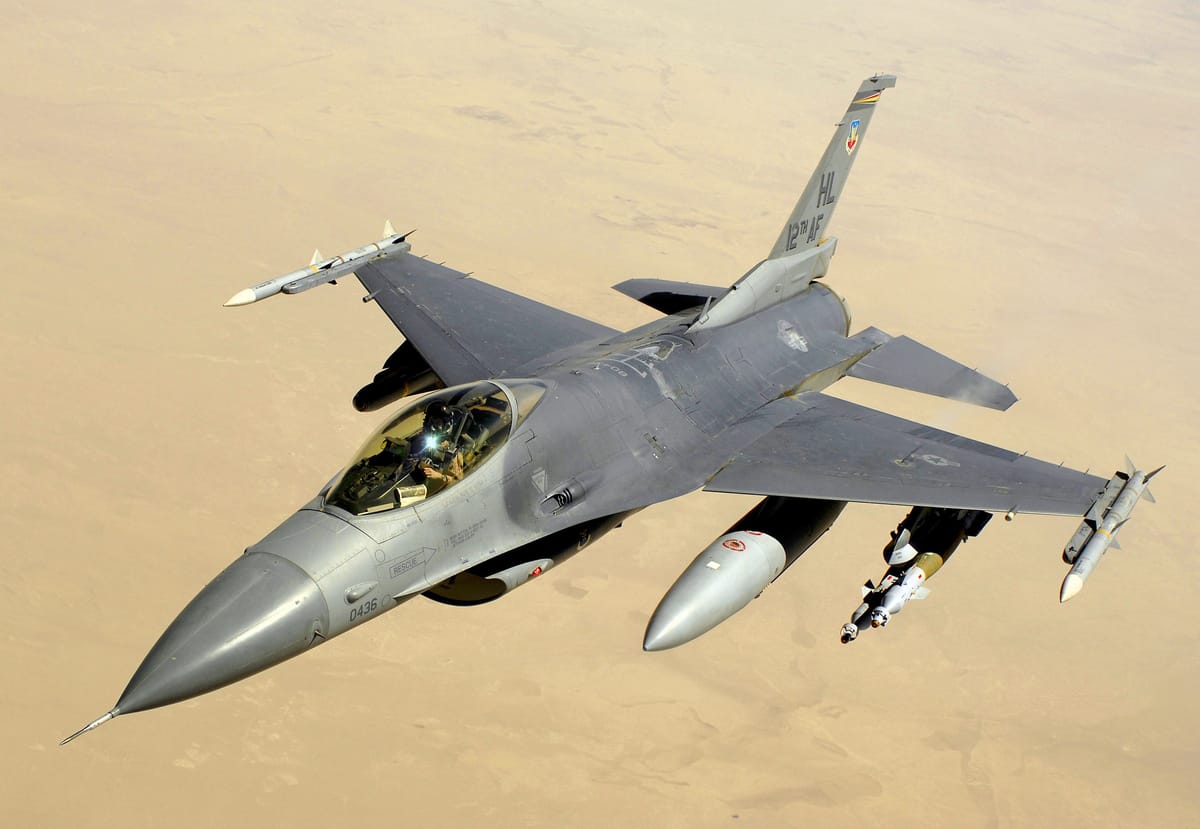
The United States Air Force has recently redeployed a group of F-16CJ "Wild Weasel" fighter jets to the Middle East as part of a broader buildup of U.S. military forces in the region, amid escalating tensions with Iran.
This movement was tracked via open-source flight data recently, involving up to 36 F-16s in total, with reports indicating that approximately 24 of them are the specialized F-16CJ variants optimized for Suppression of Enemy Air Defenses (SEAD) missions.
These aircraft originated from units like the South Carolina Air National Guard's 169th Fighter Wing at McEntire Joint National Guard Base, as well as the 480th Fighter Squadron at Spangdahlem Air Base in Germany and possibly Aviano Air Base in Italy, with tanker support facilitating the transatlantic and Mediterranean crossings.
The F-16CJ, an upgraded Block 50/52 version of the F-16 Fighting Falcon, is specifically tailored for "Wild Weasel" operations, a term dating back to the Vietnam War era for aircraft designed to bait, locate, and destroy enemy surface-to-air missile (SAM) sites and radar systems.
Unlike standard multi-role F-16s, these jets feature the AN/ASQ-213 HARM Targeting System (HTS) pod, which passively detects and geolocates hostile radar emissions to guide AGM-88 High-Speed Anti-Radiation Missiles (HARM) or the advanced AGM-88E Advanced Anti-Radiation Guided Missiles (AARGM).
They can also carry AN/ALQ-184 electronic warfare pods for jamming multiple radar threats simultaneously, enhancing both offensive strikes and self-protection in high-threat environments.
A standout feature in this deployment is the integration of the "Angry Kitten" electronic warfare pods, spotted under the fuselages of these F-16CJs.
Angry Kitten is a relatively new, adaptive electronic countermeasures system developed by Georgia Tech Research Institute, originally starting as a low-cost research project using commercial off-the-shelf components.
It employs machine learning to analyze and respond to enemy radar signals in real-time, allowing it to jam, deceive, or spoof threats dynamically, essentially making the aircraft harder to detect or target while disrupting adversary air defenses.
This could mark its first potential combat deployment, providing fourth-generation fighters like the F-16 with enhanced survivability against sophisticated integrated air defense systems (IADS), such as those operated by Iran or its proxies.
This redeployment fits into a larger U.S. posture, including other assets like F-22 Raptors for air superiority and U-2 "Dragon Lady" spy planes for high-altitude reconnaissance, signaling readiness for potential operations that might require penetrating defended airspace.
The Pentagon hasn't officially commented on the exact destinations or mission details, but the emphasis on SEAD-capable aircraft demonstrates preparations for scenarios involving robust enemy defenses.