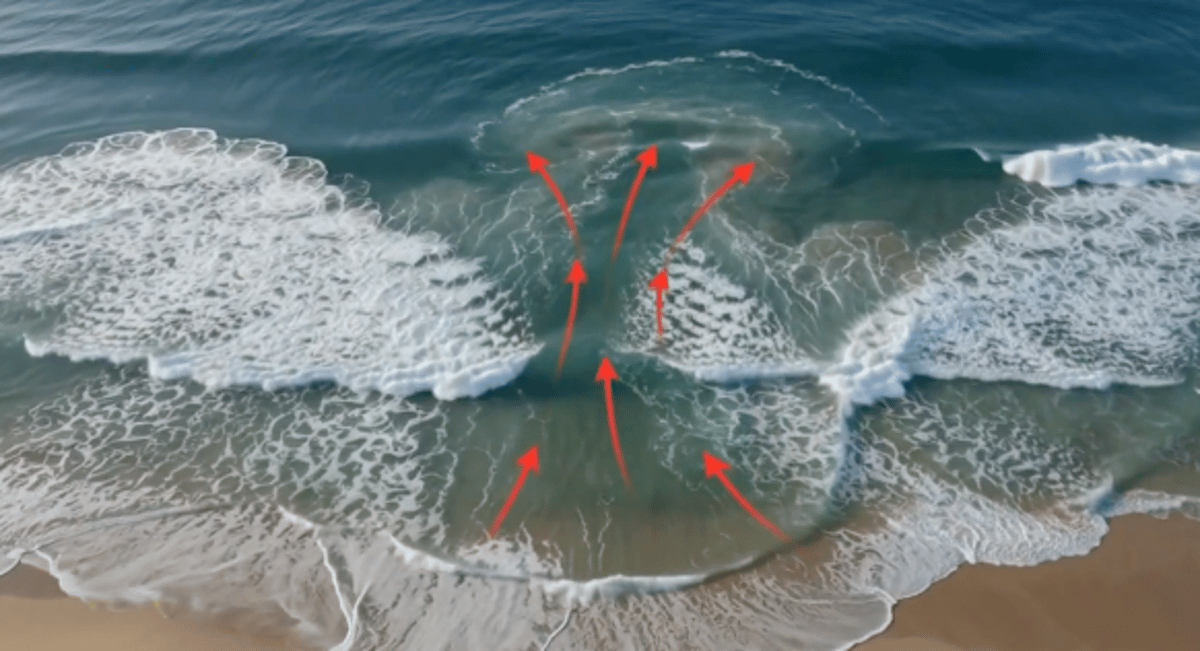
The Physics of the Trap
A rip current forms through basic hydrology. Waves breaking onto shore push enormous volumes of water landward. That water must return to the sea to maintain equilibrium. It finds the path of least resistance, a narrow channel in the seafloor where the water funnels seaward with extreme velocity.
Dror Giles, commander of ZAKA dive unit operations, described the mechanics in stark terms: "The eye plays tricks on people. Swimmers see a calm area between the crashing waves on either side and think, 'That's where I should go in.' But that calm area is exactly where the water from the waves is returning to the sea, and there's a huge current there. You walk in, reach knee depth, take one more step, and suddenly there's no ground beneath you. There's a current, and you're being pulled into pressure."
Kobi, deputy commander of the Navy Police for the central district, added: "The most lethal factor of all is a physical phenomenon hidden from sight called a rip current. The water in that area looks calm, quiet, clean, no waves. That's exactly what's deceptive. People walk in, lose their footing on the bottom, and get pulled into deep water within seconds."
The Psychological Illusion
The rip current's deadliest feature is not its power but its deception. Unlike rough surf or visible turbulence that warns swimmers away, a rip current presents itself as the safest zone, a smooth channel between crashing waves, inviting entry precisely where danger is greatest.
"The beach didn't look dangerous," Rabbi Shpiegel said. "There were over 100 people on the beach. It didn't look stormy, and I didn't see any warning sign telling people not to enter. People were standing around them and nothing happened to them, only to them did something happen. The rescue workers told us that if a lifeguard had been there in the moment, he would have recognized the pull. The incident is called 'reverse pull,' a sudden rip current that's hard to notice with an untrained eye."
The Survival Rules
Once caught in a rip current, survival depends on three counterintuitive actions that override panic-driven instinct.
The fatal mistake is fighting the current by swimming directly back to shore. Within one to two minutes, a swimmer exhausts all energy, muscles lock, panic sets in, and drowning follows. The rip current does not pull swimmers down—only seaward. Within tens of meters beyond the wave-breaking line, the current's power diminishes and disappears entirely.
Rule One: Do not fight the current. Remain calm, float on your back, spread arms and legs wide, preserve breath and energy. The current will not drag you to Cyprus; it will simply carry you seaward as the current weakens.
Rule Two: Once breathing steadies and the current's force diminishes, swim perpendicular to shore, to the right or left, parallel to the beach. Because rip currents are typically narrow (10 to 20 meters across), a short swim perpendicular to the flow line extracts a swimmer entirely from the channel's reach. From there, ordinary breaking waves push the swimmer safely back to shore.
Rule Three: Learn to swim before entering the sea. Do not enter a vehicle without knowing how to drive. Do not enter the sea without basic swimming competency.
Prevention: The Only Certainty
The safest approach is never entering a rip current at all. Lifeguards at staffed beaches identify rip current locations each morning, mark safe swimming zones with flags and buoys, and position themselves only in protected areas where water recirculates safely to shore.
As Dror Giles stated to young swimmers and yeshiva students: "Young men, the signs saying 'Swimming Forbidden' and 'Do Not Enter Without a Lifeguard' were written in blood. Do not ignore them. From our experience, God helps those who help themselves. If you are alone and there is no lifeguard, no one will rescue you. Protect yourselves, so we do not have work to do this summer."