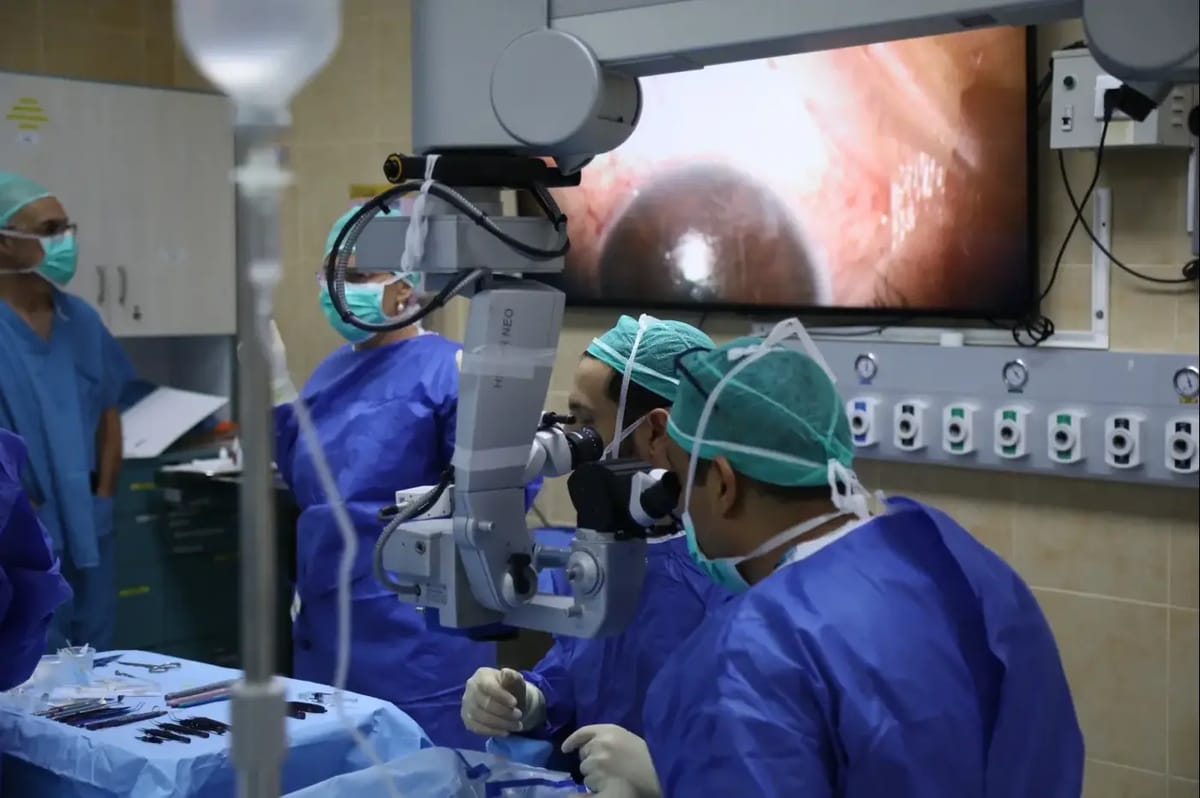
In a historic global medical achievement, Israeli scientists have successfully restored vision in a woman using the world’s first fully 3D-printed biological cornea. This pioneering procedure, performed at Rambam Medical Center, offers a radical new solution to corneal blindness and the severe worldwide shortage of donor organs.
The patient, a woman in her 70s who was blind in one eye due to corneal disease, underwent the groundbreaking surgery and has experienced significantly improved vision.
The End of Donor Shortages?
The procedure is part of an initial Phase I clinical trial involving the implantation of approximately 10 additional corneas in the coming months, with the medical team reporting highly encouraging preliminary results.
The biological cornea was manufactured by the Israeli company Precise Bio using an innovative 3D bioprinting method. Instead of relying on a scarce donor cornea, the patient received a lab-engineered, custom-printed implant derived from living human cells and a biological material designed to closely mimic natural corneal tissue.
This technological breakthrough may fundamentally reshape ophthalmology by providing a reliable and scalable alternative to traditional donor-based transplants. Globally, it is estimated that for every 100 people requiring a corneal transplant, only one donor cornea is available. Precise Bio's technology promises to drastically change this ratio, with the capacity to produce hundreds of biological implants from a single donor cornea.
Advantages of Bioprinted Corneas
The printed biological cornea offers several key advantages over traditional transplants:
- High Cell Density: Leading to significant optical improvement.
- Infection Prevention: Eliminating the risk associated with human donor implants.
- Mass and Safe Production: Enabling large-scale manufacturing under rigorous GMP standards.
- Ease of Implantation: Featuring precise mechanical properties obtained during the production process, making surgery simpler.
Experts Hail a "Historic Moment"
Professor Michael Mimouni, Director of the Corneal Unit at Rambam Medical Center and the surgeon who performed the operation, hailed the achievement: "For the first time, we have seen a cornea created in a lab from living human cells restore sight to a person. This is a moment that cannot be forgotten, a glimpse into a future where no one will live in darkness due to a lack of donations."
Arieh Batt, CEO and Co-Founder of Precise Bio, emphasized the global significance: "This is a global milestone. It is a genuine solution to the severe worldwide shortage of corneal donations. This is the first time a fully lab-created tissue has been successfully implanted in a human being."
Precise Bio, operating out of Israel and the U.S., is developing a 3D bioprinting platform for manufacturing various human tissues and organs. The printed cornea is its first product to reach the clinical stage, signaling the beginning of an era where printed organs, not donations, will provide the answer for millions of patients worldwide.