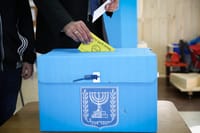
Israelis go to the polls on October 27 to elect the 26th Knesset, the first election since 1988 to follow a full four-year term. Thirty-eight lists registered, but only about a dozen are polling above the 3.25 percent threshold, and none of the blocs currently has the 61 seats needed to form a government. The race at the top is close.
For many voters the choice starts with a single issue, so that is where this guide starts too.
If one issue decides your vote
If Haredi enlistment matters most to you, Yisrael Beytenu takes the hardest line, demanding service from everyone with no exemptions and no state money for those who refuse.
B'Yachad and the Democrats also back a universal draft. Yashar wants every citizen to serve, in the army or in a civilian framework, an approach the Jerusalem Post describes as more lenient.
Hendel's Reservists have made a draft law their condition for joining any government.
Shas and United Torah Judaism, by contrast, are running to protect yeshiva students.
Within the Haredi community itself, HaTzibur HaHaredi backs service for those who are not in full-time Torah study, though it is polling far below the threshold.
If you want a state commission of inquiry into October 7, four parties promise one: Yashar, B'Yachad, Yisrael Beytenu and the Democrats. Likud prefers a commission appointed by the government.
If sovereignty and settlement in Judea and Samaria come first, Religious Zionism and Otzma Yehudit are the clearest addresses, and Yisrael Beytenu also supports expanding settlement.
On the judicial system, Likud and Religious Zionism want to continue the overhaul, while Yashar, B'Yachad and the Democrats oppose it. Yashar and B'Yachad both promise a written constitution with term limits for the prime minister.
Voters who want civil marriage and public transport on Shabbat will find those positions at Yisrael Beytenu, B'Yachad, Yashar and the Democrats. Those who want to preserve the current religious arrangements will find them at Shas and UTJ.
On the cost of living, B'Yachad has made market competition a centerpiece of its platform, the Reservists list includes the economist Yaron Zelekha, and Shas campaigns on welfare for low-income families.
And if the question is simply whether Benjamin Netanyahu stays, Likud, Otzma Yehudit and Religious Zionism want him to, while the opposition parties are campaigning to replace him. Benny Gantz is the one centrist who has not ruled him out.
The parties, one by one
Likud. Netanyahu is offering voters experience, security and what he calls a broad national government, along with a promise to continue judicial and media reform. He brings the advantages of incumbency, a loyal base and the strongest party machine in the country. Against that stand his ongoing criminal trial, the ICC warrant, and polls that put Likud about ten seats below the 32 it holds today.
Yashar. Eisenkot, the former IDF chief of staff who lost a son in the war, promises an immediate state inquiry, a cap on reserve duty of 50 days a year, and a constitution. His number two is former Shin Bet chief Yoram Cohen. His military record and his lead over Netanyahu in head-to-head polls are his main assets. His party, though, is only a year old and depends heavily on him personally, and he has yet to say clearly whether he would rely on Arab parties to govern.
B'Yachad. Naftali Bennett and Yair Lapid, two former prime ministers on one ticket, promise a constitution, universal enlistment, lower prices and a government that does not rely on Arab parties. They offer governing experience and one of the most detailed platforms in the race. Their list has nonetheless slipped from 16 seats in July to 13, and opponents point out that Bennett's 2021 government included Ra'am.
The Democrats. Yair Golan, a former deputy chief of staff, leads the merged Labor and Meretz on a platform of judicial independence, a stronger safety net and a negotiated settlement with the Palestinians. The party has more than doubled Labor's four seats in the polls. It is also the only Zionist party openly calling for Arab parties in the coalition, a position that causes friction within its own bloc.
Yisrael Beytenu. Avigdor Liberman is running a secular, hawkish campaign: defeat Hamas, Hezbollah and the Iranian regime, draft everyone, and separate religion from state. He says he is running for prime minister and can point to three decades of ministerial experience. His long feud with Netanyahu and with the Haredi parties, however, narrows the coalitions he could join.
Otzma Yehudit. National Security Minister Itamar Ben Gvir runs on law and order, the death penalty for terrorists, tougher prison conditions and a Jewish presence on the Temple Mount, with former Likud lawmaker Tally Gotliv in the second slot. His base is growing, and the party polls at nine seats. He also remains one of the most polarizing figures in the country, and several European countries have barred him from entry.
Religious Zionism and Zehut. Finance Minister Bezalel Smotrich, now running with Moshe Feiglin, promises sovereignty in Judea and Samaria and continued settlement growth, and has a concrete record to show for it. His problem is arithmetic: the list polls at about five seats, uncomfortably close to the threshold.
Shas. Aryeh Deri's party speaks for Sephardi Haredi and traditional voters, for Torah study, and for welfare aimed at poorer families. Its electorate is among the most loyal in Israel, but public anger over draft exemptions has taken a toll, and the party has fallen from 11 seats to about seven.
United Torah Judaism. Yaakov Asher now leads the list after Moshe Gafni and Uri Maklev were left off it. The party defends yeshiva exemptions and Haredi autonomy, and Asher has shown unusual flexibility, saying he has "no problem sitting with Gadi Eisenkot." The draft remains its great vulnerability, and the leadership change followed a bruising internal fight.
Amcha Yisrael. Retired brigadier general Ofer Winter leads a new right-wing list of reservists and bereaved relatives who held no post on October 7, with Yoseph Haddad as his number two. Its appeal lies in new faces with war credentials. At four seats it sits right on the threshold, and it has not said clearly whom it would back for prime minister.
The Reservists and Economic Party. Hendel's list, formed in a late merger with Zelekha and Einat Wilf, is built around a single clear demand, equal service. It crosses the threshold in some polls and misses it in others.
Ra'am. Mansour Abbas's Islamic party focuses on crime in Arab towns and wants a seat in government, and it has placed former Yesh Atid lawmaker Yoav Segalovitz on its slate as its first Jewish candidate. It could end up as kingmaker, although most Zionist parties say they will not rely on it.
The Joint List. Hadash, Ta'al and Balad, led by Yousef Jabareen, support a Palestinian state and equality for Arab citizens. The list polls at seven seats and is not expected to join any government.
HaTzibur HaHaredi (The Haredi Public). Moti Leitner, the 33-year-old deputy mayor of Beit Shemesh, launched this party in August as a challenge to Shas and United Torah Judaism from inside the Haredi world.
Leitner, who enlisted in the IDF as an adult and completed his matriculation exams after a yeshiva education without core studies, wants military or national service for Haredi men who are not learning full time, while protecting those who are. He also promises math and English in Haredi elementary schools, more employment opportunities, housing help for young families, and a dedicated Haredi framework in the army. His slate mixes Ashkenazi, Sephardi and Hasidic candidates, and he accuses the established leadership of having "forgotten what responsibility means." The party offers working Haredim a voice they have not had, but it polls at around one percent, well short of the threshold.
Blue and White. Benny Gantz calls for a broad Zionist unity government, but his party is also polling under one percent.