
Get our mobile app
Download on the App StoreGet it on Google Play

Dropped from a Hercules transport plane

US eyes massive bomb for Iran strike

The GBU-43, known as MOAB, is the largest conventional bomb in the American arsenal, but military sources say it's designed for surface targets, not fortified underground nuclear sites

Even US 'Mother of All Bombs' Can't Pierce Iranian Bunkers
Photo: US Air Force

The United States is considering the use of the "Mother of All Bombs" in a future strike on Iran, American media reported Thursday.

The weapon in question is the GBU-43, a massive air-delivered bomb designed to create a powerful blast wave and destroy targets across a wide area. Unlike bunker-buster bombs, which are engineered to penetrate layers of earth and concrete before detonating, the GBU-43 is intended primarily for striking exposed or lightly protected targets over large zones.

Its official designation is Massive Ordnance Air Blast, or MOAB. The acronym earned it the nickname "Mother of All Bombs." It was developed in the United States in 2003 as part of an effort to create an air-delivered weapon with exceptional blast power, capable of hitting large military complexes and infrastructure concentrations.

More than eight tons of explosives

The bomb contains approximately 8,500 kilograms of H6 explosive compound. Its destructive power is based on a blast that generates a significant shockwave, capable of causing widespread damage to structures and infrastructure in the impact zone.

The GBU-43 is considered the largest air-delivered bomb ever built with a satellite guidance system, according to the US Air Force Armament Museum. It was developed to replace the BLU-82, nicknamed the Daisy Cutter, which was used in Vietnam and Afghanistan.

Despite its size and weight, the bomb is not dropped from a heavy strategic bomber. It is deployed from a C-130 Hercules transport aircraft, released from the plane using a parachute extraction system.


Why it's not suitable for every target

Despite its power, the GBU-43 has a significant operational limitation: it is not designed to penetrate deep into the ground or break through thick layers of concrete to strike fortified facilities beneath the surface.

Its advantage lies in its ability to cause widespread destruction across the impact area. It is therefore better suited to targets requiring damage over a large surface zone, and less effective against well-protected installations located deep underground.

This distinction is especially significant when it comes to Iran, where parts of the nuclear program are housed in facilities built inside mountains or beneath the surface. Even if a MOAB-type bomb can cause extensive damage to above-ground facilities and infrastructure, that does not mean it is capable of destroying a fortified nuclear installation buried deep in the earth.

Against the backdrop of the possibility that the US military will use the bomb against Iranian targets, American officials cited in a CNN report expressed doubts about its suitability for certain missions. One described it as a highly effective weapon for destroying large areas, but emphasized that it was not designed to serve as a penetrating warhead.

Used in combat only once

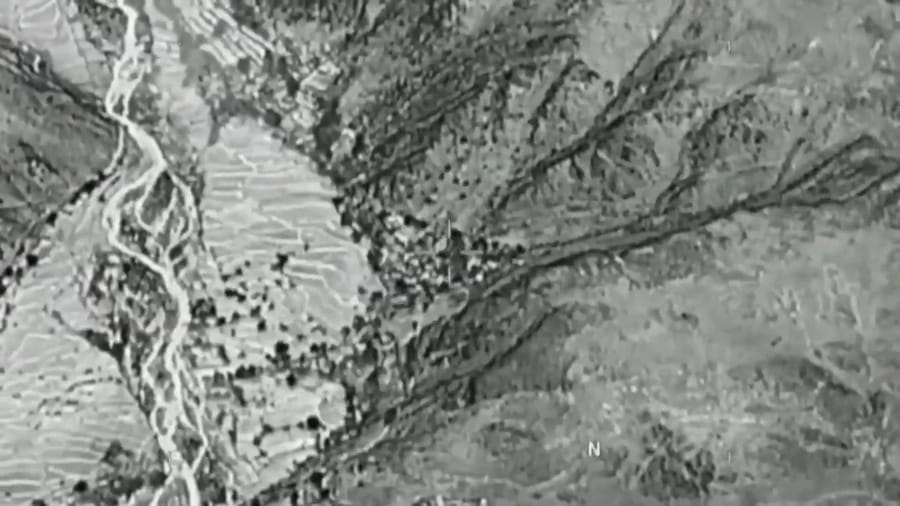
Despite its widespread publicity, the GBU-43 has been used in only one operational strike to date. On April 13, 2017, during Donald Trump's first term, the US military dropped the bomb in the Achin district of Nangarhar province in Afghanistan.

The target was a network of caves and tunnels used by the Islamic State's Khorasan branch, known as ISIS-K. According to American reports at the time, the strike destroyed a large complex used for storing weapons and explosives, and killed 36 members of the organization. US authorities said there were no civilian casualties in the strike.

The incident made the bomb one of the most prominent symbols of American military policy during the Trump era, but no further operational use has been reported since.

Despite the dramatic nickname and exceptional power, it is important to distinguish between the GBU-43 and a nuclear weapon. This is a conventional bomb, based on standard explosives and does not produce a nuclear detonation.

The damage it causes comes primarily from the blast wave and the effect of the explosion on its surroundings. It does not create the radiation or the nuclear consequences typical of a nuclear weapon detonation.

Ready for more?

Join our newsletter to receive updates on new articles and exclusive content.

We respect your privacy and will never share your information.

Enjoyed this article?

Yes
No
Follow Us:

Unmissable content


Loading comments...

Also of Interest