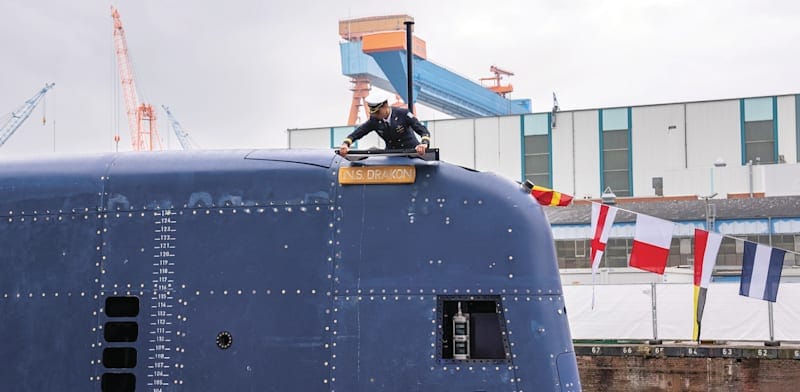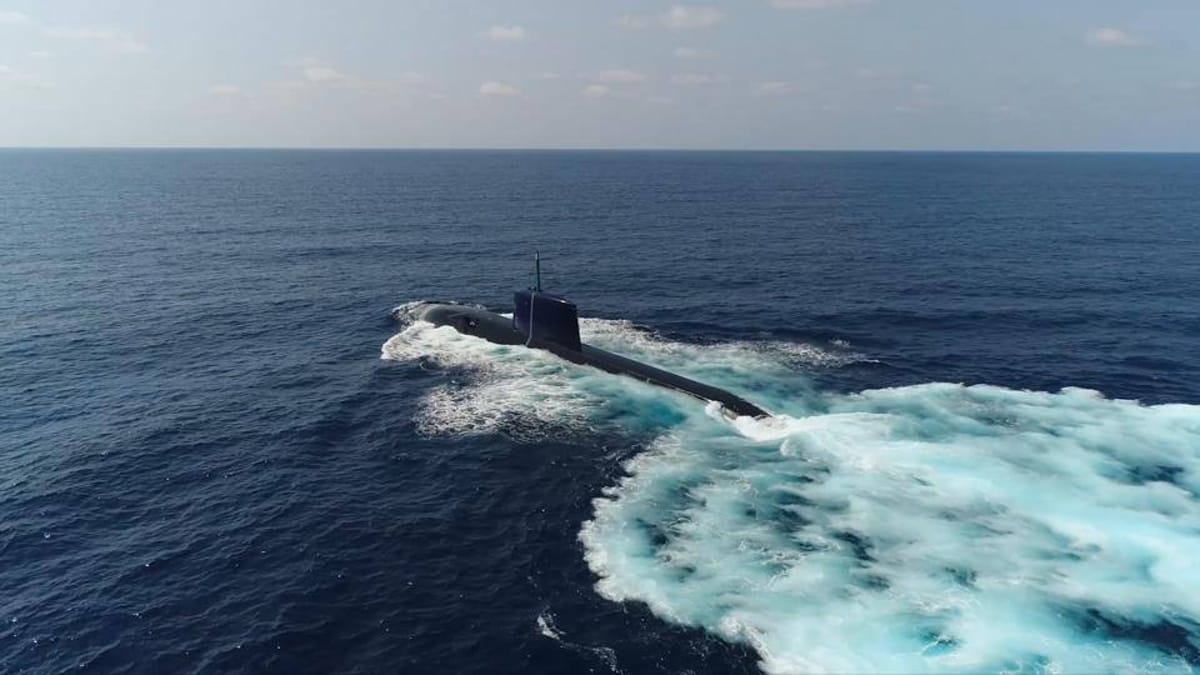
Somewhere deep in the Atlantic this week, the most secretive and expensive vessel in the history of the Israel Defense Forces began its voyage home.
INS Drakon, the new "Doomsday submarine" of the navy's Flotilla 7, left port after 14 years of construction under heavy secrecy at the ThyssenKrupp shipyards in Germany. Along the way it forced Israel's defense establishment to change its plans, spend hundreds of millions of additional euros and rethink the future of the country's strategic deterrence. The final bill ran 140 million euros over the original price. Ordinary delays were not the reason. The Drakon had become something more than one boat: a prototype for the next generation, the Dakar series.
What has drawn the most attention is the part of the submarine anyone can see. The sail, the fin that rises from the hull, is unusually long and thick, and it has become a puzzle for the naval intelligence world. Israel and Germany keep absolute silence about what is inside. So analysts and foreign media have studied the shape and drawn their own conclusions.
The leading theory is a vertical launch system. Earlier Dolphin-class submarines fired their missiles horizontally, through torpedo tubes in the bow. The Drakon's extended sail, analysts believe, was built to hold vertical launch cells, and that would change what the boat can carry: missiles far longer and heavier, with estimated ranges of thousands of kilometers. The speculation runs from advanced cruise missiles to ballistic missiles to hypersonic systems, all in service of what strategists call a second-strike capability. Many foreign publications have long attributed to Israel's submarine flotilla the ability to launch nuclear-armed missiles. According to those same reports, the Drakon's upgrade is meant to strengthen exactly that, against distant threats such as Iran.
There is a second theory. Some naval experts think the large space in the sail could serve as a bay for launching and recovering drones or tiny robotic submarines, sent to gather intelligence close to enemy shores.
Russia, for one, wanted a closer look. During the Drakon's sea trials in Europe, Moscow sent two special intelligence ships to shadow it and try to decode its secrets.
If the analysts are right, the Drakon is only the second modern submarine with air-independent propulsion designed to carry a vertical launch system, after South Korea's KSS-III series. What sets it apart is where the missiles are thought to sit: inside the giant sail and not in the hull, a layout that makes room for long, heavy weapons without eating into the crew's living space.
The hull holds its own firepower. Naval News magazine reported that the bow keeps four torpedo tubes with an unusually wide 650-millimeter diameter, used for the horizontal launch of Israeli cruise missiles, alongside standard 533-millimeter tubes. The wide tubes can also let Shayetet 13 commandos slip out covertly with full equipment for missions deep in enemy territory. The magazine's term for the combination is a "dual weapons architecture."