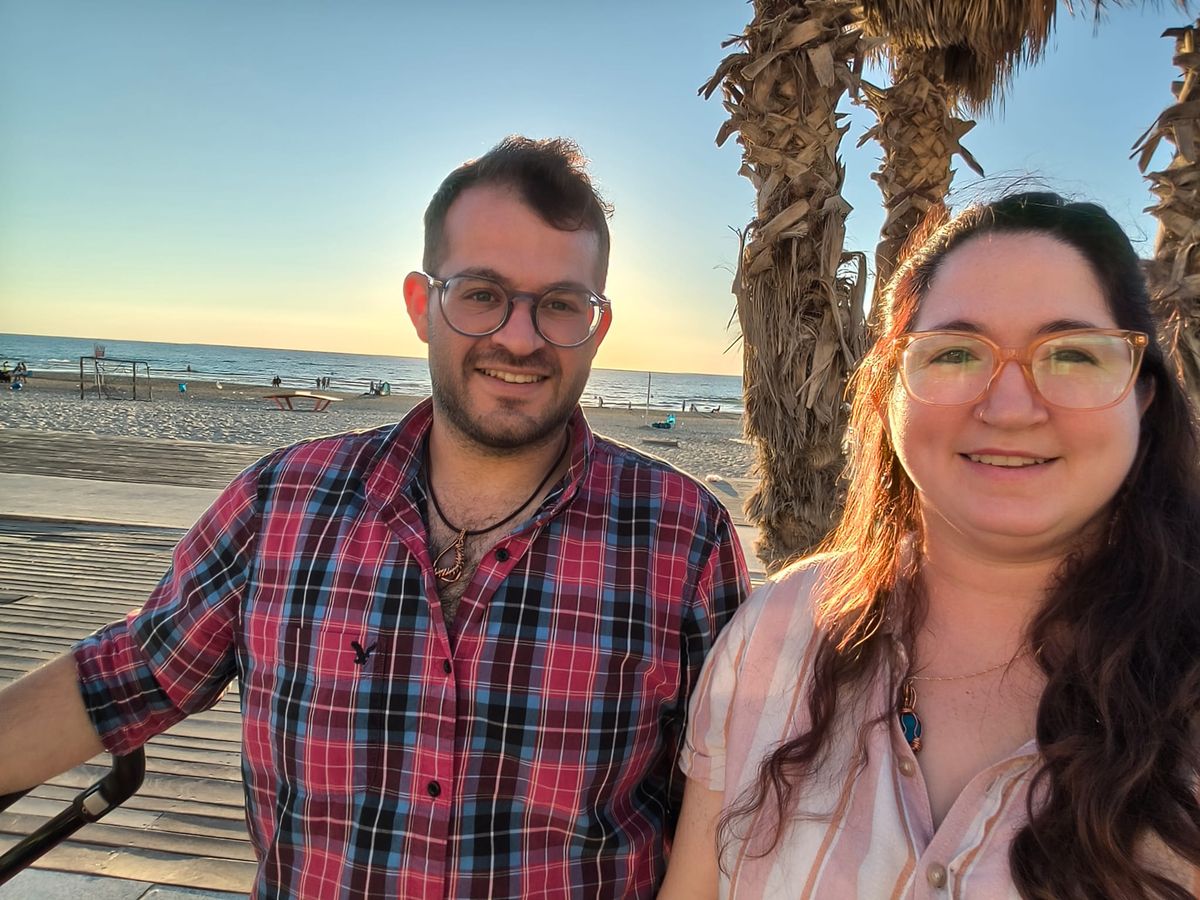
Eitan Klapish was diagnosed with PTSD after reserve duty in Swords of Iron. His diagnosis led his wife Hodaya to seek help, and she learned that the symptoms she'd lived with all her life also have a name in mental health. This is their personal, marital and family story of coping.
A journey of coping, discovery and breaking stigmas
Three years after the October 7 massacre and the outbreak of Operation Swords of Iron, Srugim's "Benafesh Chaftzah" section brings the full, painful and inspiring story of Hodaya Klapish, 29, from Mevasseret Zion.
This is not only a story about war and military trauma, but a winding and deep life journey: beginning with childhood in a charedi home and complex family struggles, through leaving the charedi world, through the upheaval of her husband's reserves duty on Simchas Torah that changed her world, and up to the dual diagnosis of Borderline Personality Disorder (BPD), Complex Post-Traumatic Stress Disorder (C-PTSD) and her husband Eitan's military PTSD.
In rare candor, Hodaya lays out the complexity of managing a home, marriage and parenting three young children in the shadow of post-trauma, faith and halachic struggles, and the daily aspiration to shatter the communal and social stigmas surrounding mental health.
The upheaval of October 7 and reserves, "Three months of crying and screaming"
When Operation Swords of Iron broke out on October 7, Hodaya and Eitan were already parents to Uri Eliyahu (now 6). Hodaya was then in early pregnancy with their second child, and the family lived in the Gush Etzion settlement of Nokdim. With the outbreak of fighting, Eitan was called up for extended reserve duty of three months.
Ready for more?
Ready for more?
For Hodaya, separation from her husband was a fall into an emotional abyss:
"Those were three months when I didn't stop screaming and crying with my little son who was three, while I was in early pregnancy with the second son. In hindsight we know to say this was severe abandonment anxiety, but at the time we didn't know how to explain what was happening to me."
Despite the outbreak of severe abandonment anxiety, the acute loneliness and lack of physical and emotional help, Hodaya discovered surprising inner strength. Looking back, she testifies that she was surprised at herself: from a woman who until then was unable to spend even one night without Eitan, she managed to hold the home, care for her toddler son and continue going to work day by day, even when her husband came only for brief and infrequent leaves.
The return from reserves and the eruption, from an incident at Gush Junction to the law course
When Eitan returned from reserve service, it quickly became clear that the person who had been before the war — happy, optimistic, active and full of vitality — had disappeared. In his place returned a tense person, impatient and suffering from severe anger attacks.
Eitan conditioned his return home on working in settlement security in Nokdim. The night shifts and Shabbos guard duty exhausted him completely and placed him under constant pressure and tension. The distress escalated and reached its peak in a series of difficult incidents:
• The chase incident at Gush Junction: During a family trip for errands in the Gush Junction area, a vehicle with Arab passengers passed them driving at high speed. Eitan, who was in a state of sharp operational alertness, approached an armed soldier who was at the scene, spoke with him, and began driving at high speed after the vehicle, while a baby sat in the back seat and Hodaya was terrified with worry.
• The anxiety attack and confiscation of the weapon: During a security shift in the Nokdim settlement, Eitan experienced a severe anxiety attack. Following the incident, his personal weapon license was taken from him, a step that became for him an additional source of frustration, helplessness and severe pressure going forward, and especially the feeling that he has no way to protect himself and his family.
The turning point in Eitan's diagnosis came from an unexpected place. Eitan, who was studying law, participated in a three-day academic course. During the course, one of the lecturers spoke about symptoms of post-trauma (PTSD). Upon hearing the words, Eitan began to shake and cry uncontrollably.
The lecturer, himself coping with post-trauma and who had known Eitan previously as a neighbor from the settlement, noticed his distress, approached him sensitively and offered to help him with a formal application to the Defense Ministry, and in fact became a significant support and assistance factor for them throughout the journey. Following his intervention, Eitan went for professional diagnosis and it was determined that he suffers from post-trauma (PTSD) due to his service in Operation Swords of Iron.
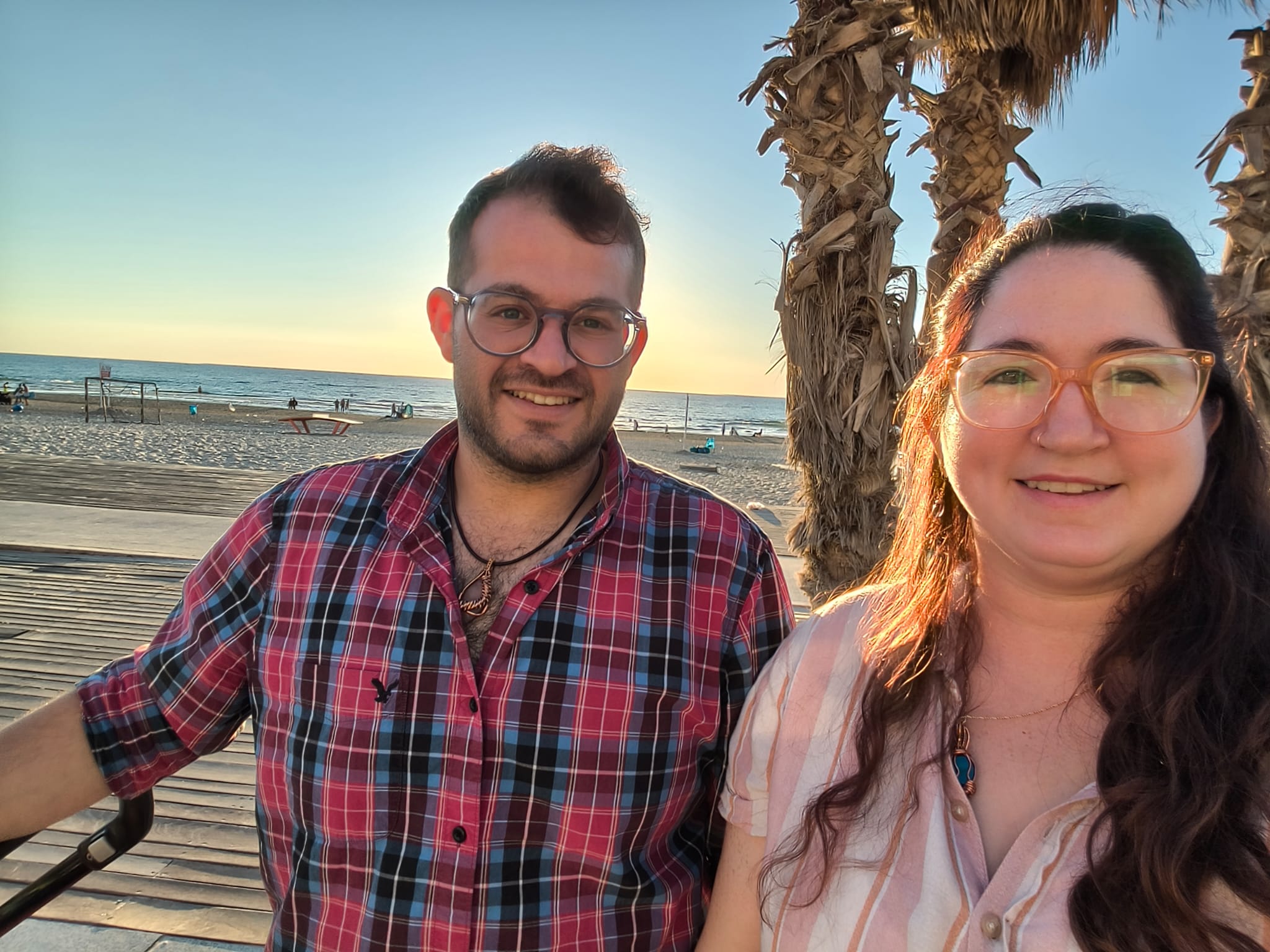
Hodaya and Eitan Klapish (Photo: Courtesy)
The dual diagnosis, "If your suffering has a name, mine does too"
Eitan's diagnosis did not remain a single event, but opened a window to understanding Hodaya's condition. While Hodaya initially thought she could continue living as she had until then ("I lived like this until now, I can manage"), Eitan immediately understood the broader picture. He turned to her and said:
"Wait, if I have all these symptoms and there's a name for it, then surely what you've had since forever, that also has a name."
Eitan did not give up, pushed Hodaya to seek diagnosis, and was by her side throughout the entire process. Following the accumulated pressure and burden and worsening of symptoms in her life, Hodaya turned for professional examination. After several months, she was given a dual diagnosis: Borderline Personality Disorder (BPD) and Complex Post-Traumatic Stress Disorder (C-PTSD).
For Hodaya, receiving the diagnosis constituted a dramatic turning point:
• Answers to life questions: The official diagnosis provided her with a response and explanation for all her days of suffering, the anxiety attacks and emotional storms that accompanied her over the years.
• Shattering the fear of the "label": "True, it's some kind of stamp, but it's not as scary as they make it out to be in the stigmas," she explains.
• Deepening the marital bond: The mutual concern and willingness to go through the diagnosis process brought them deeply closer. Hodaya shared that she felt that following his diagnosis and hers, Eitan is able to understand her deeply and what is happening inside her during attacks.
Life as a couple of mental health copers, containment and balance mechanisms
Managing a household and marriage where both spouses suffer from post-trauma and borderline personality disorder presents an extraordinary daily challenge. Nevertheless, Hodaya finds a unique point of light in their situation:
1. Containment and lack of judgment in moments of flooding
When a trigger occurs or high emotional flooding arrives (a common and complex phenomenon among BPD copers), the spouses do not panic or take things personally. They allow the other spouse to be angry, cry or unload what is on their heart at that moment, and only after calming down do they discuss the incident. The knowledge that these reactions stem from mental coping prevents mutual harm even in moments when triggers are activated unintentionally.
2. Identifying household holding capacity
In complex periods or when flooding occurs simultaneously, the spouses learned to feel each other and examine who between them is able at a given moment to "hold the house" and who is exhausted and needs to relax. The spouse whose condition allows it takes on care of the children and household tasks, while the other spouse does according to their limited ability. Hodaya emphasizes that although things sound simple in words, this is a heavy complexity they learned to navigate together.
Employment and hospitalization difficulties, "I was the only mother in the ward"
The difficulties accompanying Hodaya in daily life include anger attacks, anxiety attacks, social anxiety, abandonment anxiety, lack of emotional regulation and great difficulty functioning under pressure:
• The crisis at the workplace: Hodaya worked at a workplace where she indeed received understanding and patience from the employer, but suffered from lack of containment, contempt and severe taunting from a colleague who sat at the adjacent desk. The accumulated emotional burden alongside the hostile treatment led to a severe explosion at the workplace, after which she was forced to resign.
• Day hospitalization experience: About half a year ago, Hodaya stayed for three months in psychiatric day hospitalization. The hospitalization was accompanied by unique difficulties: Hodaya was the only mother in the ward, and was also in advanced pregnancy. She felt lonely and not understood by the other patients, and was even exposed to voices and opinions of other patients who came out against bringing children by mental health copers.
• Parental perception in the shadow of hospitalization: Hodaya clarifies that when she gave birth to her firstborn son she did not know at all about being a mental health coper. Today, even after the diagnoses, she and Eitan believe in themselves and in their duty to give their children all their heart, soul and security, while ensuring they lack nothing.
Raising children in the shadow of trauma, mediation, candor and community
Today the couple is raising three sons: Uri Eliyahu (6), Yedid Menachem (two and a half), and Itiel Pinchas (7 months).
While the two younger sons are too young to understand the complexity, with their eldest son, age 6, the couple practices openness and full age-appropriate transparency:
• About Abba: They explain to him that Abba saw difficult sights and painful events in the war, and therefore he is sadder or angrier than usual.
• About Ima: They explain to him that Ima went through a not-easy life (Hodaya is the youngest of 11 siblings, and grew up alongside a disabled brother), and therefore she is a very sensitive person.
• Separation between the difficulty and the child: The couple repeatedly emphasizes to him that the emotional storms and difficulties are not related to him at all, but stem from the parents' coping. Although people from the outside express wonder about the early mediation, Hodaya and Eitan believe this is the healthy and appropriate way.
Establishing a community for coping mothers
At the beginning of their journey after leaving the charedi world, the couple found support at the "Yotzim Leshinui" organization, where they joined a peer group and parents' community. But over time, following the military mental coping and Eitan's Zionist-fighter background (a component that usually does not exist in the charedi ex-charedi community), they felt less common language. Today Hodaya is actively working to establish a dedicated community for coping mothers, and has begun opening a dedicated WhatsApp group for mutual support.
Leaving the charedi world, charedi childhood and faith complexity
Hodaya grew up in a charedi home and later studied at "Beit Vegan" college. In that world, the subject of mental health suffered (and continues to suffer) from severe stigmas and deep lack of awareness.
When Eitan raised the need for diagnosis, Hodaya spoke in parallel with her charedi family members. The responses she received reflected the lack of awareness: one brother claimed that "it's simply part of her character," while other family members said that "we all went through not-simple lives, and it manifests in each person differently." Hodaya estimates that alongside the deep-rooted fear in the charedi world of damage to the family name and to shidduchim, lack of awareness and public stigma were the main factors that delayed her diagnosis for years.
The process of leaving the charedi world and breaking Shabbos
Leaving the charedi world was gradual. After their marriage they defined themselves as religious-Zionist Torah-observant (Eitan still wore a black kippah). The erosion began to intensify from a feeling that mitzvos were being performed out of coercion, communal fears and oppressive stringencies (such as prohibition on removing stockings or doing gel polish).
Around the passing of Hodaya's brother, she spoke with Eitan about her desire to cease keeping mitzvos out of fear. The sharp turning point occurred during the three months of reserves in Swords of Iron, when Shabbos observance was completely broken. With receiving the diagnoses and the heavy mental burden, the strength and ability to keep additional mitzvos declined. Today Shabbos observance arouses difficulty in them, because Shabbosos create acute loneliness, while hosting at the parents' home for the entire Shabbos arouses mental triggers that are too difficult.
Despite the disconnect from halacha, Hodaya holds deep inner faith:
• Connection to Hashem: She believes that Hashem cares for her and navigates the world, and within the suffering and difficulties she manages to see His presence. This perception led them to name their third son Itiel (currently 7 months old) — as a symbol that Hashem is always with them.
• Doubts in moments of flooding: On the other hand, in periods of emotional flooding and severe crises, piercing and painful questions arise in her: "Why are You doing this to me? What, do You hate me?" Hodaya admits honestly that these are difficult statements, but these are the feelings that flood her in moments of breaking.
The ongoing security situation, physical symptoms and healing tools
Today, three years after the outbreak of the war and after moving from Nokdim to Mevasseret Zion, the couple continues to cope with severe security triggers.
Eitan suffers from severe physiological and mental symptoms that erupted following the post-trauma:
• Bulimia and fibromyalgia: The diseases erupted in him as a result of the military trauma.
• Sleep disorders and nightmares: Eitan barely sleeps. On the recent Simchas Torah he did not fall asleep all night, dreamed that the events of October 7 were happening inside their home in Mevasseret, cried extensively and had difficulty calming down.
• Loss of the weapon: Loss of the personal weapon license continues to raise in him acute fears of another terror attack, and instills in him a feeling of helplessness.
Hodaya's healing and release tools:
To hold her soul, Hodaya is under psychiatric follow-up and regular psychological treatment, and draws strength from nature trips and raising her sons. Alongside these, she uses two main tools:
• Intuitive writing: In moments of emotional flooding, Hodaya takes a page and pen and allows her hand to write freely, without rules, without formulations and without judgment. Writing everything that goes through her head, even if it's strange things or nonsense, gives her great release and calm.
• Physical release: Recently the couple purchased a punching bag for their home, which serves them as a physical tool for releasing emotional dysregulation and accumulated anger.
Summary and message to society: "There's nothing to be ashamed of, go help yourselves"
In conclusion, Hodaya Klapish has a piercing and sharp message for Srugim readers and Israeli society as a whole:
"It's not shameful to go get diagnosed and receive help. You don't need to fear the label, it's not as scary as it sounds. There's really nothing to feel uncomfortable or humiliated about, and it's only the lack of awareness and stigma that must be broken."
Her great dream today is to raise awareness as much as possible about mental health issues, so that employers, colleagues, family members and the broader public will know to listen, understand, act with patience and relate with respect to mental health copers, and so that no person in mental distress will hesitate to turn and receive the treatment they deserve.
____________
Need a listening ear? Don't stay alone. ERAN hotline provides initial mental assistance 24/7 at phone 1201 or at eran.org.il. You can also turn to the mental health center of "Ezer Mizion" and "Beit Cham" clinics free of charge.
The "Benafesh Chaftzah" section is published by a mental health coper himself. For responses and participation in the section (also under pseudonym and without identifying details) you can contact david@srugim.co.il
Ready for more?
Join our newsletter to receive updates on new articles and exclusive content.
We respect your privacy and will never share your information.