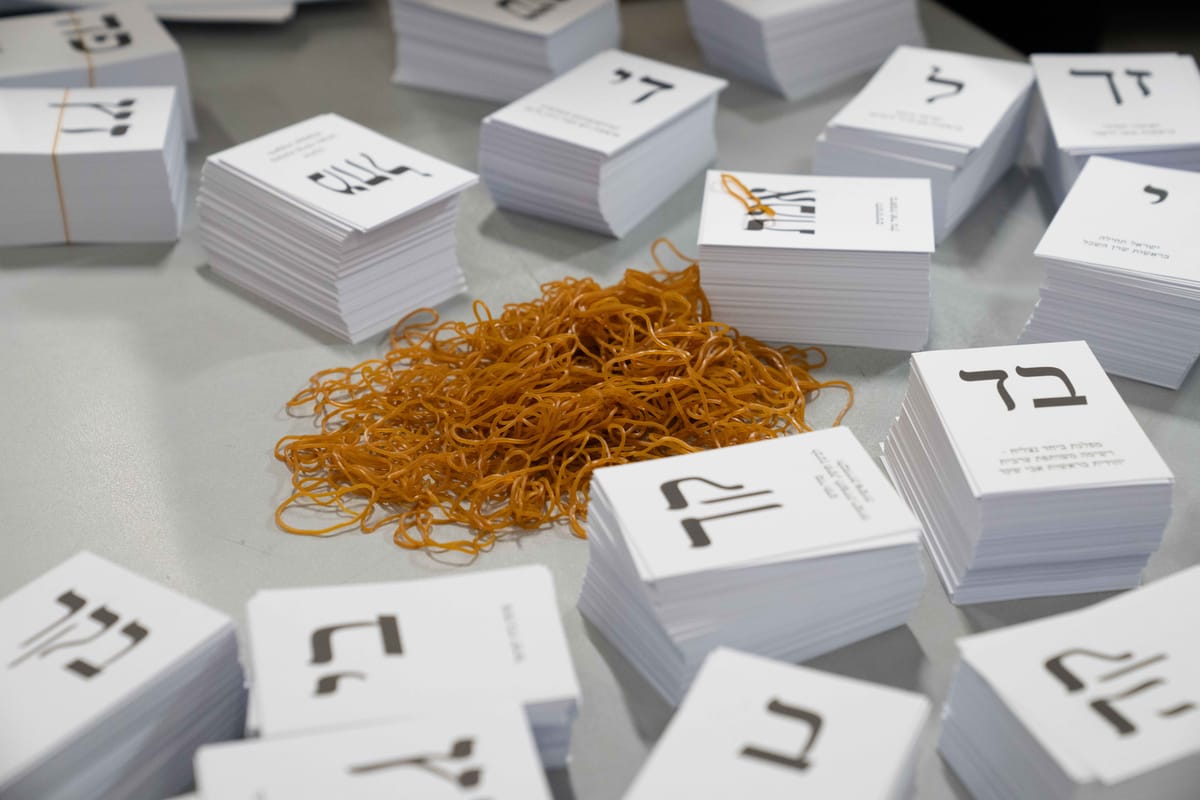
On election day, Israelis step behind the curtain and choose which slip to place in the envelope, each marked with the letters representing a party. But why letters at all, and not simply the party's name? What do the letters mean, and how are they chosen? A look at the system behind the ballot.
The font and the size
The law requires ballot slips to be printed in clear letters, in Hebrew or Arabic. Each slip measures 7 by 10 centimetres, with half-centimetre margins on all sides, leaving a print area of 6 by 9 centimetres.
No specific font is mandated, but Hebrew ballots typically use the Frank Ruehl family and its modern variants, especially David. The law sets the size at 181 points for capital letters and 24 points for lowercase. The aim is complete equality between all parties.
No early reveal
Under campaign law, parties may reveal their assigned letters only 42 days before the election. The restriction was introduced by lawmakers who wanted "not to introduce the election atmosphere too early".
The letter that's never been used
Of the 27 letters in the Hebrew alphabet, 22 standard and five final forms, almost all have appeared on ballot slips across Israel's 25 election cycles since 1949. One letter has never been used: the final peh (ף).
The letter decided by a footrace
In September 1988, former IDF chief of staff Rafael Eitan arrived at the Knesset to register his new party, Tzomet, for the elections. It was his first time running on an independent list, and he came prepared with the party's platform, the candidate roster, and the letter he wanted on the ballot: something to represent the word Tzomet.
Then something unexpected happened. A representative of another party also demanded the letter tzadi (ץ) and refused to back down. Apparently both arrived at the same moment, and a decision had to be made. At the Knesset, it's worth noting, letters are allocated on a first-come basis.
Seeing the confusion among the Central Elections Committee clerks, Raful proposed settling the matter with a footrace. The two put on trainers and launched into a spontaneous sprint, which Raful won.
What the letters mean
The Knesset Elections Law states that each list of candidates shall bear a designation of one or two different letters of the Hebrew alphabet, to distinguish it from other lists. From the first elections held in Israel in 1949, every party has been represented by a letter in the ballot box.
Under the law, letters used in the previous election remain the property of the parties that used them. For another party to use one of those letters requires the consent of the original party. The same consent is needed to use a single letter from an existing combination.
For example, the letters "emet" (אמת — truth) traditionally belonged to the Labour Party and now to the Democrats. They originated when Mapai was represented by aleph (א). Later, Mapam — represented by mem (מ) — and Ahdut HaAvoda — represented by tav (ת) — merged with Mapai, creating the combination "emet".
By contrast, the Likud's letters are "mahal" (מחל): chet (ח) from the Herut movement, lamed (ל) from the Israeli Liberal Party, and mem (מ) representing the Free Centre, the State List, and the Movement for Greater Israel.
Many parties, however, choose combinations or letters connected to the party's name or its leader. That's why the letter lamed (ל) represents Lieberman and his party Yisrael Beiteinu. In the ninth Knesset elections, Shmuel Flatto-Sharon used the letters "pesh" (פש) to represent both his surname and his list's name, Development and Peace. In the 19th Knesset elections, the letters "tzaf" (צפ) represented the Movement led by Tzipi Livni.
Sometimes a letter represents the first letter of a word associated with the list. The Green Leaf party used the letters "kan" (קנ) as the first letters of the word cannabis in Hebrew, and Rehavam Ze'evi's Moledet party used the letter tet (ט) as the first letter of the word "transfer".
The blank slip
In Israel, blank slips are counted as invalid votes for all purposes, and there is no way to know how many voters cast them. In practice, they are intended for cases where the ballot slips of a particular list run out, so voters can write their choice on the blank slip.
How many slips in the envelope
In the voting booth, you choose the slip bearing the letter or letters of the list you want to vote for and place it in the envelope you received at the polling station. There is no need to mark the slip or write anything on it. If the envelope contains two or three (but not more) identical slips of the same list, they are counted together as one valid slip. By contrast, an envelope containing slips of different lists invalidates the vote.