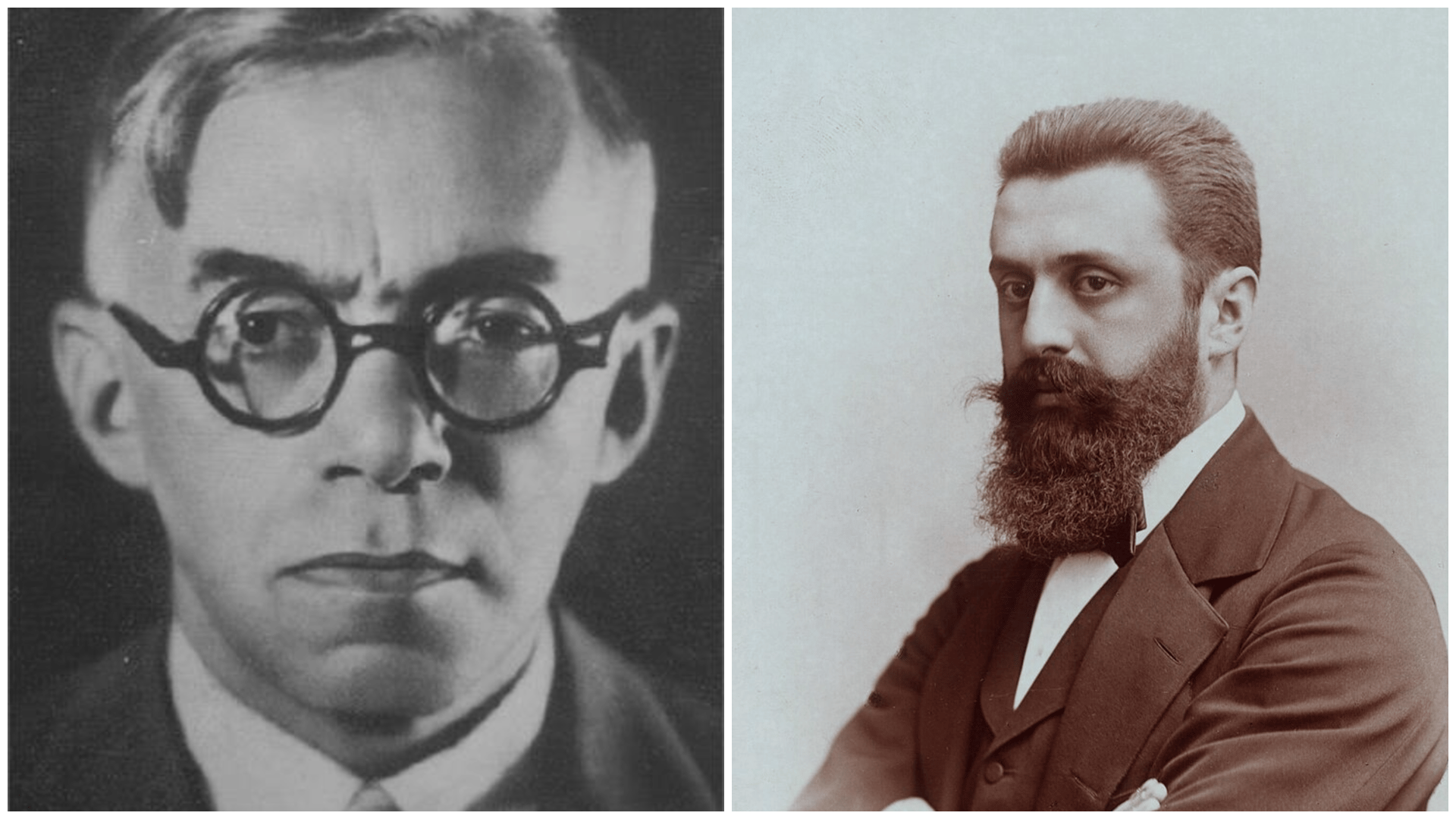

Asked to choose between the two founding fathers of the movement he leads, Prime Minister Benjamin Netanyahu declined to pick a side, then came down on one anyway.
The question came Tuesday night on Channel 14’s “The Patriots,” where journalist Avishai Ben Chaim turned a political interview into a seminar on Zionist history. Is Netanyahu closer in outlook to Theodor Herzl, the visionary of the Jewish state, or to Ze’ev Jabotinsky, the leader of Revisionist Zionism?
“I want you to settle an argument between me and Ariel Segal,” Ben Chaim told him, referring to a fellow panelist. “We have a debate between Herzl and Jabotinsky. I claim you’re more Herzlian, and Ariel claims you’re more Jabotinskian.”
“You’re making me into King Solomon,” Netanyahu replied. He then reframed the question rather than answer it: “I’ll tell you first of all that Jabotinsky was Herzl’s outstanding disciple. The one who innovated the most was Herzl.”
What followed was less a verdict than a lecture, delivered in the cadence familiar to anyone who has heard Netanyahu speak about Jewish history. Herzl, he argued, grasped the danger facing European Jewry through the antisemitism he witnessed in Vienna and in Paris after the Dreyfus trial. Netanyahu went further, claiming that “the only person in the entire world who foresaw the Holocaust was Herzl” and that Herzl wrote about it 33 times. That fear for the Jews’ survival, he said, drove Herzl’s search for a refuge.
The same logic, in Netanyahu’s telling, explains Herzl’s willingness to consider the Uganda Plan, the British proposal to the Zionist movement in the early twentieth century. Having failed to advance his vision for the Land of Israel with the German Kaiser and the Ottoman Sultan, Herzl sought another option.
Here the history became personal. Netanyahu’s grandfather, Rabbi Natan Mileikowsky Netanyahu, admired Herzl but opposed the Uganda Plan fiercely. When Netanyahu’s father, historian Benzion Netanyahu, asked him why, the answer was counterintuitive. He opposed the plan precisely because he feared the British would keep their promise, and the Jews would stay in Uganda instead of reaching the Land of Israel.