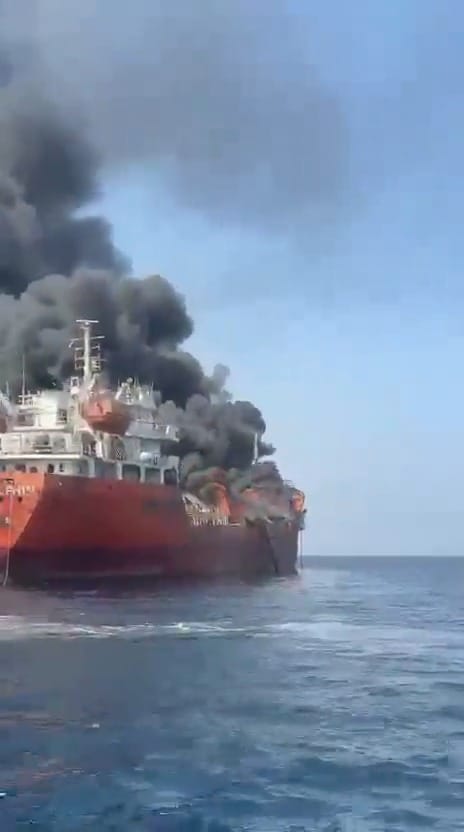
Iran is pushing its campaign against commercial shipping past the Strait of Hormuz into the Gulf of Oman and waters farther out, the latest maritime front in the war that began when the United States and Israel struck Iran on February 28. Two senior Iranian officials told Reuters the move is meant to hold oil prices up and influence the outcome of the US midterm elections in November.
Since those strikes, Tehran has worked to control the strait and has limited passage through it to gain leverage over Washington. Before the war, roughly one-fifth of the world's oil and liquefied natural gas trade moved through the waterway. Iranian threats and attacks have sharply reduced traffic there and pushed oil prices higher, although some oil has still gone through.
The wider reach may already be in effect. Reuters reported that maritime security sources reviewed attacks reported to United Kingdom Maritime Trade Operations (UKMTO), a British navy-affiliated agency, and to security firms in the region, finding at least five incidents involving tankers and other commercial ships around Hormuz in the past 48 hours, including drone strikes. Ships were also targeted in recent days in waters off Qatar and the United Arab Emirates, according to the analysis.
The officials would not detail the new strategy. They said it alters both the kind of attacks and their frequency against vessels Iran considers in breach of its restrictions. They added that the decision came from the top of Iran's leadership.
The reports differ on timing. One official said the new tactics began about 10 days ago, though reports differ on the exact timing.
"The aim is to frustrate efforts by the United States and its allies to bring down global oil prices," one of the officials said.
The second official said Tehran would not let President Donald Trump drive prices down before the vote. "Just when they think they are getting close to the point where prices will fall, we will push them away from it. This is a game of chess," he said. He warned that such vessels "would be safe nowhere, even outside the Strait of Hormuz." Both officials said Iran is working toward a situation in which no ship defying its rules could get through. "It will be complete closure soon," one said.
Independent data put attacks on ships still using the strait at their highest level since the war began. Figures from the International Maritime Organization, the UN shipping agency, show the latest 48-hour pace roughly equals the rate recorded on October 3-5. On Sunday, the Joint Maritime Information Center rated the threat to merchant shipping in Hormuz as "severe," its second-highest level. It reported that "IRGC attacks, attempted attacks, and/or harassment activity persisted including UAV overflight, targeted surveillance of merchant shipping, and occasional VHF hailing."
Trump answered with a threat. He spoke on Tuesday at a rally in Wasilla, Alaska, where he was campaigning for Republican Sen. Dan Sullivan. "Wait and see what we do to Iran. We're going to hit them hard," Trump said. He had first indicated he would not strike again before the midterms. At an October 9 rally in New York, however, he warned he could "finish it off" if Iran did not reach a deal. Neither the Pentagon nor Iran's Foreign Ministry gave an immediate response to requests for comment.