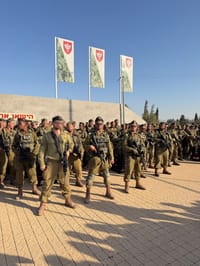
On the night of October 7, while most of Israel was still trying to grasp the scale of what had happened in the south, Ziva Glanz was placing orders. By two o'clock in the morning, she was placing orders from international suppliers for thousands of vests for the IDF.
She was not a soldier. She held no government post, and nobody had asked her to do it. She simply happened to be the one person with the right spreadsheet open.
"Due to previous experience, I was blessed to know where all of the IDF grade gear was, which we knew the army would need," she said. "I knew exactly who to call."
Three years later, Glanz is number four on the HaTzibur HaCharedi list. Her campaign rests on something she says she watched work with her own eyes during the war: Israelis from opposite ends of the ideological divide can build things together, quickly and well, when the need is great enough.
A deal that fell through
The story begins with a failure. In the months before the war, Glanz spent seven months helping to broker a major deal involving Israeli companies in the defense technology and equipment field. In the end, it collapsed.
"I was somewhat distraught," she recalled. "But I knew that God had a plan, and this wouldn't be for nothing."
The collapse left her holding something nobody else in the country had in one place: a detailed map of where protective gear sat, who made it, and which suppliers could move it. When Hamas attacked, that map became priceless.
At seven a.m. on the Tuesday morning after the massacre, her phone rang. On the line was the senior officer who had just been put in charge of army procurement. He had heard she had open orders. The army would send ballistics teams to test the equipment, he told her, and if it passed, an American military plane would collect all 85,000 sets.
"I'm like, great, I can go back to my civilian life," she said with a laugh. "And of course, as we all know, that never happened."
The testing took weeks. The results took weeks more. Meanwhile, organizations around the world had raised huge sums for soldiers, only to discover that export regulations blocked them from buying much of the gear they had promised. They needed someone on the ground who knew the suppliers. That someone was Glanz.
"I became the center point for this whole crush of donations," she said. At the peak, she was buying thousands of vests a day and getting them out to units.
Eight hours in a conference room
Eventually the Defense Ministry called her in. Around a long conference table, officials walked her through a whiteboard plan for routing donor gear through the established channels. Glanz kept stopping them. She knew those channels had no mandate to bring in equipment in wartime, and she said so, again and again, until the room finally began what she calls "an honest conversation."
She never left. Eight hours later, she was named director of the Discretionary Fund of Israel (DFI).
The fund worked in partnership with the country's national security agencies, among them the Home Front Command, the Israel Police, the fire and rescue services, the Air Force and a long roster of special and intelligence units. It took on what Glanz calls the projects of national import, the hard ones that kept falling between the cracks. One was counter-drone technology now used against the drones killing soldiers in the north. The fund also financed the rebuilding of entire units, including a Mista'arvim unit in Gaza that later took part in the rescue of hostages.
All of it was volunteer work. She had no call-up order and drew no salary. "I didn't make a penny off of all this," she said.
The drone school that began with one vest
Some of the most important work started almost by accident. Glanz had obtained a vest for her own son. A lone soldier on a base kept pestering her for one, and in the end she gave him her son's.
That soldier had a mentor named Alan Alevy, an 85-year-old real estate entrepreneur from California, and he put the two of them on the phone. Glanz spoke with Alevy five times before she even knew who he was. He had the brilliant idea of purchasing drones to help protect soldiers.
"He said, ' You know what? If we get one drone, we can cover a whole unit," she said.
As a result, Alevy donated millions of dollars to the Lotar drone school, which bought the army's first drones and trained unit after unit to fly them. At the start of the war, Glanz noted, the army had not made drones a priority. Today it is hard to imagine the fighting without them.
"The man deserves the Israel Prize," she said.
The ‘morot’
For seven months, Glanz barely saw her family. She came home half an hour before Shabbat and left again when it ended, and she had to fight even for that. She has five children at home, ages 8 to 21. Her eldest now serves in a Chareidi unit that operates between the police and the army.
She was sure her absence would scar them. Instead, help arrived: young women whose husbands had been called up for reserve duty and who did not yet have children of their own came to the Glanz home so that Ziva could go to the ministry.
The kids called them the morot, the teachers. They baked muffins and cookies together. One of the women was from Chile and taught them Spanish, and Glanz's daughter was so taken with it that she kept teaching herself the language for two years afterward.
"They kept asking me, when are the morot coming back?" Glanz said. "Here I thought they'd be traumatized. In the end, they had the best time."
The Inner Circle
As the war ground on, Glanz pulled together what she calls 'The Inner Circle', the top donors behind the civilian war effort. They ran the full spectrum, from completely secular Tel Avivians to deeply religious families, and she says they worked together without friction.
That work led them to painful places too. When reserve soldiers who died by suicide were denied military funerals, the circle paid for the funerals and the gravestones out of pocket.
"When things unfortunately morphed into that, we just took responsibility for that too," she said.
A citizen government
This is where her run for office begins. Glanz describes the network that formed after October 7 as a citizen government, a whole layer of Israeli society that stepped up when official systems faltered. When units needed logistics, she said, they often called Achim LaNeshek before anyone in uniform.
"Why do I care about cross-sector unity and working together? I just came off three years where I saw all of these people, despite every difference we had, work perfectly together," she said. "That layer of society is here to stay, and a lot of these people are moving into public life now. We're still close colleagues. We're still best friends. We have proof on the ground that we can work together and get past ideology. That is what needs to sweep into the Knesset."
Maintaining roots and a working life
Glanz carries one of the more remarkable family trees in the Chassidic world. She is a tenth-generation descendant of the Baal Shem Tov, through his daughter Udel and her son, the Degel Machane Ephraim, and a seventh-generation descendant of Rav Moshe of Kobrin. Her great-grandfather was the last Kobriner Rebbe, heir to the dynasty from which Slonim Chassidus grew. Her forebears also include the Maggid of Zlotchov, Rav Menachem Nachum of Chornobyl, author of the Me'or Einayim, and the Rebbes of Ruzhin, along with the Katzenelenbogen line and, further back, the Shelah, the Rashba and Rashi. The Zvhiler Rebbe, buried in Jerusalem, was a great-great-uncle.
Her professional life is just as full. She is CEO of The Sha'ar Group, an investment group that builds regional infrastructure projects in Israel like the expansion of Har Hamenuchot cemetery and the last land available for development on Har HaZeitim in Jerusalem. Through her own firm, Rainmaker and Associates, she has worked on developing communities in several areas in Israel, many of them specifically earmarked for new immigrants or the Charedi community.
She also founded Lashuv, a volunteer professional network focused on klitah (absorption), the stretch of the immigrant journey that begins after the airport. Lashuv mapped municipalities from Kiryat Malachi to the Golan and sat down with mayors and developers in search of three things: suitable housing, real access to education, and a genuine welcome for olim. Sadly, the group realized that very few places offered all three, so they decided to create new communities.
Many of the groups she worked with were Chareidi families from English-speaking countries. They wanted the same thing: a warm, spiritual community in a pastoral setting, with schools that fit their children's needs. When new neighborhoods were slow to get off the ground, Glanz and her husband started one themselves in Mevaseret Zion, minutes from Jerusalem. In its first year, twenty families moved in.
"I'm a businesswoman during the week and a rebbetzin on weekends," she said. "During the week, I run projects worth more than $300 million. On weekends, I have 40 boys in my house eating cholent."
The other side of the desk
If she enters the Knesset, Glanz says, the work will be the same. Only her seat will change. "I would just be doing it from the other side of the desk."
Her first priority is to improve on a national master plan for aliyah. With applications rising in droves due to antisemitism around the globe, she warns that Israel is at least eight years behind in planning, and that without action, when new immigrant waves descend on the country, Israel could end up in conditions resembling the Ma'abarot transit camps of the 1950s. Her answer is new neighborhoods, built with the infrastructure to support successful absorption from the start.
She and the HaTzibur HaCharedi party envision yishuvim for Chardal families, working Charedim, Chareidi soldiers and Chareidi olim from the Diaspora. These would be modern, elevated communities with smart infrastructure, sustainable design and planning that puts health first. Their schools would offer serious Torah learning alongside strong mathematics and English. They would have a soulful atmosphere and natural support networks for groups making aliyah together. Glanz also wants to build retirement villages, so that Jews can retire in Israel instead of Florida.
Her second priority draws directly on the war. Until this past summer, she was part of a group that met with the Defense Ministry's internal investigative committee examining how systems functioned after October 7, where there were successes, and what failed. Glanz says much of what it will present includes input from her and her colleagues. In the Knesset, she wants to keep that work going on a committee dedicated to fixing the systems that failed.
Glanz, together with the party, is also committed to strengthening dedicated Chareidi units such as the Chashmonaim unit, giving Chareidi soldiers who choose to serve a respectful, halachically grounded framework.
Her third goal is what she calls Israel 2.0. The state's systems, she argues, were invented overnight at its founding, with immigrants arriving on the shores and an existential war underway. Nobody had time to ask how best to build them, and the country has carried those emergency structures ever since.
That means creating solutions to reduce bureaucracy and smoother paths for international investment, so that people can succeed here both personally and as part of a stronger national economy.
"We're the high-tech capital of the world. We're the defense capital of the world," she said. "It's high time we re-thought how to do this smartly."