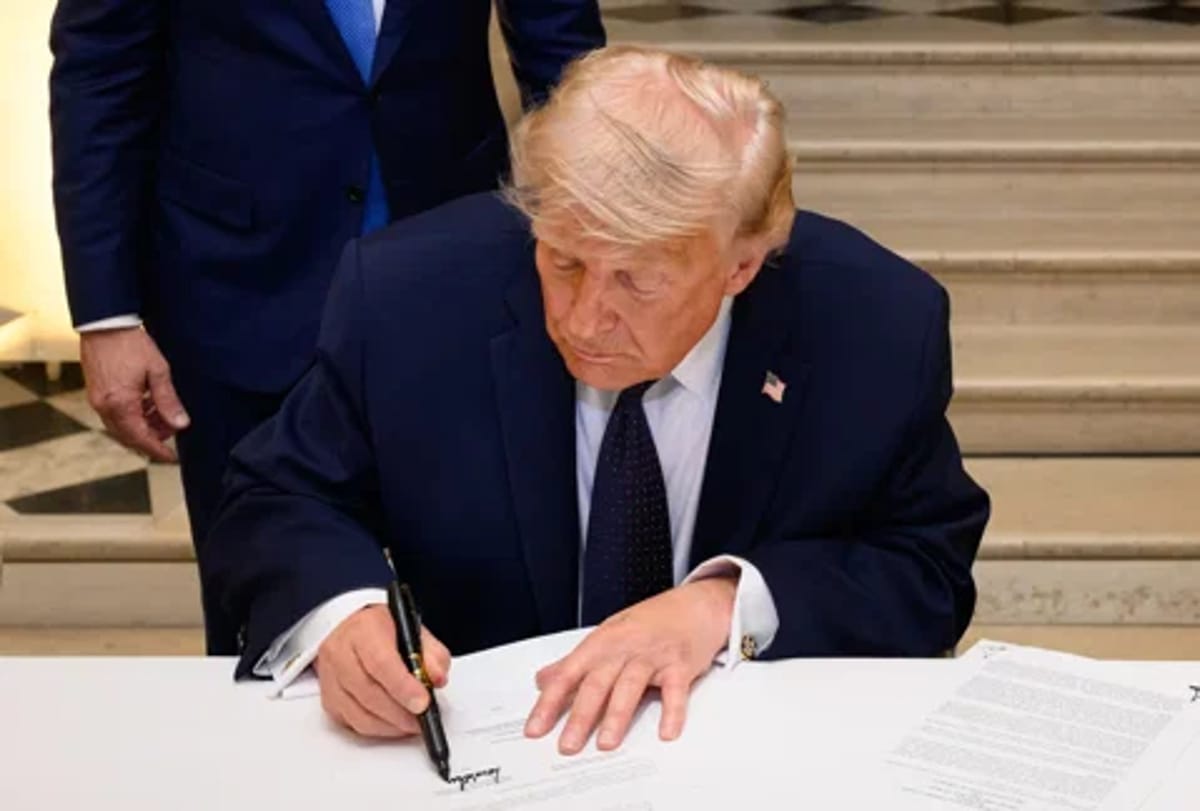
The MOU that President Donald Trump signed with Iran on June 14th was sold to the American public as a historic diplomatic achievement. His own voters are not buying it, and Republicans heading into November's midterm elections are growing quietly alarmed.
New polling from Reuters/Ipsos lays bare the political damage. Just 24% of Americans think the war with Iran was worth the cost, according to a Reuters/Ipsos survey of 1,262 American adults conducted June 18-22, with half saying the conflict was not worth it and the rest unsure. Only 23% of respondents, including just half of all Republican respondents, believe the U.S. is now in a stronger position with regard to Iran than before the war, while 35% think the U.S. is now in a weaker position.
Trump's overall approval rating has slipped to 34% in the latest Reuters/Ipsos poll, tying his second-term record low, down from 47% at the start of his second term in January 2025.
The deal itself, which includes the reopening of the Strait of Hormuz, the temporary lifting of U.S. oil sanctions on Tehran, and authorization for a $300 billion private investment fund for Iranian reconstruction, has drawn fierce criticism not just from the opposition but from within the conservative base that delivered Trump his second term.
Interviews conducted by Reuters with Trump supporters across the country revealed deep fractures. Juan Rivera, 26, from near San Diego, put it bluntly: the president had spent years attacking his predecessors for negotiating with terrorists, then did exactly the same thing. Rivera said he had met many grassroots activists who had lost their motivation to work for the party, with many asking why they should bother voting when the president was not delivering on his promises.
The sharpest frustration centers on the fact that the primary war aim many Trump supporters understood to be on the table, regime change in Tehran, was never achieved. Steve Egan, a Tampa business owner hit by tariffs and rising fuel costs, said that as things stood, it did not look like it had been worth it. He went further, saying that Trump's endorsement of congressional candidates would now amount to a "kiss of death" for them at the ballot box.
Even those hoping the peace holds expressed unease about America's standing. Robert Bilaps from Washington state said the conflict had generated more hostility toward the United States and announced he would be evaluating candidates independently in the coming election, adding that his regard for Vice President JD Vance, who led the negotiations, had fallen.
Anger over the reconstruction fund runs particularly hot. Joyce Kenny, a retiree from Arizona, said she could support lifting sanctions to help secure the deal, but directing funds to rebuild a former enemy nation crossed a line, saying flatly that it was not America's responsibility. A Pennsylvania corrections officer added his belief that the prolonged conflict had ultimately served the interests of major oil companies more than the American people.
Sixty-three percent of Americans think it is unlikely the MOU will lead to lasting peace between the U.S. and Iran, including around half of Republicans and 80% of Democrats. Only 18% of Americans, including 34% of Republicans, think the deal will deliver lasting peace.
A loyal minority of Trump supporters insists there is a larger plan at work. A secretary from the Chicago suburbs told Reuters she believed the destruction of the Tehran regime was the only way to prevent future war, and that she had faith a bigger strategy was in play. A North Carolina engineer echoed the sentiment, saying he could not imagine Trump going through all of this without finding a way to rid the region of the mullahs.
Political analysts and diplomats are less optimistic. Terry Alberta, a pilot from Michigan, captured the hawkish frustration spreading through Republican ranks with unvarnished directness, saying what was needed was to truly weaken the Iranian regime, rather than an approach of hitting them a little and then stepping back to let them rebuild.
The White House has pushed back firmly, with a spokesman telling Reuters the president's achievements on the battlefield and at the negotiating table were nothing short of extraordinary and would strengthen American security for years to come.
Republicans heading into November's midterms face a more complicated picture still, with Trump's approval on cost-of-living standing at just 22% in the latest Reuters/Ipsos poll, as affordability has become a central voter concern. The convergence of economic anxiety and disillusionment over Iran may prove a difficult combination to survive at the polls.