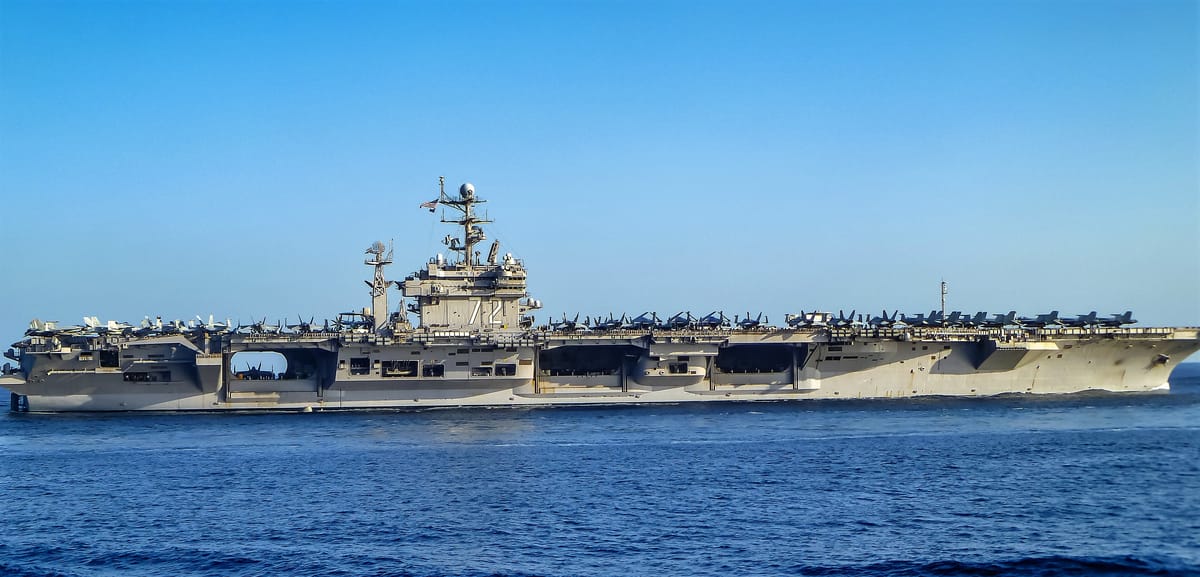
Iran's arsenal of low-cost drones represents a "credible threat" to U.S. naval forces, including the USS Abraham Lincoln aircraft carrier strike group, according to a leading defense expert, as the U.S. bolsters its military presence in the Middle East amid escalating unrest in Iran.
The New York Post explains:
Cameron Chell, CEO and co-founder of drone technology firm Draganfly, told Fox News Digital that Tehran's strategy of deploying swarms of inexpensive unmanned aerial vehicles (UAVs) could lead to saturation attacks, overwhelming traditional ship defenses.
"If hundreds are launched in a short period of time, some are almost certain to get through," Chell said, noting that modern systems were not designed for such high-volume assaults.
He emphasized Iran's advantage in producing Category One and Two drones, basic, mass-producible models equipped with warheads, allowing for asymmetric warfare against sophisticated U.S. assets valued in the billions.
"These drones give Iran a very credible way to threaten surface vessels," Chell added, describing U.S. ships as large, slow, and radar-visible targets.
The alert comes as a senior U.S. official confirmed to Fox News Digital that the USS Abraham Lincoln strike group has not yet entered U.S. Central Command's (CENTCOM) area of responsibility in the Indian Ocean, meaning it is not positioned for strikes on Iran.
"It is close, but technically not in CENTCOM yet," the official stated.
Once in the region, the group—which includes advanced aircraft like F-35 jets and missile-equipped destroyers—would need several days to become fully operational.
U.S. forces are ramping up amid reports of instability in Iran, where Supreme Leader Ayatollah Ali Khamenei has reportedly retreated to a fortified underground bunker in Tehran over fears of a potential American attack.
Protests that erupted on December 28, 2025, driven by economic woes and public discontent, have resulted in at least 5,459 confirmed casualties, according to the Human Rights Activists News Agency (HRANA), with over 17,000 more under investigation.
Recent reports indicate that as many as 30,000 Iranian protesters were murdered on January 8-9, and the number keeps climbing, as information trickles out.
The U.S. response includes deploying F-15 fighter jets and C-17 transport aircraft carrying heavy equipment, while also monitoring developments in neighboring Syria.
President Donald Trump addressed the deployment last week, stating, "We have a big flotilla going in that direction, and we’ll see what happens. We have a big force going towards Iran. I’d rather not see anything happen, but we’re watching them very closely."