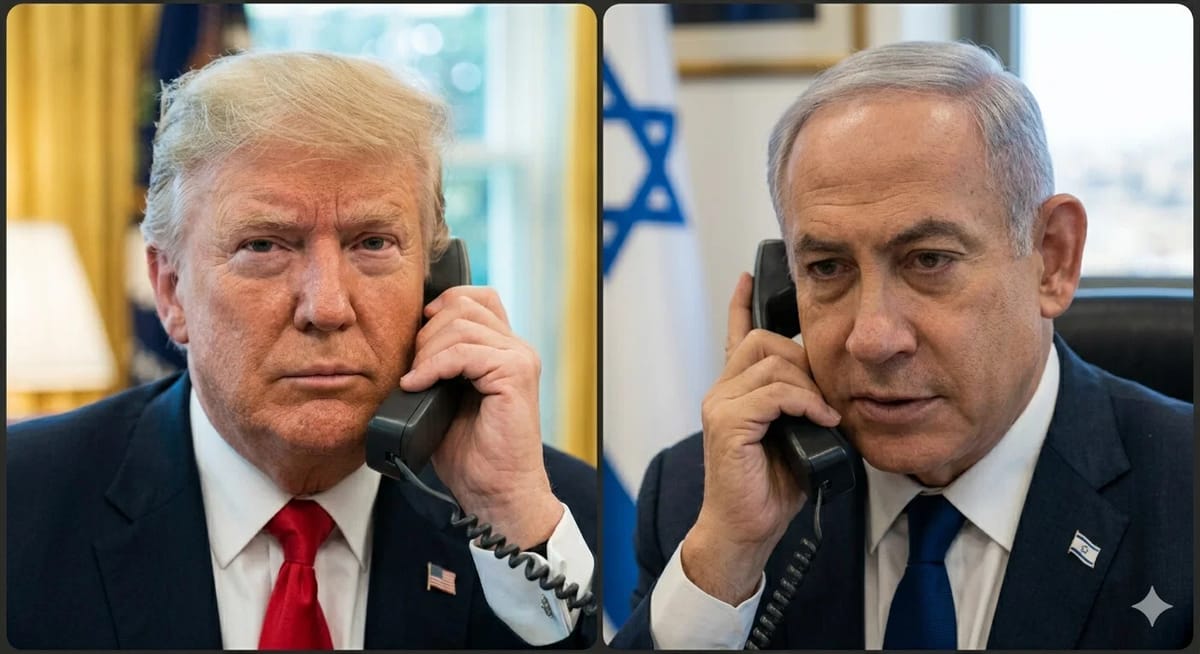
Prime Minister Benjamin Netanyahu and United States President Donald Trump held an intensive, highly confidential telephone conference late Tuesday evening to coordinate strategic policies across three volatile regional fronts, namely Iran, Lebanon, and Gaza. The high-level communication was initiated immediately following a truncated, two-and-a-half-hour meeting of the local security cabinet, which adjourned early specifically to facilitate the presidential dialogue. The strategic interaction transpires during a period of immense regional fluidity, occurring immediately after localized forces executed a dramatic assassination attempt against senior leadership targets in the south.
The focal point of the discussion centered on the advanced diplomatic tracks currently being managed by Washington regarding the permanent neutralization of Tehran's nuclear infrastructure. Netanyahu, addressing his ministers in closed-door sessions, emphasized that the state's strategic maneuvering space is closely linked to American policy, noting that it is vital to move in total lockstep with Trump's overarching objectives. While some circles in Jerusalem have expressed severe anxieties regarding the potential compromises being discussed in Qatar, Trump updated the prime minister on the structural milestones of the talks, reiterating that the United States will immediately revert to absolute military options if a verifiable treaty is not achieved.
Simultaneously, the two leaders evaluated the dramatic expansion of ground maneuvers along the northern frontier, where large-scale formations have advanced systematically beyond the yellow line to capture dominant topographical border positions. While the White House explicitly reiterated its absolute support for the state's fundamental right to self-defense against ongoing rocket fire, American diplomats expressed a firm desire to prevent the complete destruction of Lebanon's broader civilian infrastructure. Trump and his foreign policy team emphasized that while they wish to see the systematic disarmament of Hezbollah, they prefer the operational degradation to proceed without transforming the capital of Beirut into an unmanageable combat sector that could disrupt parallel diplomatic frameworks.
The complex conversation also touched upon the tactical status of operations in Gaza, where the political echelon confirmed that specialized flight wings had just targeted the newly installed chief of the local terror branch. Netanyahu re-asserted that the military would continue to relentlessly pursue every single individual who participated in the planning or execution of the October 7 massacres. The call concluded with an exchange of mutual support, with Trump publicly affirming his deep personal regard for the prime minister's wartime leadership, while both administrations solidified plans to prevent the ongoing war from expanding into a broader regional conflagration.