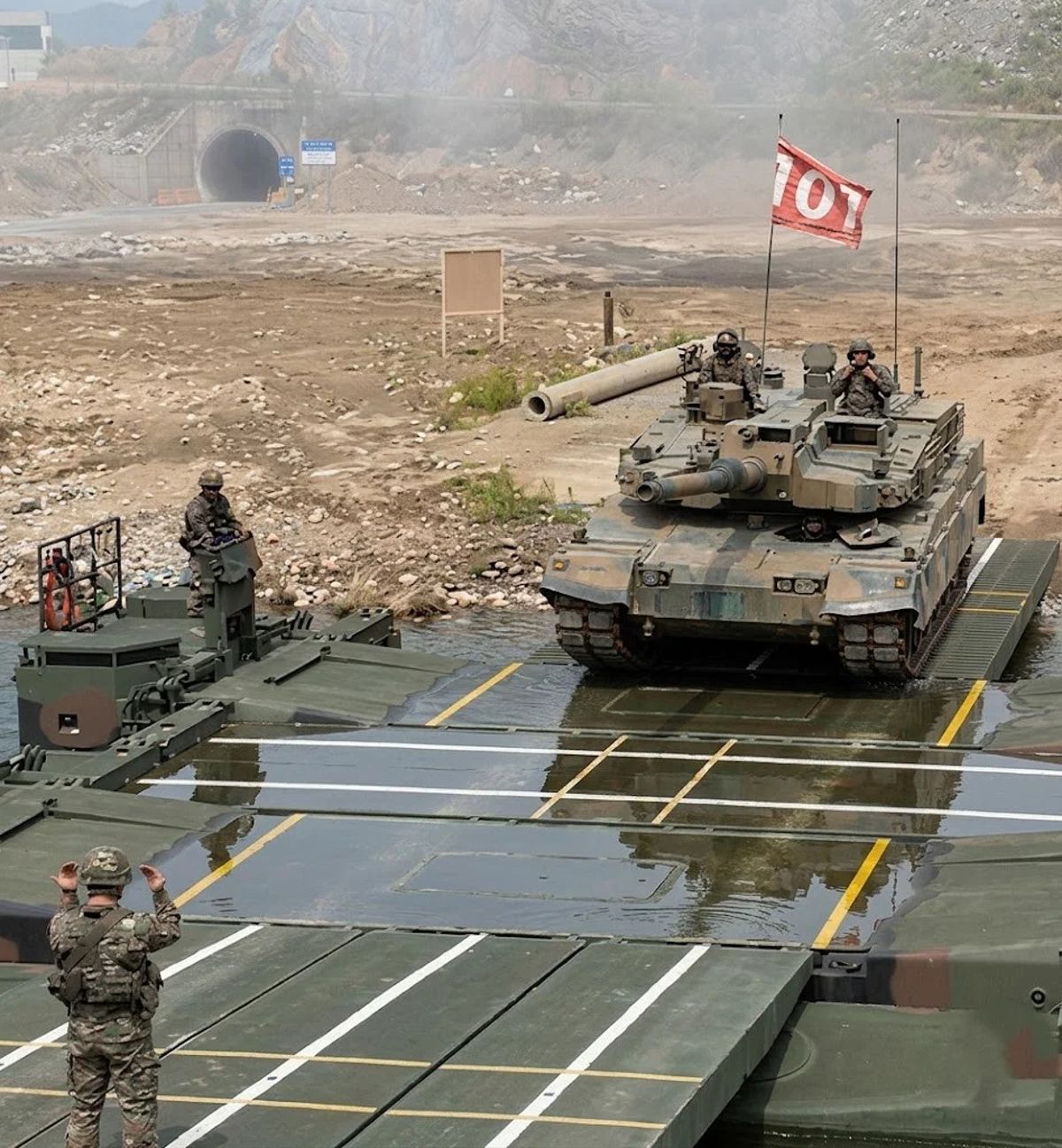
The South Korean military has officially deployed the KM3 "Suriang," an advanced amphibious bridging and ferry system, into its 7th Maneuver Corps. Based on the German M3 platform but heavily modified for the specific terrain of the Korean Peninsula, the KM3 represents a major technological leap for combat engineering. The system can rapidly transition from a standard land-driven vehicle into an independent floating vessel, providing immediate operational passage over rivers and water obstacles where speed and flexibility are critical.
Seamless Transformation and Heavy Load Capacity
The KM3 operates in two primary modes depending on battlefield requirements. In its first mode, two units can connect within just ten minutes to form a floating ferry capable of transporting tanks and self-propelled artillery from one riverbank to the other. In its second mode, eight individual units can link together in roughly 20 minutes to create a continuous 100-meter bridge, allowing heavy armored columns to cross smoothly as if driving on a standard highway. The system is built to sustain loads of up to 64 tons, meaning South Korea's heaviest armor, including K2 tanks and K21 infantry fighting vehicles, can cross water barriers without delaying the main force.
A Strategic Game-Changer on the Battlefield
The introduction of the "Suriang" changes the landscape of modern combat engineering by cutting setup times by 60 to 70 percent compared to older bridging generations.
Furthermore, the manpower required to operate the system has dropped by approximately 80 percent. On a modern battlefield where operational windows are measured in minutes, this efficiency is vital for successful maneuvers.
Given that the Korean Peninsula is filled with thousands of rivers and natural waterways that naturally restrict armored movement, the ability to cross these obstacles almost instantly provides South Korea with a major strategic advantage.