
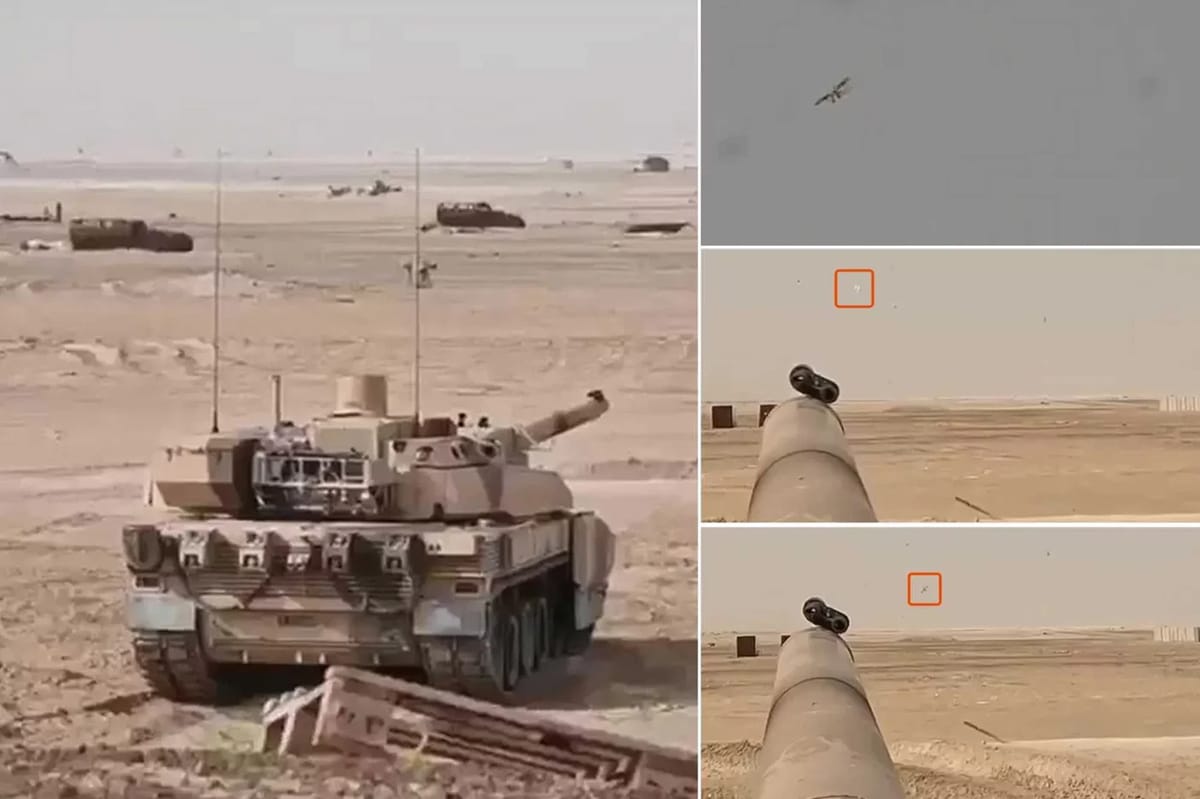
In a dramatic live-fire exercise conducted in Abu Dhabi, a French Army main battle tank successfully intercepted a small FPV drone, the type of cheap, agile weapon that has become the defining threat to armored vehicles on the modern battlefield. The trial, carried out by the French Fifth Cuirassiers Regiment stationed in the UAE, was reported first by Army Recognition and followed up by the defense publications Meta Defense and Numerama.
The test, designated "Tirs LAD XL," was born directly from lessons drawn in Ukraine, where small, inexpensive FPV drones have repeatedly disabled tanks costing tens of millions of dollars. The regiment's prolonged deployment in the Gulf has made it a live laboratory for new technology, allowing French forces to evaluate equipment under desert conditions similar to potential Middle Eastern conflict zones.
How it works
The interception relied not on a direct hit, nearly impossible for a tank cannon against a small, fast-moving target, but on a specialist 120mm round produced by KNDS France and in service since 2012. Weighing more than 11 kilograms, the shell releases a dense cloud of approximately 1,100 tungsten sub-projectiles in mid-air. The effect is that of an enormous shotgun: a lethal kinetic net fills the drone's flight path, making evasion nearly impossible. Each tungsten pellet travels at high velocity, creating overlapping coverage across the target area.
The exercise targeted a drone performing sharp maneuvers at difficult approach angles — conditions chosen to replicate real combat scenarios. The interception succeeded, demonstrating that a tank crew under immediate threat, with no time to activate dedicated air-defense systems, now has a credible last-resort option.
Limitations
Experts caution that the method is a supplement, not a replacement, for dedicated counter-drone systems. A tank cannon's slow reload rate and limited elevation angle make it poorly suited to drones arriving from steep trajectories or executing rapid evasive turns. The effective range of the tungsten-scatter round is also limited to a few hundred meters, meaning it is useful only when a threat is already dangerously close. The French military frames the capability as a final defensive layer, not a primary air-defense solution.
The timing of the disclosure is notable. Across southern Lebanon, the IDF is currently confronting fiber-optic-guided FPV drones that are immune to electronic jamming and capable of traveling up to 15 kilometers from their operators. Israeli military officials have publicly acknowledged a critical gap in counter-drone capability, and an emergency procurement effort is underway. The French trial, using off-the-shelf ammunition already in NATO inventories, suggests that solutions to at least part of the drone threat may be closer to hand than emergency research programs imply.
The development is part of a broader technology race between armored forces and drone operators that has accelerated sharply since Russia's invasion of Ukraine. FPV drones costing as little as a few hundred dollars have destroyed vehicles worth millions, reshaping assumptions about the survivability of heavy armor on a contested battlefield. The French trial adds one more data point to a fast-moving contest in which every answer tends to generate a new question.