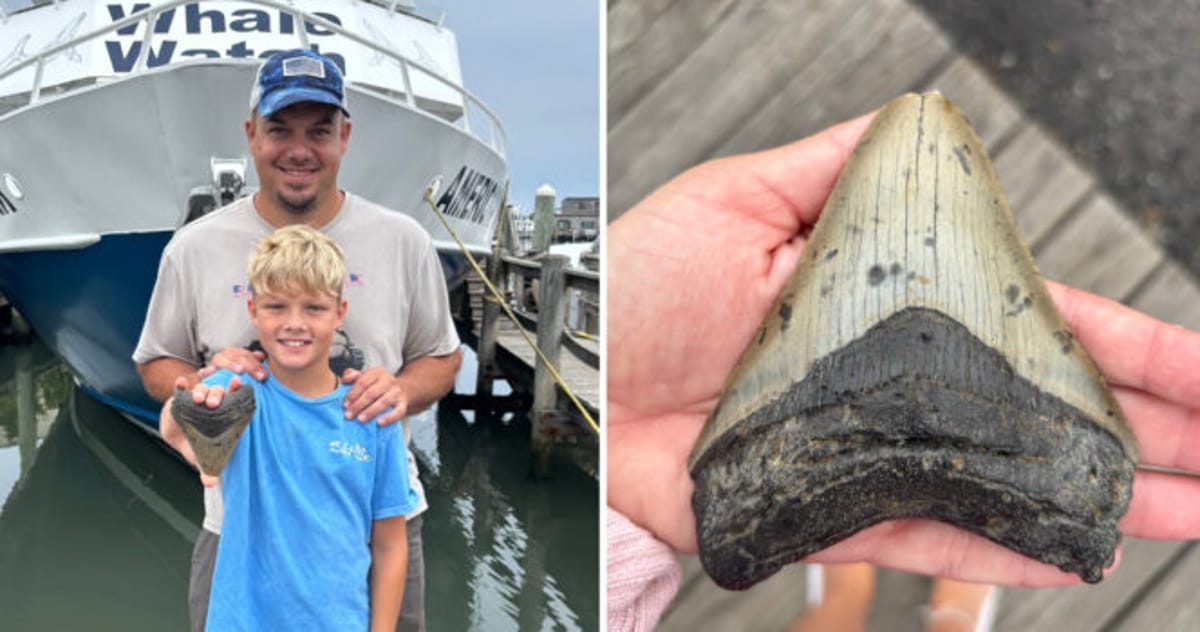
What began as an ordinary family outing to the beach turned into an extraordinary encounter with one of history's most fearsome predators. Eleven-year-old Bo Bowers from Pennsylvania was hunting for shells alongside his father Mike at Sea Isle City Beach in New Jersey when the pair noticed something dark lodged in a narrow gap between rocks.
Mike attempted to reach the object, but his hand couldn't fit into the crevice. Bo, with smaller hands, managed to extract it. Only after pulling out their find did father and son realize they weren't holding an ordinary stone, but rather a massive fossilized tooth measuring approximately four inches in length.
"I was amazed and excited at the same time," Bo recalled. His father admitted he never imagined they would discover such an item during their beach visit. According to Mike, his son was initially speechless.
The family brought the tooth to the Cape May Whale Watch and Research Center and the New Jersey State Museum. Experts who examined it confirmed that it belonged to a megalodon, an enormous prehistoric shark that once roamed the oceans before going extinct.
The tooth's condition drew particular admiration. Matt Ramucci from the Cape May center said it was the best-preserved megalodon tooth he had ever seen. A small chip is visible at the tooth's edge, which according to one theory may have occurred when the shark bit into an animal and struck hard bone.
Megalodon teeth are found at various locations along the eastern coast of the United States, but in New Jersey they are exceptionally rare. Dana Ehret, curator of natural history at the state museum, estimated that fewer than five such teeth have been documented in the state to date. The research center described the find as "a once-in-a-lifetime discovery."
The tooth may have reached the shore as a result of beach replenishment work conducted in the area. During such operations, sand is pumped from the ocean floor and transferred to the beach, and it's possible the ancient fossil was hidden within it until it became exposed among the rocks.
The megalodon, whose scientific name is Otodus megalodon, is considered one of the largest sharks that ever lived. Size estimates vary among studies, but it was clearly much larger than the modern great white shark and fed on large marine mammals.
Despite the rarity of their find, the Bowers family does not intend to sell it. For them, the giant tooth is an unforgettable memento from the day when an innocent search for shells ended with the discovery of a remnant from one of the ocean's greatest monsters in history.