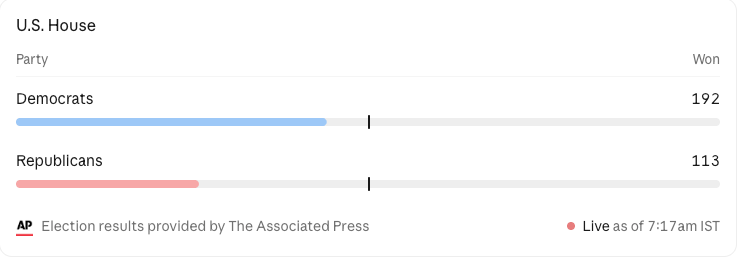
The House appears to be following. Democrats have won control of the House in the 2026 election, CBS News projects, though the Associated Press does not make projections and will only declare which party has won control of the House when one of the parties reaches 218 seats.
In Texas, James Talarico defeated Republican Attorney General Ken Paxton, overcoming a deluge of outside money to break the GOP's three-decade grip on the state. It was the first time a Democrat had won a statewide election in Texas since 1994, and the first time the party had captured a U.S. Senate seat in the state since Lloyd Bentsen won reelection in 1988.
In South Carolina, pediatrician Annie Andrews defeated Darline Graham, the sister of the late Sen. Lindsey Graham, who was appointed to complete his term after his sudden death in July. With an estimated 93% of votes counted, Andrews had 50.6% of the vote to Graham's 47.2%. Andrews is the first Democrat South Carolina has sent to the U.S. Senate since 1998. Graham conceded, telling supporters, "It is clear that we as conservatives have work to do".
In Kansas, Democrat and Methodist megachurch pastor Adam Hamilton defeated Republican incumbent Roger Marshall, becoming the first Democrat to win a Senate seat in the state since 1932. Hamilton and his allies hit Marshall on the high prices that resulted from the Iran war and Trump's tariff agenda.
In North Carolina, Roy Cooper defeated Republican Michael Whatley, flipping the seat held by retiring Sen. Thom Tillis. In Ohio, Sherrod Brown secured victory, flipping another Senate seat for the Democrats by unseating Sen. Jon Husted, who was appointed to the seat vacated by Vice President JD Vance.
Democrats also held their most vulnerable seat. Jon Ossoff won reelection in Georgia, defeating Republican Rep. Mike Collins.
President Trump distanced himself from the losses. He wrote on Truth Social that "if I was, we would have won IN A LANDSLIDE", referring to his absence from the ballot. According to the Times of Israel, Trump told The New York Times he is willing to work with Democrats after the midterms.
For supporters of Israel, the new Senate presents a mixed picture. The Jewish Telegraphic Agency described the results as a shift that could push the US further away from Israel. In Texas, Jewish Insider reported that Talarico has frustrated members of Texas' Jewish community with his criticism of Israel and, for much of the campaign, reluctance to engage with its members. In South Carolina, by contrast, the Times of Israel described Andrews as a pro-Israel Democrat.
Ossoff, a Jewish Democrat, counts himself as pro-Israel, but favors restricting some weapons sales and is critical of the current government.
The most closely watched race for pro-Israel voters remains uncalled. In Michigan, Abdul El-Sayed, a progressive and fierce critic of Israel, defeated Rep. Haley Stevens in the Democratic primary despite millions spent by AIPAC and other pro-Israel groups. AP results showed El-Sayed with 55.9% to 42.3% for Republican Mike Rogers early Wednesday. El-Sayed would become the first Muslim ever elected to the Senate.
There were bright spots for pro-Israel candidates elsewhere. In Florida, Republican Israel supporter Ashley Moody was projected to beat DSA candidate Angie Nixon, and Ritchie Torres, a staunchly pro-Israel Democrat, was reelected. Florida Democrats also defended three key House seats, as Kathy Castor, Jared Moskowitz and newcomer Pia Dandiya secured victory.
In governor's races, Democrat Amy Acton defeated Vivek Ramaswamy to win Ohio's race for governor, according to NBC News. Acton, who is Jewish, faced antisemitic attacks while serving as Ohio's health director during the COVID-19 pandemic.
A Democratic majority now gives the party control over which nominees will get floor votes, a shift that could shape confirmations for the remainder of Trump's term.