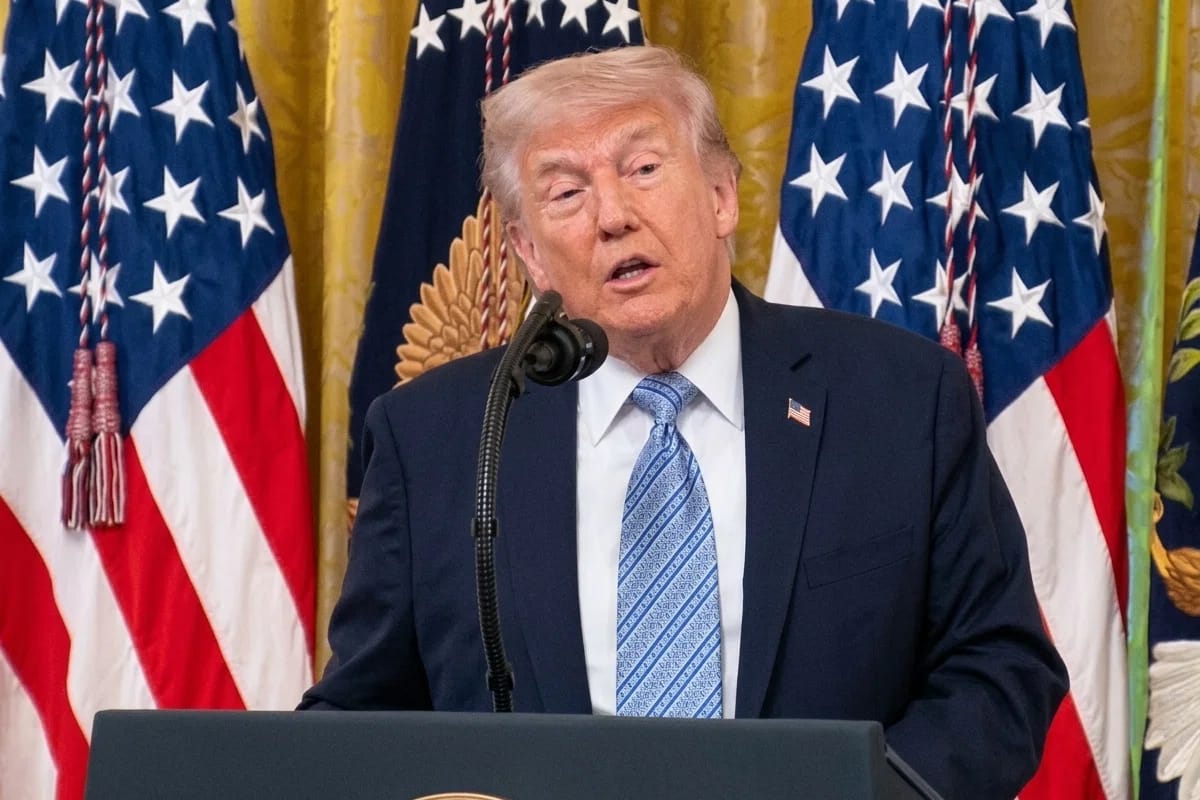
President Donald Trump launched a scathing attack Thursday on critics of his newly signed Iran Memorandum of Understanding, calling opponents "idiots," "zealots," and "bad people" in a fiery social media post that underscores deepening divisions over the controversial agreement.
"The idiots that think I wasn't tough enough on Iran, while the stock market just hit all time highs and oil prices are crashing, are either zealots, bad people, or stupid," Trump wrote, closing with his signature "Making America Great Again!!!"
The president's outburst comes as criticism of the MOU intensifies across multiple fronts, from the American Jewish community to Israeli government officials, even as Trump insists the deal represents a diplomatic and economic triumph.
The Backlash
The anger in Jewish communities across the United States has reached a boiling point. This week, a massive billboard appeared in Monsey, New York, outside a popular Haredi supermarket, with a single message in Yiddish: "Trump is a schmuck."
In Israel, government officials are expressing sharp skepticism. Defense Minister Miki Zohar told reporters that Israel possessed the military capability to devastate Iran's infrastructure entirely. "We could have struck Iran in such a way that they had no electricity, no water, no food, if we wanted to," Zohar said, suggesting that Israeli restraint stemmed not from military limitations but from respect for the US alliance.
That restraint, he implied, may have been taken for granted.
Trump's Defense
Despite the mounting criticism, Trump doubled down on his framing of the agreement as a success. In meetings with Egyptian President Abdel Fattah El-Sisi at the United Nations, Trump declared that "most people love this deal" and "the markets love this deal."
The president emphasized that financial markets were responding positively, citing record stock market highs and plummeting oil prices as evidence that the deal was working. "If this had continued, the world could have entered a global recession," Trump told Egyptian officials. "We have a strong market, oil prices are falling."
He also clarified that the MOU is not a final agreement but rather a framework, leaving room for escalation if negotiations sour. "It's a memorandum of understanding," Trump said, "and if I don't like it, we'll go back to shooting at each other." Later, he was more direct: "If the deal doesn't work out, we'll bomb Iran again."
What Iran Is Claiming
Meanwhile, in Tehran, officials are interpreting the agreement as a negotiating victory. Iranian Parliament Speaker Mohammad-Baqer Qalibaff revealed in a television interview that when Israel attacked targets in Beirut's Dahieh neighborhood last month, Iran issued an ultimatum to the United States: accept our demands, or face retaliation.
"Trump was forced to post a tweet telling Netanyahu to stop the fire," Qalibaff claimed, suggesting that American pressure on Israel to halt operations came directly from Iranian threats rather than diplomatic prudence.
This account contradicts the Trump administration's public messaging and raises questions about who dictated the terms of the ceasefire that preceded the MOU negotiations.
The Deal's Terms
According to the framework, Iran has committed to freezing uranium enrichment for 12 to 15 years and will allow enhanced international monitoring of its nuclear facilities. In return, sanctions will be lifted gradually.
However, Iranian Foreign Minister Abbas Araghchi signaled that Tehran's acceptance hinges on a condition: the deal must be "fair and comprehensive," a phrase interpreted in Iranian political circles as a demand for complete sanctions relief, not the gradual, conditional lifting that the US framework proposes.
This fundamental disagreement over what "sanctions relief" means remains a critical vulnerability in the agreement.
The Stakes
The Iran MOU sits at the intersection of three major geopolitical pressures: Trump's need to demonstrate diplomatic success and market stability, Israeli security concerns about Iranian nuclear capability, and the American Jewish community's sense that Trump has abandoned Israel in favor of a flawed agreement.
The stock market's positive reaction, which Trump cites as validation, may prove temporary if the agreement unravels or if Iranian interpretations of the terms diverge sharply from American ones.
For now, Trump is betting that economic indicators and military strength will silence domestic critics. But the furor in Jewish communities and the gap between Tehran's interpretation and Washington's suggest that this agreement may prove far more fragile than the president's Twitter confidence implies.
The real test comes in the implementation phase, when the gap between American assurances and Iranian ambitions will become unmistakable.